 Sexual” is ambiguous. Christians may use the term to describe our sex: male or female. We may use the term to describe our procreative nature. But Alfred Kinsey, SIECUS (Sexuality Information and Education Council of the U.S.) and others like them refer to children as being sexual” which, to them, means “capable of sexual activity.”
We are disregarding God’s created order when we say that “children are sexual.” Children are not “sexual” in the sense of being capable of sexual activity nor do they benefit from early libido. God does not mock His little ones by creating them with tendencies that would be harmful both physically and spiritually.
Kinsey wanted society to accept pedophilia as a natural act and believed that sex with children is a problem only because we have laws against it. The crimes of Kinsey who gathered data for his research from the sexual abuse of 317 infants and young boys by known pedophiles were exposed by Judith Reisman, Ph.D., in Kinsey: Crimes and Consequences (also: Stolen Honor, Stolen Innocence). Kinsey used his fraudulent statistics to convince the world that “children are sexual from birth.” This opened a Pandora’s Box of illicit sexuality.
Forms of sex education, based on Kinsey’s research, worked their way into state and parochial schools with the purpose of helping children learn about sex. Children began experimenting with sex at earlier ages with sure and certain consequences. By the 1980s, schools that didn’t have sex education welcomed it out of fear of AIDS. More recently, pro-sodomy groups have gained entrance into classrooms to encourage fellow “sexual beings” to express all manner of “sexuality” without fear of bullying. Slowly but steadily, attempts to break down the walls guarding children have been made since those with Kinsey’s worldview settled onto university campuses.
Anne Hendershott is a distinguished visiting professor at The King’s College in New York City. She writes,
It was only a decade ago that a . . . movement had begun on some college campuses to redefine pedophilia as the more innocuous “intergenerational sexual intimacy.”
The publication of Harmful to Minors: The Perils of Protecting Children from Sex promised readers a “radical, refreshing, and long overdue reassessment of how we think and act about children’s and teens’ sexuality.” The book was published by University of Minnesota Press in 2003 (with a foreward by Joycelyn Elders, who had been the U.S. Surgeon General in the Clinton administration), after which the author, Judith Levine, posted an interview on the university’s website decrying the fact that “there are people pushing a conservative religious agenda that would deny minors access to sexual expression,” and adding that “we do have to protect children from real dangers . . . but that doesn’t mean protecting some fantasy of their sexual innocence.”
The redefinition of childhood innocence as “fantasy” is key to the defining down of the deviance of pedophilia that permeated college campuses and beyond. Drawing upon the language of postmodern theory those working to redefine pedophilia are first redefining childhood by claiming that “childhood” is not a biological given. Rather, it is socially constructed—an [sic] historically produced social object. Such deconstruction has resulted from the efforts of a powerful advocacy community supported by university-affiliated scholars and a large number of writers, researchers, and publishers who were willing to question what most of us view as taboo behavior. (Excerpt from “The Postmodern Pedophile” by Anne Hendershott in Public Discourse [A publication of The Witherspoon Institute], December 20, 2011.)
Public opinion that pedophilia is deviant behavior still remains. We should take note that even SIECUS does not currently promote pedophilia or incest even though its early officials did. However, as we see the barriers protecting childhood innocence removed in classrooms and society in general, groups such as NAMBLA (North American Man/Boy Love Association) will push for “boy love” in every community claiming that child/adult sex is acceptable intimacy among generations.
So, the question arises: Does sex education help protect children from sexual abuse and predators? Lynette Burrows writes, “The increase in talking graphically about sex to children is essentially pedophilic in nature.” Lest anyone think her remark too sensational, let’s hear her out. She continues,
It is increasing the number of people who are allowed to “talk dirty” to children, and so to breach the protective armor of their innocence. Thus it is widening the scope for pedophiles to target children. Warning children with slimy disclaimers about “inappropriate touching” is simply token and meaningless to a child. How can they recognize the danger signals from those who wish to exploit them if such a large number of adults are implicated in the same “dirty talk”? (Excerpt from “Worst Sexualisation of Children is Happening in Schools” presented by Lynette Burrows to the Society for the Protection of Unborn Children [SPUC] Safe at School “Sex Education as Sexual Sabotage” meeting in Westminster, London, 2011.)
Sex education in any classroom encourages children to talk about sex and sexually-related subjects in explicit terms with adults who are not their parents. This strips them of natural embarrassment and modesty which play an important role in protecting them from sexual abuse. Let’s also bear in mind that many of those trained or certified to teach sex education or family living have themselves been stripped of embarrassment and modesty in postgraduate degree programs developed by Kinsey followers and using Kinsey methods. The Christian should remember that embarrassment was a new emotion for Adam and Eve after their sin, but it was for their protection in a sinful world.
What does God say? Does His Word tell us that children are sexual from birth and that child-adult sex is normal? No, it does not. The culture desperately needs the Church to stand on the solid ground of God’s Word about children, the act of sex, and marriage.
For the sake of precious souls, we must resist evil even as we shed light in dark places.
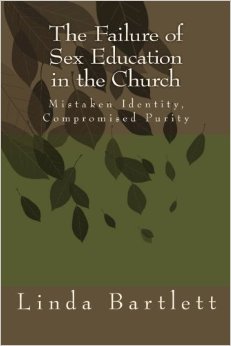
This post is taken from Chapter Three of
The Failure of Sex Education in the Church:
Mistaken Identity, Compromised Purity
(Amazon) by Linda Bartlett.




 Ezerwoman's Blog
Has the Sexualization of Children Led to the Sexualization of Marriage?
Posted in Biblical manhood & womanhood, Commentaries of others, Culture Shifts, Faith & Practice, Identity, Life issues, Parenting & Education, Relationships, Sexy or holy?, Vocation, tagged abortion, church, procreation, sexuality, social science on June 17, 2014| 1 Comment »
The following post was written by Rebecca Mayes
and posted on He Remembers the Barren~
One of the aspects of barrenness that is so awkward is the fact that the “success” of your marital relations (more modernly called your “sex life”) with your spouse is often scrutinized by those around you, either privately in their own minds, or quite publicly to your face. The joining of two fleshes into one in the bonds of holy matrimony used to be treated with such modesty and respect. No one would dare ask you whether you’re “doing it” right or if you’ve tried such-and-such a method. But the sexual revolution changed all that, and in numerous Christian publications we read that the act is a beautiful, natural part of marriage and there’s nothing to be embarrassed about. We should celebrate our gift of sexuality and teach the children in our Church all they need to know to be prepared for utilizing this gift. But is this what the Bible says? When we blush at the questions about what’s wrong with our reproductive organs, is that for a good reason, or are we just prudes?
Bartlett begins by giving the necessary history of how the Church, during the mid-20th century, put too much trust in “experts” instead of the inspired Word of God and willingly traded in our biblical understanding of manhood, womanhood, procreation, parenting, and purity for a more “scientific” approach to teaching children about the intimacies of marriage. Falsified, inaccurate, and even perverted studies on the “sexuality” of the human male and female conducted by Alfred Kinsey were presented to universities, medical associations, and church bodies as facts which could not be ignored by enlightened academics. Christianized versions of the sexual revolution’s message were then (and still are) passed down to schools and parents to share with children.
And just what are some of these myths?
The Church was naive in its promotion of sex education in the parochial schools, Bartlett points out, but not malicious. We were deceived into believing that we are “sexual from birth,” and this brainwashing had the complete opposite effect on our Church members as what was intended. It cleared the way for the acceptance of fornication, homosexuality, birth control, and even abortion as a normal part of life for those who are simply expressing their sexuality – being who they thought they were created to be.
But that’s not how we were created, Bartlett reminds us. The solution to the mess we are in now is our Baptism. This is where we received our true identities as children of the Heavenly Father, not sexual beings created to express our sexuality, but holy beings, created to live holy (not sexual) lives. “It is important,” Bartlett says, “for the Body of Christ to see each member as fully human as opposed to sexual and, therefore, an instrument for God’s purpose and glory whether a child or adult, single or married, in this circumstance or that,” (pg. 108).
Because Bartlett presents such shocking evidence of our deception, she presents her case in the form of a patient dialogue between herself and her readers, including over 100 questions and then answering almost every objection one could think of to the notion that there is anything wrong with the way the Church has been educating her children. Her love and concern for her Church family flow through each section as she gently reminds us all that, “Even well-intentioned sex education in the Church leans the wrong way if built on the wrong foundation,” (pg. 129).
If you have children, if you teach children, if you are related to children, or if you once were a child, this book is for you.
Read Full Post »