Feeds:
Posts
Comments

Archive for the ‘Life issues’ Category

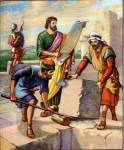
joseph-and-his-rib-biblepictures-net

Joseph, a young man from the house of David, was probably like every other soon-to-be husband: nervous, but excited all the same.  That is, until his fiancée came to him with shocking news.  Mary was pregnant, but Joseph was not the father.  The world, as Joseph knew it, had collapsed around him.  He felt betrayed, hurt, angry.  Break the engagement, whispered his pride, and walk away from this woman.

Everything had changed.  Plans were ruined.  Reputation was at stake.  Unchartered territory lay ahead.  At this precarious moment in his life, Joseph had nothing to hang on to… nothing, that is, except the Word of the Lord.

The Word gave Joseph courage.  “Don’t be afraid!”  It was the word that showed Joseph how to be faithful.  “Take Mary as your wife.  She will give birth to a son, and you will name him Jesus” (Matthew 1:20-21).

Perhaps, in holding on to the Word, Joseph remembered the experience of his ancestor, Adam.  Perhaps, in a moment of truth and with eyes focused, Joseph could picture Adam standing next to his wife, Eve.  Perhaps, with wisdom only from the Holy Spirit, Joseph recognized the significance of Eve’s creation by God from man’s rib.

God made (literally: “built”) woman using part of man.  With this, He established their relationship within the order of creation.  A rib is structural; it supports.  A rib guards and protects the heart and breath of life, yet it is vulnerable.  Under attack, it can easily be fractured or even broken.  Satan despises the order of creation that God uses to protect the man and woman He so loves.  So, that day in the Garden, Satan set his target and went straight to Adam’s rib.  The man was responsible for using God’s Word to cover his wife, yet he did nothing.  Joseph knew the consequences that followed.

Perhaps, with discernment only from God, Joseph understood that he must not repeat the sin of his ancestor and do to his rib what Adam had done to his.

Perhaps, in remembering what Adam had failed to do, Joseph was given the courage to cover his wife, Mary, and lead her to safety.  Let the village talk!  Adjust carefully-made plans!  Trust the Word of the Lord!  Although it meant leaving his zone of comfort, Joseph did what the angel of the Lord had commanded him to do.  He covered his rib by taking Mary as his wife.  And, when Mary’s child was born, Joseph named Him Jesus.

God wanted Joseph to make a difference – a difference that would impact the world.  But, such a difference could be made only by being faithful.  Such faithfulness required that Joseph leave all that was familiar and put his life and the life of Mary into the hands of God.

Today, when a young man pressures his girlfriend to have sex, he is leaving her physically, emotionally, and spiritually vulnerable.  He has placed his “needs” before hers and, in so doing, left her open to attack.  When a man does not promise to love, cherish, and cover a woman with his name, but simply share living quarters and a bed, he is leaving her open to attack.  When a man fathers a child but does not accept the privilege and responsibility of being a daddy, he is leaving both mother and child uncovered and vulnerable to the world.

But, when a man remembers God and His call to leadership, he is able to make a difference.  A young man who guards his girlfriend’s virtue makes a difference.  A husband who remains true to his wife makes a difference.  A dad who understands the privilege, responsibility, and generational influence of fatherhood makes a difference.  Men of faithfulness have a grand opportunity to defend against chaos and leave a legacy of hope.

Convenience told Joseph to walk away from Mary.  Self-defense told Joseph to think of “number one.”  Pride told Joseph that he could do better.  Fear told Joseph to hide.  But, God told Joseph not to be afraid to take Mary as his wife.

Joseph did what the angel of the Lord commanded.  He covered Mary, his rib, and the unborn Child whose heart beat under her own.  And, after the Baby was born in the most humble of circumstances, Joseph named the Child Jesus.  Through all the frightening days ahead, Joseph remembered the Word of the Lord.  And the Lord did not forget Joseph.  In the midst of danger, the angel of the Lord warned Joseph.  When uncertainty abounded, the angel of the Lord directed Joseph.

It’s true that life wasn’t ever the same for Joseph.  It certainly wasn’t what he had planned.  But, Joseph remembered the Word of the Lord.  And, in doing so, he received courage to do what was asked of him.  Joseph was faithful to cover Mary, his rib.  He raised her Son Jesus in a godly home and took Him to worship.  Some 2000 years later, the Boy who grew to be a Man in the house of a carpenter is still changing lives.

Joseph made a difference.

by Linda Bartlett
Revised 2010
(image: biblepictures.net)
“Joseph & His Rib” available from LFL
Read Full Post »

Nehemiah buildingWhat is a Christian to do?  It’s as if God asks the impossible of us.  He wants us to build with one hand and resist evil with the other.  But with more cultural decay comes more evil.

Mindful of raising up a new generation of Christians but also keenly aware of our own inadequacies and failures, parents, pastors, and all who love children become discouraged and even fearful.  With fear comes the temptation to doubt the sufficiency of God’s Word and more easily accept the help of passionate unbelievers.  “Why do you cling to ancient traditions?” they ask.  “Can’t you see?  We have something new!”

There is a lesson to be learned from God’s people who, in a time before us, were also discouraged, overwhelmed, and taunted by unbelieving neighbors who offered something new.

The remnant of Israel that had survived exile in Persia returned home to find the walls of Jerusalem broken down and city gates destroyed.  To this small number of faithful people was given the arduous task of re-building the temple and walls of Jerusalem.  God also wanted His people to grow faithful families.  He wanted them to be holy and set apart in their worship and practice.  When people in the neighboring land saw that Jerusalem was being restored, they offered their help.  After all, these people explained, they worshipped God, too.  (In reality, they were a people of blended religions.)  Fearing that they would commit themselves to false worship, the Israelite fathers refused the offer of resources and help.  They knew that God had entrusted the job of rebuilding the temple and walls only to them.  So “the people of the land discouraged the people of Judah and made them afraid to build and bribed counselors against them to frustrate their purpose” (Ezra 4:4-5).

The culture in which God’s people found themselves made the building project very difficult, but the Word of the Lord consistently commanded the people to persevere.  God also reminded His people that they were to be holy and set apart for His good purpose.  But the people of Israel, following the example of some of their leaders, mixed themselves with the Canaanites, Ammonites, Moabites, Egyptians and others through marriage (9:1-2).  The people were guilty of breaking faith with God and allowing impurity of worship, teaching, and practice.  There was confession and absolution but, because the potential for continued corruption of worship was so great, illegal marriages were identified and ended (10:18-19).  The rebuilding of the temple, restoration of the walls, and growing of faithful families began anew.

However, when the neighbors in the land saw that the Israelites were again doing the work of God in rebuilding Jerusalem, they were angry.  “[T]hey all plotted together to come and fight against Jerusalem and to cause confusion in it” (Neh. 4:8).  It was easy to cause confusion and discouragement among the Israelites because fathers, mothers, and grandparents were overwhelmed by the task that lay before them.  “There is too much rubble.  By ourselves we will not be able to rebuild the wall” (4:10).  The enemies said, “They will not know or see till we come among them and kill them and stop the work” (4:11).  Nehemiah encouraged the people, “Do not be afraid of them.  Remember the Lord, who is great and awesome, and fight for your brothers, your sons, your daughters, your wives, and your homes” (4:14).  When the walls were rebuilt and the gates restored, the law of God was read to the people who were both joyful and repentant (chapters 8 and 9).

Everything was coming back into order and Israel was prepared to live by the truth of God’s Word.  What could go wrong?  What went wrong is incredibly significant.  Eliashib, the priest appointed over the chambers of God, gave Tobiah the Ammonite a place in the temple (13:4-5).  Under the guise of helping God’s people, Tobiah was given a room formerly used to store the offering for God.  There, within the temple, sat Tobiah and his possessions.  Nehemiah was away when this happened, but when he returned, he “was very angry, and [he] threw all the household furniture of Tobiah out of the chamber.  Then [he] gave orders, and they cleansed the chambers, and [he] brought back there the vessels of the house of God” (13:8-9).

God entrusted the rebuilding of His temple and the city walls to His people.  He entrusted the growing of holy families to husbands and wives equipped with His Word.  He does the same today.

God wants His people to keep their worship, teaching, and practices pure and different from that of the dark and unbelieving world.  Certainly, there are resources in the world that can be practical and helpful to the Christian.  But we must take care especially when it comes to instructing Jesus’ little ones.  “See that you do not despise one of these little ones.  For I tell you that in heaven their angels always see the face of my Father who is in heaven” (Matt. 18:10).  It is a frightening thing indeed to compromise one of the Father’s children.

Compromise happens, however, when God’s people are weary and burdened, or prideful and above reproach.  Compromise happens when we let down our guard and grow comfortable with the world.  At such times it is easier for an opposing foe to gain access by offering some kind of help or resource.  It was for this reason that Nehemiah “stationed the people by their clans, with their swords, their spears, and their bows … each of the builders had his sword strapped at his side while he built” (Neh. 4:13, 18).  The men were on guard at night and labored by day (22).

We are weary and overwhelmed by a multitude of life issues.   Sometimes we are prideful after doubting God’s Word and trusting something else.   As the culture decays and evil abounds, we may believe that God asks the impossible of us.  But, Martin Luther reminds us that the task of rebuilding the temple and shoring up walls was given to a weak people, few in number; a people against whom stood powerful princes and nations, which lived round about and daily threatened imminent destruction.

There will be days when failure distracts us from the building project.  There will be those like Tobiah who mock our faithfulness to an ancient faith while tempting us with new practices.  In the face of evil, let it be said of us:  Look!  They remember “the Lord who is great and awesome,” and they “fight for [their] brothers…sons…daughters…wives…and homes” (Neh. 4:14).

Excerpted from The Failure of Sex Education in the Church:
Mistaken Identity, Compromised Purity
(pp 61-63) by Linda Bartlett;
Amazon.com.  Please also visit Our Identity Matters.
Image: mudpreacher.org

Read Full Post »

student reading Bible

“I never chose to be gay; I was born this way.”

“I’ve felt same-sex attraction since I was very young.”

“Who would choose to be gay?  If it were actually a choice, I would have chosen to be heterosexual.  My life would be so much easier.”

“I believe God created people to be gay; therefore, how can it be a sin?”

The statements above were made by Scott Barefoot during the ten years that he openly practiced the behavior of homosexuality.  The gay community with whom he surrounded himself reinforced his beliefs.

Love.  Peace.  Happiness.  When Scott read his Bible or went to church, these were the things he was searching for.  When his definitions of “love” and “happiness” differed from God’s, he moved on.

Scott moved on from the Wisconsin Evangelical Lutheran Synod* of his childhood during the time he was a practicing homosexual to attend a church where 80 percent of the members identified themselves as gay or lesbian.  The pastor went to great lengths to spin the interpretation of God’s Word and did not address the spiritual danger that threatened to consume Scott.

Do not judge became Scott’s “go to” scripture.  If he needed to tweak God’s Word to justify sexual relationships with other men, he did so.  But something was happening to change Scott’s perspective.

Scott held the prestigious position of Clinical Assistant to the Director of Interventional Cardiology at a large hospital in the Washington, D.C., area.  He immersed himself in the gay “Christian” community,  had plenty of cool guys seeking to date him, and brushed aside guilt in order to celebrate his sexual freedom.  Then Scott learned he was HIV positive.

For a year, Scott was in severe depression.  Slowly, he came face to face with the realization that his “unnatural and unrepentant behavior” had placed him in physical and spiritual danger.  He had wrapped Jesus around his sensual desires and, in so doing, moved farther away from God.  But how could he ever change?  How could he overcome same-sex attraction?

On his own, Scott could not change.  But through the work of the Holy Spirit, Scott acknowledged that he was sinning against God and his own body.  Like King David, Scott felt God’s hand “heavy upon” him and his “strength was dried up” (Ps. 32:3-5).  Scott, the creature, was led to trust the pure Word of his Creator.  At the foot of the Cross, Scott confessed that his behavior was not pleasing to God and, with the shedding of any notion of a sensual identity, he was set free by Christ to continue living as a redeemed child of God.

But redeemed children of God are not promised an easy life.  Jesus says, “If anyone would come after Me, let him deny himself and take up his cross daily and follow Me” (Luke 9:23).  Scott—like every one of us—is called to resist earthly temptations and persevere in Christ.

Scott did not wake up one magical day with a natural attraction to women.  He may never marry or father children, but he finds peace in celibate singleness that gives him freedom to grow in the Lord.  He can choose to live in a way that honors God and does not tempt others.  He is free to shine light in dark places and help others know that release from sexual captivity is possible.

Like an alcoholic who never returns to a bar, Scott explains, “I am no longer captive to a destructive behavior . . . The Holy Spirit led me to make my exodus from the fantasy land of thinking I could live as a practicing homosexual and still be right with God.”

This is the message that Scott brought to my hometown during the weekend of April 9-10.  His visit was sponsored by the Lighthouse Center of Hope, a pregnancy and family life center.  Why?  Because at the Lighthouse, we see young people struggling with the deception of a sexual identity.  We want male and female to know who they are in Christ and why that matters.  So we invited Scott to speak to teens, parents, and pastors.  At three different locations, Scott shared his story and offered wise and sensitive counsel.

Scott does not stand alone.  In my book, The Failure of Sex Education in the Church: Mistaken Identity, Compromised Purity, I quote another man who turned from his homosexual practice while in study of God’s Word.  Christopher Yuan writes, “My primary identity didn’t have to be defined by my feelings or sexual attractions.  My identity was not ‘gay’ or ‘homosexual,’ or even ‘heterosexual,’ for that matter.  My identity as a child of the living God must be in Jesus Christ alone.”  Christopher continues, “God did not say, Be heterosexual, for I am heterosexual.  God says, ‘Be holy, for I the Lord your God am holy’ (1 Peter 1:15-16).”  (Out of a Far Country, p. 187-188)

The opposite of holy is common, referring to things that can be used by anyone.  But to be holy means to be uncommon and useable by God.  Once Scott let go of his proud identity as “gay,” he could begin to see himself as God does.  He is called by name (Is. 43:1)!  He is an heir of God (Ro. 8:17)!  He has come out of darkness and into the light (1 Pt. 2:9) for God’s good purpose.  From the time of Scott’s baptism, the Holy Spirit was faithfully at work in him.  The world and his own sinful nature did not want Scott to change.  But change for this repentant man was possible because of mercy and grace.

Scott told me, “I was, but now I am.”  The Word of the New Testament explains —

Do not be deceived: neither the sexually immoral, nor idolaters, nor adulterers, nor men who practice homosexuality, nor thieves, nor the greedy, nor drunkards, nor revilers, nor swindlers will inherit the kingdom of God.  And such were some of you.  But you were washed, you were sanctified, you were justified in the name of the Lord Jesus Christ and by the Spirit of God (1 Cor. 6:9-11).

If you are a Christian struggling with same-sex attraction, Scott has a message of hope for you.  If you are a parent concerned about a son or a daughter, Scott has resources and helpful advice.  Please contact him or visit his ministry, People of Grace.

In Jesus Christ you, too, have mercy and grace.


                                                                                                                                              * Scott returned to the Wisconsin Evangelical Lutheran Synod

Linda Bartlett is the president and co-founder of
The Lighthouse Center of Hope in Iowa Falls, IA.

Read Full Post »

3-Two grandpas - CopyMy dad is my hero.  He is not my only hero, but he is my first. 

At 93, he continues to be my hero because, as my father, he is still teaching me what it means to be human.  In other words, he is teaching me what it means to be a person created in God’s image.  

I’ve always looked at my dad as my hero, but until recently I didn’t truly understand the reasons why.  Early last summer, I asked Dad if he would write his story; a kind of autobiography, if you will.  I promised that I would serve as his editor, creating a book for his children, grandchildren, and great-grandchildren.  Bless my dad’s heart!  He did it!  His willingness to record history and his perseverance to stay on task gives evidence of his respect for family.  More so, it is an act of obedience.  “[T]ell to the coming generation the glorious deeds of the Lord, and His might, and the wonders that He has done” (Ps. 78:4). 

The wonder of my father’s life is that he is a common man set apart for uncommon use.  He writes about a very ordinary life, but therein is the truth about being human.  From ordinary dust of the ground, God formed man to reflect His own extraordinary image.  Dad is the first to admit that he is a poor reflection of God’s image.  In his poor, sinful condition, he could have chosen to follow the pattern of the world.  But he did not because he sees his human identity in light of the fact that he was formed by God’s own hands for God’s own purpose.  My dad’s story proves to me that to be human does not mean to be self-defined, but God-defined.  And in each ordinary life experience recorded by Dad, I see that his identity affects his attitude and behavior. 

As you think about my dad writing his story, bear in mind that he writes with two hands, his left needed to steady his right.  One day, he appeared at my door, asking, “Do you still have that portable electric typewriter?”  By the end of summer, my hero entrusted to me a precious bundle of typewritten papers.  “Here!” said Dad with a knowing grin.  “You have some work to do!”

To be human means to be given work to do.  Work was a privilege given to the first man by His Creator.  It was God’s design that Adam work in the garden and keep it.  As a farmer, my dad has shown me the “thorns and thistles” that sin brought into this world.  I’ve seen the sweat on his brow, but also heard his sigh of accomplishment at the end of a long, hard day.  My dad has shown me that work is neither a punishment nor unpleasant.  When done to the glory of God, it is a source of contentment. 

To be human means to be male or female.  My parents did not preach to me when I was a child about the differences between men and women.  Rather, the behaviors and interaction of my mom and dad demonstrated to me that male and female are the two eyes of the human race, each needed for their unique perspective.   My dad valued my mom’s opinion and help.  He respected her even when she frustrated him.   My dad might not realize it (and perhaps I didn’t either until now), but he showed me that men and women are more than sexual.  God does not say: Be sexual, for I am sexual.  He says, “Be holy, for I the Lord your God am holy.”  Men are especially tempted by sensual thoughts and desires, but my dad showed that because of Jesus Christ, a man (or woman) is not captive to them.

To be human means to have choices.   Dad helped me understand that choices are best made in light of our relationship to God and with trust in His Word because to be human means that Satan will surely slither up to us at the moment of decision, asking: “Did God really say…?”  Adam was given the instruction for life and the warning against death, but he failed to engage Satan with that Word for the sake of his bride.  My dad, being mindful of this, nurtured my respect for men because he’s never stopped trying to lead his family away from harm. 

To be human means to be forgiven.  My dad knows the consequence of sin.  But he also knows that because of Jesus Christ, God’s mercies are new every morning.  If I were to thank my dad for one thing, it would be for helping me understand the free and willing desire of Jesus to be my crucified Lord and Savior.  Easter, for a human being, means nothing without the Cross.

To be human means to suffer.   The only way for God to save humans from themselves was to become one of them.   The Lord Jesus Christ suffered as a human… and He died.  In this sinful world, we suffer, too.  And because of sin, we will die.  But my dad also taught me that to be human means to have hope.  Jesus rose from the grave, ascended back to heaven, and will come again to take God’s weary, but faithful children home.

To be human means to persevere.   Dad has experienced hardship, disappointment, and the loss of his wife, my mom.   But he is my model of daily perseverance no matter the circumstance.  “Keep calm and carry on” is a quote of Winston Churchill, but it is a way of life for my dad.  He has watched this culture change at warp speed, but because he knows that his call to think, act, and live like a Christian changes not, he continues to “run with endurance the race that is set before [him]” (Heb. 12:1-2).

Finally, for the human, “the greatest of these is love.”  Just as God defines humans and makes them unique persons, so also He defines love.   So, thank you Dad, for not loving carelessly.  Thank you for your patient, kind, and selfless love (1 Cor. 13).  Thank you for showing me “what kind of love the Father has given to us, that we should be called children of God” (1 John 3:1). 


Read Full Post »

woman combat gun

“Women in combat” is a life issue.  It is an issue to which God speaks. 

Some say, “If men can do it, so can women.”  Let us look for, shall we say, better ammunition to defend our Biblical worldview on this debate.

THE DEBATE GOES ON

Discussions of men and women in combat bring mixed reactions.  Some people believe that women do not belong in combat because they do not have the physical capacity to endure the rigorous standards of training or the hardships of war.  Some believe that it is a woman’s “right” to defend her country and that she can do so as well as any man.  Besides, they insist, modern warfare seldom involves the physical force of front-line battle

Let’s put reason and logic to work: Consider the physical differences between men and women, such as their bone and muscle structures.  Gender-integrated basic training undermines rigorous standards.  But, this argument can be countered with examples of women who have developed body strength and can keep up with a man.

Consider the sexual attraction between men and women.  Gender-integrated training and combat duty creates an environment in which men and women are vulnerable to sexual misconduct and abuse.  But, this argument can be countered with practiced self-control.

This debate deserves more than opinion.  It deserves more than a simple “it’s my right.”  To honor God and better serve society as a whole, which is the right question: Can women be in combat… or, Should women be in combat?

REAL LIFE EXAMPLES

So, what are real soldiers saying?   A classmate of my son served on board a ship in the Persian Gulf.  In a conversation, this 21-year-old woman confessed a breakdown in respect for both women and men.  Everything, she said, took on a “sexual connotation,” modesty was nearly “impossible,” and the rate of pregnancies on board ship was “higher than on shore assignment.”

Specialist Hollie Vallance was quoted in the Dallas Morning News (2-20-91) before being shipped to the Gulf War.  She said, “I never really thought about going into combat.  I never dreamed anything like this would happen in my lifetime, let alone right after I had my first child.”  She continued.  “I’ve built an ice wall around my heart to try to cool the pain, and sometimes I worry that [my husband and baby daughter] won’t be able to melt it away.”

In a commissioned survey of women in the Army, 79% of enlisted women and 71% of female noncommissioned officers said they wouldn’t volunteer for combat.  Only 10% of the female privates and corporals agreed with this statement: “I think that women should be treated exactly like men and serve in combat just like men.”  Less than one-quarter of mid-grade sergeants answered yes.  (The Washington Times, 10-5-98).

A young husband and relative of mine serving in the Persian Gulf was forced to share his tent with a woman soldier.  He told me “it was not a good situation any way you chose to look at it.”

Pfc. Jessica Lynch and Army Specialist Shoshana Johnson returned home from the War in Iraq in the spring of 2003 as heroines.  Although neither of them was technically in a combat position, they were, nonetheless, placed so close to the front line of battle that they were each captured by the enemy.  After being rescued, it appeared that neither of them wanted to be “poster girls” for women in combat.

Is there wisdom in pretending that women are no different than men, placing them together in close quarters, lowering standards of physical endurance, and compromising training and military readiness?  Should national defense be the proving ground for a particular group’s ideology or desire for social change?

In the end, which matters most: How we feel about it… or what God says about it?  The Biblical argument that women should not engage in combat is expressed in the ESV Study Bible article on “War”:  “Most nations throughout history, and most Christians in every age, have held that fighting in combat is a responsibility that should fall only to men, and that it is contrary to the very idea of womanhood, and shameful for a nation, to have women risk their lives as combatants in a war.”  For discussion, read Deuteronomy 3:18-19; Joshua 1:14; Jeremiah 50:37 and Nahum 3:13.  (Note: The Lutheran Study Bible commentary on “they shall become women” in Jeremiah 50:37 reads: “unskilled to fight; therefore, terrified.”)

If we believe that women should not serve in combat, are we saying that they should not serve their country in the military?  Explain your answer.  Can a strong, effective military respect and utilize the abilities of women?   If so, in what ways?

In Nehemiah 4, we learn that enemies threatened the people of God during the rebuilding of Jerusalem.  They wanted to cause confusion and stop the good work.  Read specifically Nehemiah 4:13-14.  What did the prophet say to the men (vs. 14)?   Does this have meaning for you in our modern world?   As enemies of God’s people threaten home and family, is there wisdom in men and women serving in their God-given vocations of steward/defender of life and bearer/nurturer of life?  For whose benefit?   Sometimes, because we can, women imagine leaving what seems ordinary and common to excel away from home and, indeed, compete with men for glory.  But who fills the void?

If we resist women in combat, are we questioning their ability, or are we choosing to live within the boundaries of the created order for the benefit of civilization?

THE FIRST BATTLE FOR LIFE

God’s order of creation speaks clearly to the issue of women on the front lines of battle.  The first battle for life took place in a beautiful garden under the tree of the knowledge of good and evil.  Who was given the instructions for life and the warning against death (Genesis 2:15-17)?  Satan was well aware of God’s order of creation.  He knew that man was created as steward over all of creation and entrusted with the responsibility of defending life.  But the enemy of life ignored man and chose woman as his target.  He deceived the woman into thinking that God was holding something back from her, something that should rightfully be hers.  She sinned when she failed to trust the Word of God.  The woman spoke for God, but what else did she do?  Compare Genesis 3:1-3 with Genesis 2:17.   It is often said that whenever we speak what God has not, trouble brews.  Do you agree or disagree?  This is called spiritualizing or thinking ourselves godlike.  Note the progress of temptation: 1) doubt of God’s Word, 2) rejection of God’s Word, and 3) effort to establish our own standard of right and wrong.

Sin did not enter the world when Eve disobeyed God.  What does Genesis 3:6-7 tell us?  Who did God hold accountable (Genesis 3:8-9)?   What light does this shed on military readiness and national defense?

Death had its first victory, but the war was not over.  The enemy of life may have celebrated his successful deception of Eve and assaulted Adam’s leadership, but Satan did not have the final word.  Read Genesis 3:20.  Eve (Hebrew: chawwah) means “life.”   Do you find significance in the fact that this name was bestowed upon woman after sin brought death into the world?   With this name, Adam expressed hope for the future though the promised Seed of the woman who is Jesus Christ, the Savior of the world.   Satan’s plan was for evil, but it was God’s plan for Eve to become the mother of every living person.  What does this say to you?

Dear Father God, You are the Creator and Redeemer of human life.  Please give us wisdom and discernment to know how to bear and defend life in ways that honor Your created order.  We pray in Jesus’ name and for the sake of generations to come.  AMEN.

This four-part study written by Linda Bartlett
is adapted from a larger collection of studies entitled
Men, Women and Relationships first published in 1999
by Lutherans For Life.
This study in PDF format is available to download
by visiting Titus 2 for Life

Read Full Post »

Jesus and little childrenSex education as we know it originated with unbelievers. Knowing the history of sex education since the 1960s, it behooves the Christian parent to ask:

For what partnership has righteousness with lawlessness? Or what fellowship has light with darkness? What accord has Christ with Belial? Or what portion does a believer share with a non-believer? What agreement has the temple of God with idols? For we are the temple of the living God; as God said, “I will make my dwelling among them and walk among them, and I will be their God, and they shall be my people” (2 Cor. 6:14-16).

Biblical instruction in purity is mismatched with sex education rooted in secular humanism like a donkey is mismatched to an ox. Yoked together to plow a field, the larger animal will walk at a different pace than the smaller one. Attempting to drive the two together will be erratic and potentially dangerous. Mixing the Word of the Lord together with false teaching may, in time, weaken or even destroy a believer’s relationship with Jesus and others.

Christianity and sex education as we know it are unequally yoked because the founders of sex education did not see children as God sees them and had no respect for the complementary differences of men and women. Neither did they have a respect for natural, innate modesty nor parental authority. Those who developed sex education had little or no regard for the conception and birth of human life. In fact, great effort went into disconnecting sex and sexuality from marriage and procreation. All of this compromises the teaching of purity.

But what is a Christian parent to do? Our children live in the real world. Don’t they need to be educated about sex in the right way?  Most of us agree that parents should be the ones to have the sex talk with their children, but they need help, don’t they? From where does that help come? Busy and overwhelmed parents in today’s world can easily be discouraged. Discouraged, they may doubt that the Word of God is enough. They may rationalize a partnership with unbelievers or make use of resources that appear beneficial for the healthy growth of their children. But, history proves that compromised faith and practice can turn a culture upside down… one child, one family, one neighborhood at a time.

There is a lesson to be learned from Ezra and Nehemiah useful for a discussion on sex education.

The remnant of Israel that had survived exile in Persia returned home to find the walls of Jerusalem broken down and city gates destroyed. To this small number of faithful people was given the arduous task of re-building the temple and walls of Jerusalem. God also wanted His people to grow faithful families. He wanted them to be holy and set apart in their worship and practice. When people in the neighboring land saw that Jerusalem was being restored, they offered their help. After all, those people explained, they worshiped God, too. (In reality, they were a people of blended religions.) Fearing that they would commit themselves to false worship, the people of God refused the offer of resources and help. They knew that God had entrusted the job of rebuilding the temple and walls only to them. So, “the people of the land discouraged the people of Judah and made them afraid to build and bribed counselors against them to frustrate their purpose” (Ezra 4:4-5).

The culture in which God’s people found themselves made the building project very difficult, but the Word of the Lord consistently commanded the people to persevere. God also reminded His people that they were to be holy and set apart for His good purpose. But the people of Israel, following the example of some of their leaders, mixed themselves with the Canaanites, Ammonites, Moabites, Egyptians and others through marriage (9:1-2). The people were guilty of breaking faith with God and allowing impurity of worship, teaching, and practice. There was confession and absolution but, because the potential for continued corruption of worship was so great, illegal marriages were identified and ended (10:18-19). The re-building of the temple, restoration of the walls, and growing of faithful families began anew.

However, when the neighbors in the land saw that the Israelites were again doing the work of God in rebuilding Jerusalem, they were angry. “[T]hey all plotted together to come and fight against Jerusalem and to cause confusion in it” (Neh. 4:8). It was easy to cause confusion and discouragement among the Israelites because fathers, mothers, and grandparents were overwhelmed by the task that lay before them. “There is too much rubble. By ourselves we will not be able to rebuild the wall” (4:10). The enemies said, “They will not know or see till we come among them and kill them and stop the work” (4:11). Nehemiah encouraged the people, “Do not be afraid of them. Remember the Lord, who is great and awesome, and fight for your brothers, your sons, your daughters, your wives, and your homes” (4:14). When the walls were rebuilt and the gates restored, the law of God was read to the people who were both joyful and repentant (chapters 8 and 9).

Everything was coming back into order and Israel was prepared to live by the truth of God’s Word. What could go wrong? What went wrong is incredibly significant. Eliashib, the priest appointed over the chambers of God, gave Tobiah the Ammonite a place in the temple (13:4-5). Under the guise of helping God’s people, Tobiah was given a room formerly used to store the offering for God. There, within the temple, sat Tobiah and his possessions. Nehemiah was away when this happened, but when he returned, he “was very angry, and [he] threw all the household furniture of Tobiah out of the chamber. Then [he] gave orders, and they cleansed the chambers, and [he] brought back there the vessels of the house of God” (13:8-9).

God entrusted the rebuilding of His temple and the city walls to His people. He entrusted the growing of holy families to husbands and wives equipped with His Word. He does the same today. God wants His people to keep their worship, teaching, and practices pure and different from that of the sinful world. Certainly, there are resources in the world that can be practical and helpful to the Christian. But we must take care especially when it comes to instructing Jesus’ little ones. “See that you do not despise one of these little ones. For I tell you that in heaven their angels always see the face of my Father who is in heaven” (Matt. 18:10). It is a frightening thing indeed to compromise one of the Father’s children.

Is there hope?

When the Church grows comfortable with the world, it lets down its guard. With guard down, our heads are easily turned. This is true with sex and sexuality education. A Christian parent might be complacent or even intimidated by the thought of teaching their child about sex. Christian educators may pride themselves on years of higher learning or believe that they can discern good material from bad.

But there is hope! In Jesus Christ, there is always hope! By virtue of our Baptism, God sets us apart as “holy ones.” As “holy ones,” we are called “out of darkness into His marvelous light” (1 Pt. 2:9). We do not have to conform to the ways of the world but, with trust in God’s Word and the power of the Holy Spirit, we can be on guard and resist deception.

It’s true that when God’s people are weary and burdened, or prideful and above reproach, it is easier for an opposing foe to gain access by offering some kind of help or resource. So Nehemiah “stationed the people by their clans, with their swords, their spears, and their bows . . . each of the builders had his sword strapped at his side while he built” (Neh. 4:13, 18). The men were on guard at night and labored by day (22).

Nehemiah did not allow Tobiah the Ammonite to remain in the house of God because he would confuse the people of God. For the same reason, the Church should resist the temptation to allow secular humanistic teaching within its walls. Wherever sex education has been welcomed, we have reason to repent, but also opportunity to throw out anything that threatens to redefine the worship and practice of a younger generation.

“Do not be afraid,” said Nehemiah. “Remember the Lord, who is great and awesome, and fight for your . . . sons, your daughters . . . and your homes.”

from Chapter Four
The Failure of Sex Education in the Church:
Mistaken Identity, Compromised Purity
by Linda Bartlett (Amazon)
(Blog first posted in Case of Mistaken Identity)

Read Full Post »

sweetening the pill coverA woman can learn much from her mother and grandmother. But we learn the most, I think, from the first woman, Eve. From Eve we learn a woman’s identity and value, but also why we must be on guard against deception. Satan—who despises the humans upon whom Christ lavishes so much attention and love—had no good will for Eve or her life as God’s creation. Nor does he have good will for us, the daughters of Eve.

Satan, the world, and our own sinful nature constantly labor against us. They are faithful to nothing but themselves with no purpose other than enticing our bodies and souls away from all God declares us to be. Words like “equality” and “my body, my choice” get our attention but soon take us captive. The woman who believes that she is no different from a man is a woman “taken captive by philosophy and empty deceit, according to human tradition, according to the elemental spirits of the world, and not according to Christ” (Col. 2:8). Captive indeed is what we all are when we live as if God does not matter and “I matter most.”

Doubting God, we are more easily deceived. Fearing insignificance and loss of control of “my” life, we set ourselves in God’s place. Such doubts and fears are associated with The Pill.

In her book, Sweetening the Pill or How We Got Hooked on Hormonal Birth Control, Holly Grigg-Spall shares her personal story as well as the history and medical facts of The Pill taken by millions of healthy women who really know very little about how the drug works. “When the Pill was released, it was thought that women would not submit to taking a medication each day when they were not sick,” writes Grigg-Spall. “Now the Pill is making women sick.”

Grigg-Spall published her book in 2013.  Today, she is working with filmmakers Ricki Lake and Abby Epstein to produce a documentary of her book. (You may preview the documentary at Sweetening the Pill  or Kickstarter.

Grigg-Spall asks, “Who am I when I’m not on the Pill?” She recognized her own disintegrating mental health and physical problems while on the Pill. These included “regular urinary tract infections, sore and bleeding gums, hypoglycemic symptoms, hair loss, and muscle weakness to name just a few.” Going off the Pill, however, “. . . I became stable in both my thoughts and feelings. I felt stronger, more confident and far less fearful. I reconnected with the world. I had clarity of thinking that allowed me to engage again.” Perhaps a man might ask the question differently. “Who am I if I disregard the health and well-being of my wife?”

Sweetening the Pill is categorized as psychology. The author writes about “fertility awareness” and women’s health more than spiritual wellness. She is not hesitant, however, to document the Pill’s dark history. “. . . [S]ex hormones were discovered in the 1920s, but synthetic hormones were developed in Nazi Germany . . . Bayer Schering Corp—now Bayer—developed synthetic estrogen and experimented on Jewish prisoners in the hope of sterilizing them. They found that although women stopped menstruating they were not made permanently infertile. This became an important part of the process of developing the Pill.”

In 1951, Margaret Sanger persuaded endocrinologist Gregory Pincus to work on a birth control pill. The Pill was approved for contraceptive use in 1960, making it easier for women to re-define their identity, reject femininity and, in fact, reject their own bodies. The “female body” became “an object of and a source for fear and oppression.” Still in circulation today is the idea that the ovary and uterus make women inferior to men. The Pill, writes Grigg-Spall, “provided the opportunity to silence . . . rationalizations that had plagued women for so long. The Pill shut down the troublesome organs. Without these organs weakening their bodies and minds the argument for keeping them out of the workplace and the realm of men had shaky foundation. It became a necessary part of the progress of women’s liberation that women deny female biology.”

In 1969, feminist writer Clare Boothe Luce said, “Modern woman is at last free, as a man is free, to dispose of her own body, to earn a living…to try a successful career.” The Pill does, indeed, “dispose” of femaleness and this should make those who put their trust in God—who created male and female at different times, in different ways, and for different purposes—very uncomfortable. Grigg-Spall says there is more to consider. The Pill shuts down the reproductive systems of teenage girls “before they are fully developed,” manipulates their endocrine systems “as they go through volatile puberty,” and impacts their “developing libido and displaces [their] sexuality.”

Sweetening the Pill is a must read for mothers of daughters and every woman who has ever attended a Titus 2 Retreat, been tempted to believe that “equal” means being “the same,” struggled with the physical and spiritual consequences of hormonal contraceptives, or prayed, “Dear Lord, help me to value what You have wonderfully made.”


Learn about Titus 2-4Life here.
Linda Bartlett is the author of
The Failure of Sex Education In the Church:
Mistaken Identity, Compromised Purity
(Amazon) Our Identity Matters

Read Full Post »

Jesus Teaches Christian Stock PhotosA man who did not begin his life as a Christian is today appreciated for his understanding and teaching of “mere Christianity.” C.S. Lewis brought together what he saw as the fundamental truths of Christianity. He rejected the boundaries that divide Christianity’s many denominations and found a common ground on which all of those who have Christian faith can stand together. C.S. Lewis makes a powerful case for the behavior and personality of a Christian.

There is common ground that all believers in Jesus Christ can stand on concerning the Christian life of purity. For this reason, I quote C.S. Lewis in my book, The Failure of Sex Education in the Church: Mistaken Identity, Compromised Purity. But, there was space for only so much of Lewis in the book. Here is more. Lewis writes:

“Chastity is the most unpopular of the Christian virtues. There is no getting away from it: the old Christian rule is, ‘Either marriage, with complete faithfulness to your partner, or else total abstinence.’ Now this is so difficult and so contrary to our instincts, that obviously either Christianity is wrong or our sexual instinct, as it now is, has gone wrong. One of the other. Of course, being a Christian, I think it is the instinct which has gone wrong. But I have other reasons for thinking so.”

APPETITE FOR FOOD AND SEX
“The biological purpose of sex is children,” writes Lewis, “just as the biological purpose of eating is to repair the body. Now if we eat whenever we feel inclined and just as much as we want, it is quite true that most of us will eat too much: but not terrifically too much. One man may eat enough for two, but he does not eat enough for ten. The appetite goes a little beyond its biological purpose, but not enormously. But if a healthy young man indulged his sexual appetite whenever he felt inclined, and if each act produced a baby, then in ten years he might easily populate a small village. This appetite is in ludicrous and preposterous excess of its function.

“You find very few people who want to eat things that really are not food or to do other things with food instead of eating it. In other words, perversions of the food appetite are rare. But perversions of the sex instinct are numerous, hard to cure, and frightful. I am sorry to have to go into all these details, but I must. The reason why I must is that you and I, for the last twenty years [or, in our case, the last fifty years or more], have been fed all day long on good solid lies about sex. We have been told, till one is sick of hearing it, that sexual desire is in the same state as any of our other natural desires and that if only we abandon the silly old Victorian idea of hushing it up, everything in the garden will be lovely. It is not true. The moment you look at the facts, and away from the propaganda, you see that it is not.”

SEX CHATTER ALL DAY LONG
“They tell you sex has become a mess because it was hushed up,” writes Lewis. “But for the last twenty years [fifty years for us moderns] it has not been hushed up. It has been chattered about all day long. Yet it is still in a mess. If hushing up had been the cause of the trouble, ventilation would have set it right. But it has not. I think it is the other way round. I think the human race originally hushed it up because it had become such a mess. Modern people are always saying, ‘Sex is nothing to be ashamed of.’ They may mean two things. They may mean ‘There is nothing to be ashamed of in the fact that the human race reproduces itself in a certain way, nor in the fact that it gives pleasure.’ If they mean that, they are right. Christianity says the same.

“But, of course, when people say, ‘Sex is nothing to be ashamed of,’ they may mean ‘the state into which the sexual instinct has not got is nothing to be ashamed of.’ If they mean that, I think they are wrong. I think it is everything to be ashamed of. There is nothing to be ashamed of in enjoying your food: there would be everything to be ashamed of if half the world made food the main interest of their lives and spent their time looking at pictures of food and dribbling and smacking their lips. I do not say you and I are individually responsible for the present situation. Our ancestors have handed over to us organisms which are warped in this respect: and we grow up surrounded by propaganda in favor of unchastity. There are people who want to keep our sex instinct inflamed in order to make money out of us. Because, of course, a man with an obsession is a man who has very little sales-resistance. God knows our situation; He will not judge us as if we had no difficulties to overcome. What matters if the sincerity and perseverance of our will to overcome them.

“Before we can be cured we must want to be cured . . . A famous Christian long ago told us that when he was a young man he prayed constantly for chastity; but years later he realized that while his lips had been saying, ‘Oh Lord, make me chaste,’ his heart had been secretly adding, ‘But please don’t do it just yet.’”

THERE IS ALWAYS HOPE
Lewis recognizes that purity is difficult for us to desire, let alone achieve. But there is hope. There is always hope!

“In the first place our warped natures, the devils who tempt us, and all the contemporary propaganda for lust, combine to make us feel that the desires we are resisting are so ‘natural,’ so ‘healthy,’ and so reasonable, that it is almost perverse and abnormal to resist them. Poster after poster, film after film novel after novel, associate the idea of sexual indulgence with the ideas of health, normality, youth, frankness, and good humour. Now this association is a lie. Like all powerful lies, it is based on a truth—the truth . . . that sex in itself (apart from the excesses and obsessions that have grown round it) is ‘normal’ and ‘healthy,’ and all the rest of it. The lie consists in the suggestion that any sexual act to which you are tempted at the moment is also healthy and normal . . . [T]his is nonsense . . . For any happiness, even in this world, quite a lot of restraint is going to be necessary. . ..

“In the second place, many people are deterred from seriously attempting Christian chastity because they think (before trying) that it is impossible. But when a thing has to be attempted, one must never think about possibility or impossibility . . . [I]n war, in mountain climbing, in learning to skate, or swim, or ride a bicycle, even in fastening a stiff collar with cold fingers, people quite often do what seemed impossible before they did it . . . [P]erfect chastity—like perfect character—will not be attained by any merely human efforts. You must ask for God’s help . . . [and] after each failure, ask for forgiveness . . . and try again.”

There is hope. There is always hope. C.S. Lewis writes, “Very often what God first helps us towards is not the virtue itself but just this power of always trying again. For however important chastity . . . may be, this process trains us in habits of the soul which are more important still. It cures our illusions about ourselves and teaches us to depend on God. We learn, on the one hand, that we cannot trust ourselves even in our best moments, and, on the other hand, that we need not despair even in our worst, for our failures are forgiven.”

This is why, in The Failure of Sex Education in the Church: Mistaken Identity, Compromised Purity, I continually point to our true identity as sons and daughters of God through the redeeming work of Jesus Christ. God does not say: Be sexual for I am sexual. God says, “Be holy, for I the Lord your God am holy.” We become holy in the eyes of God when wearing Christ’s robe of righteousness. That robe changes our attitude and behavior. The only fatal thing, then, is to shed that robe and be content with anything less than Christ.

(Mere Christianity by C.S. Lewis; Chapter 5: Sexual Morality)
The Failure of Sex Education in the Church:
Mistaken Identity, Compromised Purity
by Linda Bartlett (Amazon)

Read Full Post »

grandparents & grandchildrenAs a grandmother, it is difficult—no, impossible—to stomach the arrogance of those who seek to make marriage what it isn’t.
Each of us is alive today because of fathers, mothers, grandfathers and grandmothers who believed in and practiced the “one flesh” union of what only God can define as marriage.

We live, breathe, speak, relate, and contribute to this big world because of the Masterly design and institution of marriage. If there are no complications, the flesh of one man joined with the flesh of one woman creates the flesh of a child–new life! For that, a son or daughter can be forever grateful.

How can a society thrive if two men or two women set up housekeeping and call it “marriage”? What vitality is there in this unnatural pairing? Sure, it may produce certain emotions (“I feel so loved!” “I am so happy!”), but it is the “one-flesh,” male/female pairing in real marriage that produces generational fruit even as it perseveres with patient, kind, and selfless love.

Those who practice same-sex pairing and call it good exist because of those of us who do not. They can continue to define marriage as “two people who love each other,” but marriage isn’t really about love. It is about commitment—one man and one woman to each other and (should God bless their “one flesh” union with new life), that father and mother to their son or daughter.

Even the Greeks, with their tolerance of “man-boy love,” knew that marriage was the bedrock for family and society. When young men grew up, they were expected to marry a woman and father sons and daughters. Aristotle and others understood a “natural law” and the importance of building up rather than tearing down.

For our society to thrive, we need men and women who (pardon me) do it the old-fashioned way: in their marital bed, by design of God, acknowledged by man, and with commitment to birthdays and anniversaries to come.


Read Full Post »

My husband, Paul, and I just returned from a 35-day road trip through British Columbia and the Yukon of Canada to Alaska and back.  The wonders of God’s creation were always before us… but so were little “lessons for life.”

34-time outSometimes, a gal just needs “time out” from resisting the darkness of the world to be renewed by the Creator of light and life.


55-placer mining67-Dredge 8 stories highWhat is the value of one human life? Up in the Klondike of the Yukon, a gold dredge eight stories high running 24/7 that cost $25 million (today’s dollar) and brought in $75,000/day in gold (today’s dollar) was shut down for three days in order to find the body of a man caught in the conveyor and buried in the tailings.


79-Matanuska ferry87a-sunset from ferryFor two days, we were aboard the Matanuska Ferry that carried us (and our car) from Haines, Alaska, to Prince Rupert, B.C. The views were breathtaking, but most encouraging and hopeful was the father and his daughter sitting next to us at dinner who bowed their heads and began their meal with “Come Lord Jesus, be our guest… .”


1-Paul Linda best Cassiar Hwy - CopyLook at this couple. Do we appear dangerous? A threat to society?  At 2:30 a.m., after driving off the Matanuska ferry and showing our passports at Prince Rupert, B.C., customs, we were pulled out of the line and asked to exit our car while it was searched. Eventually (and with a smile), the border patrol guard gave us permission to proceed. After 3:00 a.m., we were driving the streets in rain and fog hoping to locate our hotel when a fine officer of the Royal Canadian Mounted Police turned on his lights and pulled us over for “weaving across the yellow line.” When he realized that we had not “been drinking,” but were strangers in a foreign land just off the ferry and seeking safe haven, he graciously gave us directions (with a smile).  The words of Ezekiel 34:12 are comforting: “As a shepherd seeks out his flock when he is among his sheep that have been scattered, so will I seek out my sheep, and I will rescue them from all places where they have been scattered on a day of clouds and thick darkness.”


22d-smouldering21-grapes at Osoyoos“So also the tongue is a small member, yet it boasts of great things. How great a forest is set ablaze by such a small fire! And the tongue is a fire . . .”  After crossing the border between British Columbia and Washington, we drove in dense smoke; in fact, the forest ground along our highway was still smoldering and I saw flames consuming a fallen tree. The acrid smell permeated our car and clothing. Here and there, it was evident that firefighters, national guardsmen, and neighbors joined to save a house from untamed and restless tongues of fire.  Our tongues are too often untamed and restless. With our tongues, “we bless our Lord and Father, and with it we curse people who are made in the image of God. From the same mouth come blessing and cursing. My brothers, these things ought not be so . . .” (James 3:5,10). Instead, like the grapevines that we saw persevering even as fires raged all around, may we bear the good fruit of mercy, patience and kindness.


Read Full Post »

« Newer Posts - Older Posts »