Feeds:
Posts
Comments

Can A Person Truly Change?

prison cellIs it possible to change our thinking and behavior?  Leave bad habits behind?  Resist evil and despair?

Yes.

Evidence of change is all around me.  For some, change has come with maturity or wisdom gained from experience.  Some literally kicked and screamed all the way to a new place in their life where change took them by surprise.  Some are being changed through pain and suffering.  Others are changing, but only after falling into the darkness of bitter despair.

Travis is one of them.  Travis had fallen so deeply into the pit that he could never pull himself out.  I believe that Jesus literally reached down into that pit to lift Travis upward.  The circumstances in which Travis finds himself are grave.  He is serving 20 years in a federal penitentiary without parole.  Travis is in a place of shame but, face to face with his Savior, true freedom and dignity are being restored.

What follows is a letter from Travis:

Often, people ask, “Why did you throw everything away to pursue a life on drugs?  You threw away your relationships with good friends.  You threw away your good reputation.  You threw away the respect of your family.  You threw away everything that you ever worked hard for.  Why?”

I have never been able to come up with a rational answer to these questions.  Sin, I’ve figured out, is always irrational.  Sin doesn’t consider the consequences.  It just leads us to say, “I want more.”  In my case, becoming addicted to meth was that sin that gave Satan a strong foothold in my life.

I’ve come to see things a little more clearly today.  In John 10:10, Jesus says, “The thief comes only to steal, kill and destroy.”  Satan wants to steal my joy.  He wants to steal my freedom.  He wants to kill and destroy everything that makes my life worth living: my relationships, my peace, my sanity.  He will use any means: deception, lying, and false promises to keep me from enjoy God’s plan for my life.

When I was enslaved to my sin of addiction it was evident that something was wrong with me.  Not everyone noticed, however, because I put on a good mask.  But, my life was full of filthiness.  My thoughts, speech, conduct, and even my house was filthy.  I would find a lewd or filthy element in any situation.

Satan was working to steal my morals, relationships, will, and dignity.  In the end, Satan wanted my life.

Once I started doing meth, I experienced dreams and visions.  While driving on a particular curve into town, I imagined taking my own life.  Perhaps, I thought, it would relieve the pain I was experiencing.

I didn’t like the person I had become.  A couple of girlfriends tried to help get me sober.  One helped me escape to her family’s cabin.  She would help me detox and get sober.  I would sleep, eat, and begin to act normal… only to return to my habit five days later when I got home.  Another girl begged me to get sober.  She wanted my family to help.  I said, “No!”  How could I face the people that had raised me so well?  The last thing I wanted to do was admit I was a failure.  I thought I could do it on my own.”

Travis is suffering the terrible consequences of his addiction and sinful ways.  He is separated from his family and shamed by incarceration.  Although his faith has grown, he is taunted by unbelievers.  He has explained to me that despair comes often to visit, yet the mercies of God really are new every morning.

Those mercies recently came through a fellow prisoner.  Travis was feeling especially low at Christmastime when, unexpectedly, he crossed paths with a man he had met early in his imprisonment.  Travis had befriended that man and encouraged him with words of hope.  The man apparently never forgot Travis and, in a moment of darkness, the man reappeared as a ray of light with reciprocal words of encouragement.  “You made a difference,” the man told him.  “You helped me get through a tough time.”  Travis was reminded that Jesus knows just what we need when we need it most.

Travis is painfully aware that Satan, in partnership with his own sinful nature, is a powerful force.  Alone, Travis cannot defeat the liar and thief.  But, another force is working in Travis’ life.  It is the force of love.  Forgiveness.  Hope and new life.  Satan wants to steal Travis’ soul, but Jesus Christ died for that soul.  He has already won for Travis the victory over sin and death.  Victory is hard to see through the veil of depression and discouragement; even so, I believe that the Holy Spirit has been at work in Travis adjusting his perspective and restoring the dignity of his personhood.

Perhaps prison is the Potter’s wheel where Travis is being carefully shaped as a vessel for noble service.  I really do believe that Travis sees himself a different man than when he stood haughtily before the federal judge.  As a different man, he will find himself at odds with the world.

In that world, Satan will continue to press on Travis.  Satan doesn’t want change.  He wants Travis captive to his sinful nature.  He wants him haughty.  Dependent on self, yet burdened by failure.  But, in Christ, Travis is no longer bound to old sins and failures.  In Christ, Satan holds no lasting power over Travis.

Travis told me,

Addiction never filled me up.  I was never satisfied.  The thief really does come to steal, kill and destroy, but read the rest of the passage!  Jesus says, “I have come that they may have life and have it to the full.”

Is change possible?  God says it is.

“Put off your old self, which belongs to your former manner of life and is corrupt through deceitful desires, be renewed in the spirit of your minds, and put on the new self, created after the likeness of God in true righteousness and holiness.  Put away falsehood, speak the truth with your neighbor . . . give no opportunity to the devil . . . Let all bitterness and wrath and anger . . . be put away from you . . .” (Ephesians 4:22-32).

Because change is possible, Travis can live as the beloved son of God in Christ that he is.   He can leave the filthiness and foolish talk and crude joking behind.  He was in darkness, but now he is in the light of the Lord.  He can try to discern what is pleasing to the Lord.  Expose deception.  Be filled with the Spirit.  Give thanks. (Ephesians 5:1-21).

Yes, echoes Travis,

Thanks be to God!”

viva crista reyWhat do you know of Mexico’s struggle for religious freedom?  Have you ever been told about the Cristero War?  Would you be surprised to learn that Margaret Sanger, founder of Planned Parenthood, supported this war against people of faith?

Here in the U.S., many people of faith are asking: “What is the price of religious liberty?”   During the 1920s, people of faith in Mexico knew the answer: Life itself.

I had never heard about the Cristero War until the movie “For Greater Glory” was released in 2012.  I purchased the DVD and companion book by Ruben Quezada (Ignatius Press) as gifts for my husband.  We have shown this epic film three times to family members and plan to show it again… and again.  How fitting that this movie made its debut the same year that our federally mandated health care made its.

Please.  Rent or, better yet, purchase this DVD.  Host a movie night and invite your Bible study, youth, or parent group.  Hear young people raise their voices as one, proclaiming: “Viva Crista Rey!”  (“Long live Christ the King!”)  Understand that what happened in Mexico was an aggressive war on the Catholic Church which resulted in the death of 200,000 people of faith.  But, recognize that what is happening here in the U.S. is an insidious and, thus, potentially more devastating assault on those who seek to follow the Lord and Savior Jesus Christ rather than man.

Mexico was the original cradle of Christianity in the New World.  Missionaries were dispatched from Mexico to North and South America.  Yet, this deeply Catholic country was repressed by an atheist-socialist regime.  Following the revolution in 1917, the government vowed to free the people from “fanaticism and prejudices.”  President Calles, clever with his language, spoke of defending “Mexican dignity” against “foreign intruders” (the Holy Roman Catholic Church).  Public displays of faith were outlawed.  Churches, seminaries and convents were desecrated.   Catholic schools and newspapers were shut down.  Priests were tortured and killed, many shot while celebrating Mass.  But, so were fathers, mothers, grandparents, and young people.

Cristiada, the name given to the Cristero movement, was a response to the direct attack on the Catholic faith by the Mexican president and his “Calles Law.”  The Cristiada movement was organized by the National League for the Defense of Religious Liberty.  (Does this name bring to mind our own Alliance Defending Freedom or Becket Fund for Religious Freedom?)  Initially, the League advocated peaceful resistance to the Calles Law in the form of boycotting taxes and nonessential goods.  Petitions were signed, but refused by the Mexican Congress.  It soon became evident that Catholics would have to fight back or surrender their religious freedom.  The Cristero War was costly.  Relative peace may have come after the bloody years between 1926 and 1929, but practice of the Catholic faith in a predominately Catholic country has never been the same.

Margaret Sanger, the founder of Planned Parenthood, supported the Mexican dictator’s war against Catholic people of faith.  Sanger, writes Maureen Walther and Jennifer Daigle, “praised Calles’ campaign against the Church as a strike against intolerance and a step toward making her work easier: ‘With the yoke of medievalism thus thrown off we can anticipate a splendid development of the government work for birth control already begun in Mexico.’” (www.kofc.org “The Voice for Religious Freedom” 4/26/12)

Sanger was a devout advocate of eugenics and a society of the “most desireable.”    She worked tirelessly to promote birth control, most curiously in Hispanic and African American communities.  We should not be deceived.  Birth control has its roots in the eugenic movement.  Sanger, the mother of eleven living children, was a believer in eugenics or a “race of thoroughbreds.”  Her original organization, the American Birth Control League, was quickly renamed Planned Parenthood Federation of America.  Birth control may be masked as a “woman’s reproductive freedom,” but can you tell me why advocates of eugenics would join forces with those promoting birth control?

“Religious persecution,” writes Carl Anderson of the Knights of Columbus, “rarely begins with blood.  It begins with redefinition – redefinition of the religion’s role in personal lives, in ministers, in churches, in society and in government.  In Mexico’s case, the clergy were the state’s first target.  It began with a simple statement: all priests must register with the state.  The problem was that by this law, the state gave itself the authority to determine who was a minister and who was not.  A state that can decide ministers can also decide what doctrines it will permit to be preached. Priests and [the] religious were forbidden from criticizing the government.”  (“For Greater Glory,” p. 95)

President Obama and Secretary of State Hillary Clinton remind us that we, in the U.S., enjoy “freedom of worship.”  But, this is deception.  It is a redefinition.  This is not what was guaranteed in the Bill of Rights.  Correctly stated, American citizens enjoy “freedom of religion.”  Freedom of religion means more than just being able to “go to church.”  It means being able to speak and live the faith; to set up schools, hospitals, and agencies of servanthood in the name of Jesus Christ.

Oh fellow frogs in the boiling pot!   Know your history!  Learn from our neighboring people of faith in Mexico while we have opportunity.  Resist evil.  Guard liberty.  Teach the faith.

A Culture of Lying

robert knightThe following is excerpted from “The Allure of the Lie” by Robert Knight.  It’s worthy of your read.

We are hip-deep in a culture of lying. It’s the coin of the realm for liberal politicians, the “mainstream” media and Hollywood, all of whom cover for each other. Since an accusation of lying amounts to fighting words, journalists reporting the lies tend to use softer terms, such as prevarication, dissembling, not forthcoming, not fully disclosed, misleading, redirecting, etc.

Lying often is accomplished with euphemisms. Government spending is “investment.” Raising taxes is “revenue reform.” Torture is sanitized as “enhanced interrogation techniques.” Global warming is morphing into “climate change” to accommodate obvious departures from the warming scenario. Gambling is “gaming.” Defense of religious freedom is a “war on women.” There’s a slew of terms invented to validate sexual immorality. The sin of sodomy became homosexuality and then merely gay. Adultery became “finding oneself,” “open marriage” or “swinging.” Prostitutes are “commercial sex workers.” Two men – with no bride – are considered “married.” Pornography became “erotica.” And abortion – the killing of unborn children – is “choice.”

The culture of lying has become so entrenched in American political culture that any deviation is swiftly punished. People who question any part of the theory of man-caused global warming, for instance, are branded “deniers.”  End of discussion. Question the junk science behind the “born gay” myth and you’re a “hater.” If you believe God created marriage as the union of a man and a woman, you’re not only a hater but a bigot. If you favor photo ID laws to thwart fraud, you want to “suppress the minority vote.” If you question the morality or wisdom of putting women into combat, you’re against “equality.”

Often, liberal policies are sustained by repeated citations of a single study or studies, however flawed.  The granddaddy of those is Alfred C. Kinsey’s fraudulaent sex studies . . . .

One of the biggest lies in recent years is that there are no real biological differences between men and women – that masculinity and femininity are artificial social constructs. The latest fallout from this departure from reality is the Pentagon’s opening the military to homosexuality and putting women into combat. We’re told that everyone in the armed forces thinks this is wonderful. Sure they do. It would be a career-ender in this culture of lying to say otherwise.

The culture of lying depends heavily on cooked studies, weasel words and a compliant media that parrots them without examination. It’s a house of cards that’s waiting for a gentle breeze of truth to blow it over.

As G.K. Chesterton observed, “Fallacies do not cease to be fallacies because they become fashions.”

Robert Knight is a Senior Fellow for the American Civil Rights Union
and contributor to The Washington Times.
He wrote this article following Secretary of State Hillary Clinton’s
testimony before Congress.
I encourage you to read the complete article here

woman soldier with gunDeborah was a judge and prophetess.  To this, many of my gender quickly add, “Deborah was also a courageous military leader in battle.”  But, what does God’s Word tell us?

Let’s Think About It

Q: Deborah was a prophetess.  A prophet or prophetess speaks on behalf of another but, as far as I can determine, not as a public speaker for God during a congregational gathering.  A prophetess might give counsel, settle disputes, or offer thankfulness and praise to God.  Deborah was also a judge.  What was the condition of Israel in the years prior to her leadership (Judges 2:13, 16-17; 3:7, 13; 4:1-4)?

A: Martin Luther took note of the service of Deborah and other women as rulers.  He said that they “have been very good at management.”  He suggested that women’s leadership in other areas of life might motivate men to properly fulfill their responsibility.  It is important to note that Deborah became a judge after the people of Israel repeatedly “did what was evil in the sight of the Lord.”  Evil, in every way, opposes God’s created order for men, women, and the benefit of a thriving society.

Q: We may think that Deborah was sent by God into combat against Israel’s enemy.  But, is this the case? 

A: A careful read of Judges 4:4-15 reveals that God did not ask Deborah to carry the sword in combat.  He asked Barak through Deborah.  Victory was promised to Barak if only he would obey, but he chose not to.  Barak said he would do the Lord’s bidding only if Deborah went with him into battle.  Deborah told Barak that the glory in battle would not be his because the enemy Sisera would be delivered “into the hand of a woman” (v. 9).  The woman Deborah refers to in this verse is not herself, but Jael.  Dr. Vogel explains: “Deborah accompanied Barak to Mount Tabor, but no further.  Consistent with Deuteronomy, she donned no battle gear nor engaged in the conflict.   Barak (unaccompanied by Deborah) led 10,000 men into the valley to a resounding victory. The rebuke for Barak’s recalcitrance was rendered when a heroic woman, Jael, was given the opportunity to slay the fleeing enemy commander, Sisera.  She did this in her own tent, with household equipment [a tent peg], not as a warrior on a battlefield.”  (“Women in Combat: Two Views,” The Lutheran Witness, May 2003, p. 16-20)

Q: Deborah served as a judge and prophetess.  She counseled Barak as the leader of Israel’s troops.  Yet, how did she sum up her role in Judges 5:7?

A:  Deborah was praised for her leadership, yet she does not sing about being raised up as a warrior.  She sings of being a “mother in Israel.”  Though no biological children of Deborah are mentioned, she is an encourager and helper for her people.  Scripture, like much of human culture, consistently distinguishes the roles of men and women.

Q: Specialist Hollie Vallence, quoted in Part 1 of this series, was asked by her country to sacrifice home and family.  In doing so, she explained that she had to build an “ice wall around her heart.”  Is this consistent with God’s design?  What are the consequences for women, men, and children if a mother hardens her heart?

A: Luther noted that a woman is merciful by nature because she is born to show mercy and to cherish just as a man is born to protect.  This is why, Luther says, no living creature has more mercy than a woman, particularly in respect for her infant.  Men are known to focus on one project, putting all others aside, until it is finished.  In times of war, this allows them to leave their home and family for periods of time in order to “do their duty.”  It is not that they always feel brave and fearless, but perhaps their vocation of steward and protector allows them to do what they need to do for wives, sons and daughters; indeed, for future generations.  They are free to accomplish what is necessary, knowing that their children are in the capable and loving care of mothers.  Here, then, is the woman partnering with her husband and serving her country by guarding hearth and home while he is doing battle with the enemy of that home.  In war, as in work, men understand other men.  When a country is serious about winning victory over its enemy, it brings well-trained men together, with no distractions, to focus on the job at hand.  These men may return home “changed,” but most can resume life as usual.  Mothers, as explained by Hollie Vallence, are not programmed to put distance between themselves and young children.  Dr. Vogel offers wisdom: “If God is indifferent to the woman-warrior concept and a woman chooses to serve in a noncombatant role, God is not offended.  If, however, God is not indifferent to the woman warrior concept, and a woman seeks service as a combatant, does she not become a victim of her own will and disobedient to that of God?”  Is there a problem with women in the military?  No, but as in any workplace, there will certainly be a changed environment and cautions to heed.

Q: Will God bless a people or a nation whose men send women to the front lines of battle?  Will He bless the men (defenders of life) who send women (bearers of life) to meet the enemy?  To be shot at, brutalized, or sacrificed in the name of “equality” or “rights?”

A: God was not pleased with the man who used Deborah as a kind of “human shield.”  That is because the Groom of the Church does not stand behind his Bride.  He stands in front of her.  Small tribes and great countries who honor the human rule of chivalry understand that great sacrifice may be necessary in order to protect mothers of children for they are a people’s future.

Conclusion

It is not that God wants men to die, but that He entrusts to them the noble role of protector and defender.  As the Man of Sacrifice, Jesus led the way into battle.  He did not send others.  Jesus faced the greatest weapon of mass destruction – the anger of God upon sinful people.  He did not stand behind “human shields,” letting you and me die so that He might avoid pain and death.  In the battle for the life of His Bride, Jesus “took the bullet.”  He died so that we might live.

Jesus is both a model and Savior for men and women.  He wants us to follow Him and imitate His behavior.  Sinful as we are, we will want to test the boundaries.  We will put ourselves in God’s place, but such pride can put others at risk.  Is all hopeless?  No!  The One who faced our enemy – and won the eternal victory – reaches to us with nail-pierced hands, saying: “The thief comes only to steal and kill and destroy.  I came that you may have life and have it abundantly” (John 10:10).  I am the Way, the Truth, and the Life” (14:6).

“Bearers and Defenders of Life” is Lesson 11 of
Men, Women, and Relationships, first published in 1999 and revised in 2004.
(Lutherans For Life, Concordia Publishing House)

woman combat gunWho lobbies for women in combat?  Is it with national security… or something else… in mind?

In light of terrorists and all-male armies around the world, should we regard serving in combat as an “equal job opportunity?”

Elaine Donnelly and the Center for Military Readiness, released a 42-page report mid-January exploring the unintended consequences of putting women on the front lines.  “It will do great harm to women in the military, especially those who will find themselves in the infantry – something there’s no indication they wanted.”  Mrs. Donnelly asks an important question: “Why is the Secretary of Defense ramming this on through?”

This, says Mrs. Donnelly, “is social engineering to achieve a political end in the name of diversity”. . . [but] it is unfair to the women, it’s unfair to the men, it’s problematic for the readiness and efficiency and effectiveness of infantry battalions.

Let’s Think About It

Q: Civilized cultures have always trained men to protect and defend women and children.  Christian fathers who follow the example set by Jesus mentor sons to be gentlemen and treat girls and women with upmost respect and care.  However, the effective utilization of women in combat requires that men put aside such behavior in order to treat a woman like just another man.  What kind of culture does this create?

A: Even non-Christians note that groups tend to disintegrate and face extinction when societies fail to train their men to protect and defend women.  Men on board the Titanic gave their lives for women, not because they were all Christian men, but because Biblical teaching for society had become the “law of the sea.”  The titanic chivalry of “women and children [into the lifeboats] first” flows from Ephesians 5:25.   There is also the issue of mentoring.  When we focus on “it’s my right” or perpetuate the myth that “equal means ‘being the same,’” how are we instructing a younger generation?  What is a young man taught to think about women as they endure the rigors of military training side by side?  What do boys learn from fathers who intentionally put women in harm’s way?  What is the carry-over to life outside the military?  If society will not tolerate male aggression toward women in everyday life, is it wise – or necessary – to make an exception in combat?  A civilization that wants to thrive does well to think beyond the present to the future.

Q: What are the realities of both training and battle conditions?

A: We may want to envision pleasant images of skilled women managing high tech equipment, young men and women successfully practicing self-control in close quarters, and enlisted men snapping to the attention of female drill sergeants, but evidence reveals much to the contrary.  There are reported increases of sexual abuse, unfaithfulness of spouses, unintended pregnancy, a supposed “need” for easier access to abortion, and deployment of single moms.  Jessica Lynch, pulled from her Humvee and taken prisoner in Iraq, was raped and sodomized by her captors (I Am A Soldier, Too; the biography of Jessica Lynch by Rick Bragg).

Q: “Equal means ‘being the same’” may sound good, but can we really ignore the differences between male and female anatomy?  Mrs. Donnelly says, “Women don’t have an equal opportunity to survive in combat.”  Why might this be?  How might the anatomy of a woman put her more at risk than a man?

A: In seeking a bush for privacy, how does a woman avoid sniper fire and landmines?  Men can quickly unzip and zip, but is it the same for women?  In addition to dignity and modesty, what about hygiene and gynecology?  There are drugs that “shut down” a woman’s menstrual cycle, but is this natural and healthy?  Feminists and social engineers may deny the differences between men and women, but will the enemy?  How might a female prisoner of war be treated differently than a man?  If he is obedient to his calling as a defender of women, what lengths might a male soldier go to in protecting a female soldier?  

Q: Rev. F.A. Hertwig asks, “If there is a threatening noise at the front door, who do you expect should be the first to investigate?  Will the man sit back and send his wife, daughter or mother while he goes to the basement?”  (“Letters” in The Lutheran Witness, June 2003, p. 4)  When Eve stood in harm’s way before Satan, how did Adam respond (Genesis 3:6, 12)?  What is the significance of these verses when it comes to the discussion of women in combat?

A: Genesis 3:6 reveals that Adam sinned when he failed to remember God’s Word and use it in the battle between life and death.  Adam failed to protect his wife from Satan’s attack.  He failed to bring order out of chaos for the sake of future generations.  Rev. Hertwig, a pastor in Lincoln, Missouri, explains Genesis 3:12 in this way: “When God stood at the door, a confused and fallen Adam sent his wife, Eve, to face the catastrophe.  He chose to deny the one who had come from his side.  For the rest of his 930 years, he lived with daily contrition each time he looked at his bosom friend.  His protecting embrace had all the more fervor mixed with regret that he had failed.”  Rev. Hertwig continues, “For a man to see his wife, mother or daughter writhing in the mud with a bayonet rifle is repulsive to the core.  When Adam retreats, yes even in the face of God, he has in a miserable moment surrendered to the devil.  To venture the ‘absence’ of specifics on our subject is an accommodating detail to the devil’s question, ‘Yea, hath God said?’” (The Lutheran Witness, “Letters,” June/July 2003)

Deborah is held up by many Christians as the Old Testament example of a woman in combat.  But, was she?  Part 4, the last in this series of posts, will take a closer look at Deborah and Jael.

“Bearers and Defenders of Life” is Lesson 11 of
Men, Women and Relationships first published in 1999 and revised in 2004.
If you’re curious about this collection of 12 studies on
Biblical manhood and womanhood, please contact
Lutherans For Life or Concordia Publishing House.

women combat waitingAmericans have developed a bad habit of turning social experiments into policy and code.  Do you know what I’m talking about?

A social experiment arrogantly opposes God’s created order.  It has the look and feel of liberty but, in reality, puts human life at risk.   Abortion and the “marriage” of two men or two women are social experiments.  So is the political correctness of putting women into combat.  Social experiments are reckless and foolish.

Let’s Think About It

During His life on earth, Jesus honored and elevated women in remarkable new ways.  Certainly, He could have chosen both men and women to serve as His apostles.  He did not.  Jesus was not only aware of the created differences of male and female (after all, He was present at creation Genesis 1:26), but of their differing yet complementary roles and vocations.  Equality does not mean that everyone does the same thing, but that male and female each have the opportunity to serve God and others according to their design.

Q: How might the Christian woman consider serving in combat in this light?

A: We might begin with some personal introspection.  I know that God created me.  I am His design for His purpose.  But, like Eve before me, I am tempted to doubt the Creator and, in fact, position myself as lord of my own life.  My choices are too easily influenced by personal feelings, circumstance, convenience, pride, envy, short-sightedness, and search for identity.

Dr. Leroy Vogel, retired U.S. Navy chaplain and professor emeritus at Concordia Seminary, St. Louis, writes, “While it may be argued that there is no specific Scriptural passage that forbids a woman to serve as warrior, the apparent accommodation of some within the Church to the spirit of the age that turns warrior into a unisex role would appear, at a minimum, to be a departure from the divine wisdom of the Creator regarding the differentiation of the sexes.”

Q: What is the issue – sexual equality or ordered equality?

A: Dr. Vogel notes that when we ignore the Biblical account of creation, sexual differentiation and roles are viewed as “social constructs and, if society has created the distinctions, society can abolish them.”  To overturn the created order of differentiation and roles is to abandon Biblical faith.  “Scripture is clear,” writes Dr. Vogel.  “God made two sexes [genders], equal but with assigned roles.  Sexual equality is not the issue; ordered equality is.  Scripture and the tradition of the Church assign to man the role of defender, protector, warrior.  To woman is given the role of life-giver, nurturer, sustainer.”  Dr. Vogel offers a curious Hebrew interpretation of a Deuteronomy 22:5 (NIV translation): “A woman must not wear men’s clothing . . . for the Lord your God detests anyone who does this.”  Dr. Vogel submits that this verse is about more than cross-dressing.  He explains that “men’s clothing” in Hebrew is translated keli-gerber.  Keli denotes “equipment,” specifically a soldier’s equipment.  The Hebrew noun geber denotes “mighty man” or “hunter” or “warrior.”  So, writes, Dr. Vogel, “a legitimate translation of the phrase uses language of a decidedly military flavor: ‘No woman shall put on the gear of a warrior.’”  It seems that the church fathers John Calvin and Martin Luther agreed.  “Luther knew Hebrew,” writes Dr. Vogel, “and comments on the verse as follows: ‘A woman shall not bear the weapons of a man . . . it is improper . . . Through this law [God] reproaches any  nation in which this custom is observed.’”  Why, you ask?  Dr. Vogel answers, “Because God created male and female with specific and complementary characteristics.  It is in their relationship with one another that the two constitute the full expression of humanity.” (“Women in Combat: Two Views,” The Lutheran Witness, May 2003, p. 16-20.)

Q: What is the significance of Genesis 3:20 for this issue?

A: Woman’s glory is found in her God-given role as life-giver and nurturer.  Dr. Vogel paraphrases Luther, saying that “women were created not to kill and destroy, but to be a vessel for life.”  A culture that encourages women to destroy life is a culture that rebels against God’s design for His creation.  A culture that doubts the created differences between the “defender” of life (male) and “bearer” of life (female) is a culture that has been deceived by Satan’s question: “Did God really say . . .?” (Genesis 3:1).

Q: George Gilder writes, “The ancient tradition against the use of women in combat embodies the deepest wisdom of the human race.  It expresses the most basic imperatives of group survival: a nation or tribe that allows the loss of large numbers of its young women runs the risk of becoming permanently depopulated.  The youthful years of women, far more than of men, are precious and irreplaceable.”  (Men and Marriage, p. 135).  What brings a society to the place where it forgets or ignores this truth?  What does the future hold for such a society?

A: There are two worldviews: God’s and all others.  The Christian who trusts God’s Word can be confident that the Creator of life has a way that things of life work best.  Consider the words of God to Job (Job 38-41).  God speaks His worldview to us through His Word – from Genesis to Revelation.  He speaks His Word to us through Jesus Christ who, literally, is the Word become flesh (John 1).  But, perhaps, when we are blessed with resources and exist without threat of enemy at our door, we can become complacent and self-absorbed.  At such times, might our hearts and minds be influenced more by the foolishness of the world than the wisdom of God?  What does 1 Corinthians 1:16-30 say about wisdom?  What does the future hold for people who seek after personal desires or the world’s view?  “. . . [T]he world is passing away along with its desires, but whoever does the will of God abides forever” (1 John 2:15-17).

Before moving on to Part 3, here’s something to ponder.  Edwin Feulner, president of the Heritage Foundation, writes, “The reason we all know the idea of women playing pro football is absurd is because we’re serious about football.  It’s tough game, and if you allow yourself to be distracted by irrelevant issues like ‘sexual equity’ when you should be making your team the toughest it can possibly be, you’re going to get creamed.  So why are we letting feminists impose ‘sexual equity’ on an area that makes football look like a tea party; something that is  not a game, but a matter of life and death for our nation as well as for the ‘players,’ namely, our military?”

“Bearers and Defenders of Life” is Lesson 11 of
Men, Women, and Relationships first published in 1999 and revised in 2004.
If you’re curious about this collection of 12 studies on
Biblical manhood and womanhood, please contact
Lutherans For Life or Concordia Publishing House.

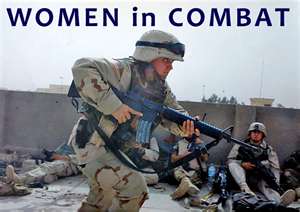
women in combat“Women in combat” is a life issue.  It is an issue to which God speaks.  In this post and several to follow, I would like to offer questions, answers, and commentary for Christians to ponder. 

The question, I think, that we need to be asking is not: “Can women be in combat?”  The question is: “Should women be in combat?”  I don’t know about you, but I’m looking for, shall we say, better ammunition for my argument than “if men can do it, so can women.”

Bearers and Defenders of Life

Discussions of men and women in combat bring mixed reactions.  Some people believe that women do not belong in combat because they do not have the physical capacity to endure the rigorous standards of training or the hardships of war.  Some believe that it is a woman’s “right” to defend her country and that she can do so as well as any man.  Besides, they insist, modern warfare seldom involves the physical force of front-line battle

Let’s put reason and logic to work: Consider the physical differences between men and women, such as their bone and muscle structures.  Gender-integrated basic training undermines rigorous standards.  But, this argument can be countered with examples of women who have developed body strength and can keep up with a man.

Consider the sexual attraction between men and women.  Gender-integrated training and combat duty creates an environment in which men and women are vulnerable to sexual misconduct and abuse.  But, this argument can be countered with practiced self-control.

This debate deserves more than opinion.   It deserves more than a simple “it’s my right.”

So, what are real soldiers saying?   A classmate of my son’s served on board ship in the Persian Gulf.  In a conversation, this 21-year-old woman confessed a breakdown in respect for both women and men.  Everything, she said, took on a “sexual connotation,” modesty was nearly “impossible,” and the rate of pregnancies on board ship was “higher than on shore assignment.”

Specialist Hollie Vallance was quoted in the Dallas Morning News (2-20-91) before being shipped to the Gulf War.  She said, “I never really thought about going into combat.  I never dreamed anything like this would happen in my lifetime, let alone right after I had my first child.”  She continued.  “I’ve built an ice wall around my heart to try to cool the pain, and sometimes I worry that [my husband and baby daughter] won’t be able to melt it away.”

In a commissioned survey of women in the Army, 79% of enlisted women and 71% of female noncommissioned officers said they wouldn’t volunteer for combat.  Only 10% of the female privates and corporals agreed with this statement: “I think that women should be treated exactly like men and serve in combat just like men.”  Less than one-quarter of mid-grade sergeants answered yes.  (The Washington Times, 10-5-98).

A young husband and relative of mine serving in the Persian Gulf was forced to share his tent with a woman soldier.  He told me “it was not a good situation any way you chose to look at it.”

Pfc. Jessica Lynch and Army Specialist Shoshana Johnson returned home from the War in Iraq in the spring of 2003 as heroines.  Although neither of them was technically in a combat position, they were, nonetheless, placed so close to the front line of battle that they were each captured by the enemy.  After being rescued, neither of them, it seems, wanted to be “poster girls” for women in combat.

Is there a problem with women serving in the military?  I don’t think so.  A strong, effective military respects and utilizes the abilities of women in medicine, teaching, and tactical maneuvers.  But, to pretend that women are no different from men, place them together in close quarters, lower standards of physical endurance, and compromise training is to place men, women, families, and country in harm’s way.

The question we need to be asking is not: “Can women be in combat?”  The question is: “Should women be in combat?”

In the end, it really doesn’t matter what our opinion might be or how we feel about it.  What does matter is what God says.

In gaining perspective on women in combat, do you find significance in the name of the first woman?  Genesis 3:20 tells us that Adam named his wife Eve.  Eve, in Hebrew, means “life.”  How this must have angered Satan who despises the humans that God so loves.  But, it was God’s plan that Eve became the mother of every living person.

During a Titus 2 Retreat, some women will tell me that having women in combat must be o.k. because, after all, Deborah went into battle against the enemy of the Israelites.  But, have they read the whole account found in Judges 4:4-22?  Did Deborah lead the troops into battle or fulfill the role of encourager?  Why didn’t the man Barak receive glory for the way his enemy died?  Was the enemy killed by a woman with a weapon on the battlefield… or not?  (Be patient.  We’ll come back to this in Part 3.)

The prophet Nehemiah told the men to do battle for their families.  He said, “Do not be afraid of them [enemies].  Remember the Lord, who is great and awesome, and fight for your brothers, your sons, your daughters, your wives, and your homes (Nehemiah 4:1-14).

Want to continue this discussion with some Q & A?  Then please continue to Part 2 of this series.

“Bearers and Defenders of Life” is Lesson 11 of
Men, Women, and Relationships first published in 1999 and revised in 2004.
If you’re curious about this collection of 12 studies on
Biblical manhood and womanhood,
please contact
Lutherans For Life or Concordia Publishing House.

sandy hook school shootingThe Sandy Hook Elementary School massacre caught the attention of most Americans.  It should.  The brutal killing of students and teachers is a national wound.  It should be.  Parents and families mourned the loss of 26 human beings whose lives were cut short.  We all should.  What happened at Sandy Hook was evil.  Evil should always be resisted.

On this 40th anniversary of Roe v. Wade, 54 million other deaths should also capture our attention.  Be felt as a national wound.  Bring us to our knees in mourning.  But, 3,500 preborn babies are aborted every day in this country and people act as if nothing is happening.  An evil of monumental proportions is taking place before our very eyes, yet people who call themselves by Christ’s name appear unmoved and indifferent.

How can this be?

Rolley Haggard, writing for Breakpoint, observes that apathy and silence on abortion are evidence of a theological problem.  He notes that some will argue that Scripture is silent on abortion; after all they say, the term does not appear once in the Old or New Testament.  Nor are there any commands to “vote pro-life” or “peacefully demonstrate in front of Planned Parenthood.”  So, some Christians actually believe they have discerned the “letter of the law” and are obeying it by keeping silent.

But, asks Haggard, what about the “spirit of the law”?   The purpose and intent of the law?  St. Paul was  inspired to write, “He who loves his neighbor has fulfilled the law.  If there is any other commandment, it is summed up in this saying, ‘You shall love your neighbor as yourself.’  Love does no wrong to a neighbor; therefore love is the fulfillment of the law.  The whole Law is fulfilled in one word, in the statement, ‘You shall love your neighbor as yourself.’  Bear one another’s burdens, and thereby fulfill the law of Christ” (Romans 13:8-10; Galatians 5:14; 6:2).

Haggard begs the question of us all: Can we hear and believe God’s commandment to love our neighbor and still maintain passivity on abortion?  “The sober reality,” Haggard writes, “is that ‘he who does not love his brother whom he has seen cannot love God whom he has not seen” (1 John 4:20).  Modern technology allows us to see inside the womb.  Having seen, can we un-see?  Are we not compelled to speak of what we have seen?

It’s possible, Haggard writes, that our error in not speaking has been an honest one.  “Perhaps our embrace of the letter rather than the spirit of the law has been unwitting.  Perhaps.  This much is certain: ‘When a man who is honestly mistaken hears the truth, he will either quit being mistaken, or cease to be honest.’” (Note: This quote is often attributed to Abraham Lincoln).

Have those of us who call ourselves “Christ followers” heard the truth?  Knowing the truth, how do we respond?  When we see babies (woven together in the womb by God’s own hands – Psalm 139:3-16) being denied their God-given right to life, how do we respond?  When we know that the majority of abortions are done for convenience (not the life and health of the mother), how do we respond?  When we know that abortion says “no” to a new generation of creativity and hope, how do we respond?

(My appreciation to Rolley Haggard, “Brilliant Darkness,” www.breakpoint.org 1/23/2013)

Bedroom Perplexities

make abortion legal rallyI’m perplexed.  Can you help?

When I speak up against abortion and for the rights of unborn children and the well-being of women, I’m told: “What happens in the privacy of a bedroom is none of your business.”

Well, if that’s true, then why should I be forced to pay for what happens there?

people in churchOur “progressive” culture avoids any return to the past.  Questions and dialogue about traditions — or beginnings — are not generally welcomed.  This is arrogant… and deadly.

Until we go back to or re-visit things of the past, how will we know what works and what doesn’t?  Why we are where we are?   Until we re-visit our beginnings — either as human beings or as people with a particular worldview or ideology — how will we know who we are, or upon what we stand, or why?  If I see that my culture is in decay, can I really be of help to family, neighbors, or community if I don’t know why I believe what I say I believe or do what I do?  Many of us speak of what is “traditional” (in worship, marriage, morality, etc.), but if we can’t explain it, how can we defend it when someone wants to tamper with it?

For this reason, I am extremely grateful to my pastor.  Some people see him as “too catholic” or “inflexible.”  Some ask, “Why do we have to sing old hymns?”  Or, “Why do we have to use a liturgy?”  Or, “Why do we have to learn creeds or attach ourselves to the doctrine of a bunch of dead Europeans?”  Some wish he would just “lighten up” and “get with the movement of our day.”  Oh, how thankful our little flock should be that our shepherd resists the “movement of our day” in order to teach us why Christian Lutherans believe what they believe and do what they do.

My pastor has been gifted with a pair of worldview glasses that help him contrast God’s Word with the ways of the world.  My congregation is blessed — whether it knows it or not — because our pastor is not afraid to return to the past.

In his book, A Free People’s Suicide,” Oz Guinness writes,

A return can be progressive, not reactionary.  Each movement in its own way best goes forward by first going back.”

What does Guinness mean?  National, church, or even family  renewal happens by going back to its beginnings.  To its reasons for being in the first place.  Martin Luther knew this.  The Puritans knew this.  Thomas Jefferson knew this.  History, writes Guinness, “shows that when it comes to ideas, it is in fact possible to turn back the clock.  Two of the most progressive movements in Western history — the Renaissance and the Reformation — were both the result of a return to the past, though in very different ways and with very different outcomes.”

It is, in fact, a law of physics that things are preserved from destruction when brought back to their first principles.  Guinness calls this innovative thinking “outside the box” because it is “back to basics and not a mindless espousal of the present or a breathless chase after some purported future.”  Guinness states,

The most creative re-makings are always through the most faithful re-discoveries.”

I am a Biblical Christian of the Lutheran bent living in a hurting world.  For the sake of my grandchildren, I need to help re-build, in church or society, by re-discovering things of the past.  There is no embarrassment or intellectual shame in this endeavor.

So, thank you my dear pastor, for taking me back so that I might better move forward.  Thank you for helping me re-make what is good and right and true by re-discovering who I am.  Upon what I stand.  And why.