Feeds:
Posts
Comments

Archive for the ‘Culture Shifts’ Category

My book coverWithout fanfare or ceremony, the deed is done!  I have just completed nearly two years of writing a book.

On May 2, 2014, it was officially published and made available on Amazon.  There is enough left in my well of words to say “thank you” to an extraordinarily patient and helpful support team.  You know who you are.

The title of the book is The Failure of Sex Education in the Church: Mistaken Identity, Compromised Purity.  It is not the book I dreamed of writing.  It is the book I was compelled to write after thirty years of working with and listening to parents and the children they care about.

The book is 250 pages with over 230 footnotes.  No, I’m not in graduate school, but yes, this is my thesis. It is a dissertation that covers more than the controversial subject of sex education.  It explains how humanists bestowed a mistaken identity upon our children and why, nearly a half century later, Christians still nod their approval.  Yet, everywhere I go, I hear people ask, “Why are children sexualized?” The fact that a book like this hasn’t already been written tells me that too many of us have been deceived about our identity.

Christians live in a foreign land.  We are called to be uncommon, but have accepted the common ways of our neighbors.  We have let the unbelievers identify us.

The Failure of Sex Education in the Church: Mistaken Identity, Compromised Purity is a “catechism” for parents, pastors, teachers, those struggling with sexual temptations, and everyone who is concerned about the sexualization of children.

For fifty years, Christians and non-Christians alike have been taught to believe that “children are sexual from birth”.  Nowhere in Scripture does God describe children this way.  The phrase was coined by a humanist named Alfred Kinsey who believed infants and children can enjoy and benefit from early sexual activity.  His social science was wrong, but his research was widely accepted.  Our nation and even the Church were set on a dangerous course.  By accepting Kinsey’s data and the expertise of other like-minded humanists, the Church played a role in bestowing a mistaken identity, compromising purity for multiple generations, and ultimately putting human lives at risk.

A false identity has both temporal and eternal ramifications.  With painstaking care, I have attempted to explain why the Church can no longer participate in a tragically flawed social experiment and going beyond diagnosis, I propose a hopeful, radical and thoroughly biblical remedy.

There is no personal delight in pointing out error.  I have persevered with this project because I am motivated by love for my own children and grandchildren and by love for God’s Word.  For the sake of all children, I believe that Christians need to know the origin of sex education, then ask:

  • What fellowship has light with darkness (2 Corinthians 6:14-16)?
  • Upon what foundation have we built?
  • Young or old, single or married, who does God say that I am and what does this mean?

For the sake of generational holiness and purity, it is my prayer that we encourage honest and kind dialogue.  The 107 questions and answers I offer in my book are a good place to start.

Curious?  Please visit Our Identity Matters to learn more.

The book may be ordered from Amazon.



Read Full Post »

modest dressWelcome back!  Are you ready to…

#4 — Mentor a Changed Attitude

For what we proclaim is not ourselves, but Jesus Christ as Lord (2 Corinthians 4:5).

Reflect Christ, not self.  It is natural to default to self.  We too easily focus on our needs and defend our behaviors.  But it’s not about me!  It’s about God our Creator and Redeemer!  It’s not about first loving “me”; it’s about first loving God.  Loving God first means that we will more easily love and serve others in His name and with His forgiveness, mercy and kindness.  God created the first man and woman in His image.  We have fallen from that perfect image, but because of what Jesus Christ has done for us, it is possible with the help of the Holy Spirit to reflect more of God and less of self.  In what ways can we point people to God and less to ourselves?  How does a woman who professes to worship God speak?  Dress?  Treat others?  What kind of choices does she make?  What does it mean to be free of the life that we thought would make us happy and to, instead, live life in a way that leads others to Christ?

Be a Vessel for Honorable Use.  God’s Word tells us, “Therefore, if anyone cleanses himself from what is dishonorable, he will be a vessel for honorable use, set apart as holy, useful to the master of the house, ready for every good work” (2 Timothy 2:21).  What is our house?  Who is the “master of the house”?  What is our “good work”?   What more do we learn about ourselves in 1 Corinthians 6:19-20?   What a difference it makes when we see ourselves as God sees us!  Recognizing that our Baptism makes us daughters of God through Christ, we can “flee youthful passions and pursue righteousness” (2:22).

Practice a Changed Attitude.  On brightly colored sticky notes, write: “It’s not about me”.  Place this reminder on a mirror, in a wallet, by the sink, on the refrigerator, in the car, and inside the cover of a well-worn Bible.  Jesus promised that He would send “another Helper” (John 14:16).  That “Helper”, the Holy Spirit, “will teach you all things and bring to your remembrance all that I have said to you” (14:26).  That “Helper” is “the Spirit of truth, who proceeds from the Father, he will bear witness about me.  And you also will bear witness” (15:26-27).  When we believe that Jesus is Truth, how will our attitude and witness change?

Adjust Focus.  Instead of fantasizing through the pages of romance novels (which, if played out in real life, should make us blush) or searching for our inner selves through “spiritual masters”, we can find our true identity and rightful behavior in Jesus Christ.  Rather than being tempted by the ideas of others or our own passions, we can turn our eyes away from “irreverent, silly myths” and, instead, “train [ourselves] for godliness; for while bodily training is of some value, godliness is of value in every way, as it holds promise for the present life and also for the life to come” (1 Timothy 4:7-8).  Training in godliness begins at the foot of the Cross where, at the beginning and end of every day, we can leave our baggage of sin, disappointments, and wrong perspective.  There, at the Cross, we can focus on Jesus who says, “I am the Way, and the truth, and the life.  No one comes to the Father except through Me” (John 14:6).

Live a Holy, Not Sexy Life.  God calls us to be holy (1 Thessalonians 4:7; 1 Peter 1:14-16).  We can mentor others away from the self-focus of sensual dress by explaining our responsibility to help men avoid temptation.  A suggested Bible study for girls ages 13 and up is Dressing for Life: Secrets of the Great Cover-up (#LFLDFL) available from CPH.

Resist the Idolatry of Self-Worship.  Analyze words and phrases such as “self-worth”, “self-promotion”, “celebration of self”, and “self-esteem”.  In the last days, writes St. Paul to Timothy, people will be lovers of self (2 Timothy 3:2).  Spend a day with an “older” Christian woman whose life appears self-less.  Ask: Is it necessary to preserve self?  From where do we get our worth?  Is there benefit in promoting self?  Is there any reason to celebrate self?  What do we learn from Christ?  To “put off your old self, which belongs to your former manner of life and is corrupt through deceitful desires” and to “be renewed in the spirit of your minds” and to “put on the new self, created after the likeness of God in true righteousness and holiness” (Ephesians 4:21-24).

Rebel Against the Culture.    Help a younger generation turn from “me” to others.  Gather a small group of women together for an “It’s Not About Me” night.  Forget the pedicures and pampering.  Instead, discuss what women can do to bring out the best in men by way of dress, speech and behavior.  List the ways that women can help one another practice biblical womanhood and not be shamed in doing so.  Design postcards that proclaim “It’s Not About Me” with 2 Corinthians 4:5 printed on each card.  Finish off with stamping, calligraphy or artwork. Be of service through accountability by sending the cards to one another throughout the year.

What’s Next?  #5: Mentor Self-Control

Ezer’s Handbook is a resource developed by
Linda Bartlett and presented at Titus 2 Retreats.

Read Full Post »

thinking womanLet’s continue with opportunity #3 —

#3 — MENTOR BIBLICAL WOMANHOOD

A woman who fears the Lord is to be praised (Proverbs 31:30b).

Fear and Love the Lord.  Martin Luther begins each of the meanings for the Ten Commandments with: “We should fear and love God . . . .”  In a sinful world, “fear” and “love” hardly seem to fit together.  But the Heavenly Father can be both feared (for His justice) and loved (for His mercy).  How does this give freedom to modern women?

Reject the Deception of the World.  The Christian woman is often reminded of the Proverbs 31 woman.  But do we know why she was praised?  Church Father St. Bernard of Clairvaux draws us away from the idea that this woman was praised for her spectacular work.  He wrote, “You have been able to reject the deceitful glory of the world . . . you deserve to be praised for not being deceived.” (The Lutheran Study Bible ESV, Commentary on Proverbs 31:30-31, page 1047.)  How was the first woman, Eve, deceived?  Why did Satan approach her rather than the man?  What is the deceitful glory of the world?  How do we resist it?  How do we help others resist it?

Discern Personal Mentors.  Whose counsel and advice do we seek?  Do we surround ourselves with women in the same situation and circumstance as our own or do we glean wisdom from “older” women who have matured in the face of challenge?  What kind of reading material is on our coffee table or by our bedside?  Have we been influenced by human opinions and fickle emotion… or the Word of the Lord who calls Himself “the Alpha and Omega”?

Resist the Temptation to Divide Generations.  Bring older and younger women together in Titus 2-style groups.  Suggested resources include Titus 2 for Life, Dressing for Life: Secrets of the Great Cover-up (a ten-lesson reproducible Bible study on modesty and clothing available from CPH [#LFLDFL]), Men, Women and Relationships: Building a Culture of Life Across Generations (a 12-lesson Bible study with leader’s guide from CPH [#LFL901BS]), The Council on Biblical Manhood and Womanhood, Girl Talk: Mother-Daughter Conversations on Biblical Womanhood by Carolyn Mahaney and Nicole Mahaney Whitacre, and Lies Women Believe and the Truth That Sets Them Free by Nancy Leigh DeMoss.  We can encourage and be encouraged by building relationships across generations.

Take Care Not to Burn Bridges.  Sometimes, the relationship of two women can suffer because of a difference in thought or behavior.  Even so, the Holy Spirit may keep that person close to the heart.  Perhaps we will be nudged to send a simple “thinking of you” card or a gift on her birthday.  We do well in not resisting opportunities to reach out.  For example, years after a Christian woman had an abortion followed by a divorce, she wrote her friend, “Thank you for keeping the communication open and not burning any bridges.  You have not abandoned me.”  That friendship was restored in greater measure.  How do such invaluable lessons encourage others?

Send a card.  This may be the age of e-mail, texting and Facebook, but none of these replace a personal phone call, handwritten note or card.  We all like to be remembered, don’t we?  It is not uncommon to send a card and then have the recipient, sometime later, ask, “How did you know that I needed encouragement that day?”  If we can’t find the right message or can’t afford a pricey card, we can write a favorite Bible passage on a note and tuck it in an envelope with a tea bag or pre-packaged coffee pouch.

Start a Mother’s Group.  Include “older” and “younger” moms.  In a mobile society, young moms are often miles away from their mothers and grandmothers.  They are in need of older women who can mentor self-control, purity, homemaking, kindness, and why submission to husbands is obedience to God (Titus 2:5).  Offer opportunity to learn from faithful biblical practice in the home, but also mistakes made and lessons learned.  Experienced moms can point to the discipline of God’s Law and offer the forgiveness and life-changing hope of the Gospel.  Even in a changed culture, God’s Word for women provides all we need to persevere in the vocation of motherhood.   Can you count the ways that godly motherhood influences children and impacts society?

What’s Next?  #4: Mentor a Changed Attitude

Ezer’s Handbook is a resource developed by
Linda Bartlett and presented at Titus 2 Retreats

Read Full Post »

two women talkingReady for a second opportunity?   Here’s #2 from Ezer’s Handbook

#2 — MENTOR CONFIDENCE IN THE CREATED ORDER

Then the Lord God said, “It is not good that the man should be alone; I will make him a helper fit for him” (Genesis 2:18).

Find Hope in the Order of God’s Creation.  Woman was not created at the same time, in the same way, or for the same purpose as man (Genesis 2:7, 15-22).  But many women perceive the role of “helper” (2:18) as being inferior or second-best.  Encourage younger and older women in your circle of relationships to read John 14:16, 26; 15:26; 16:7-8.  Who is “the Helper” of whom Jesus speaks?  “Helper” in Greek is parakletos which means “comforter” or “advocate”.  “Helper” might also mean “encourager” or “ally”.  The question for women is: how will we choose to help or encourage? Submission is another troublesome word for us as women, but a biblical perspective helps bring understanding.  God uses the order of His very nature—Father, Son and Holy Spirit—to bring hope to a sinful people.  The Trinity is equal, but with different and definitive roles.  Jesus Christ is God, yet He submitted Himself to the Father for the sake of our salvation.  To bring order out of chaos, God uses the headship of husband and father in marriage and family for the benefit and well-being of children and society.  God uses the submission of the Son, Jesus Christ, to save His Bride, the Church, and serve with humility.  What begins to change when we understand “helper” and “submission” in light of God’s Word rather than our own opinion?

Trust the identity bestowed in Baptism.  A woman’s identity is not dependent on a man’s love, her appearance or what she does.  God does not define a woman as “sexual,” but as “holy”.  In Baptism, a woman becomes a daughter of God in Jesus Christ.  Yes, she is still a sinner, but now God sees her covered in Jesus’ robe of righteousness.  From a biblical perspective, the word “holy” means “set apart by God”.  “Holy” is the opposite of common.  Something common can be used by anyone, but a holy woman is used by God for good and holy purpose.  In light of her Baptism, how can a woman view herself?  How does true identity affect our choices and behavior?

Believe That Male and Female Are More Than Sexual. Too often, we skip from Genesis 1:27 to Genesis 2:24.  In doing so, we miss something very important about the complementary purpose and vocation of male and female.  Before God brought Adam and Eve together as “one flesh” in His institution of marriage, He called man to be a steward of all that He had made, to remember God’s Word, and to choose life.  God called woman to help man in the stewardship of all creation and help him remember God’s Word and choose life.  Do men and women have to be married in order to serve God in these ways?  Although it has become commonplace during the last 50 years for men and women to be identified as “sexual beings,” we are more than that to God.  While it is true that God designed male and female in the faithfulness of marriage to procreate, it is just as true that unmarried men and women are “holy” in Christ Jesus and can work together as caretakers of God’s world and be people of His Word and advocates of human life.  We are not defined by our sexuality—in this life or the next—but by our holiness.  What do Jesus’ words about marriage in Matthew 22:30 tell us about our “sexual” identity?  To help yourself and others better understand true identity as male and female, google The Failure of Sex Education in the Church: Mistaken Identity, Compromised Purity (publication release: May 2014 by Linda Bartlett).  We can help others understand that no matter our age, health or circumstance in life, every male and female has unquestionable identity and purpose as “holy ones”.

Stand Guard Against the Enemy of Life.  Satan despises God’s order of creation because he wants us to live in chaos.   His one question, “Did God really say . . .,” was all it took for Eve to doubt God’s Word for her life (Genesis 3:1).  In doubt, Eve loosened her grip on the Sword of Truth.  Did she believe that she was the privileged recipient of some new knowledge that God was keeping from her? Do you see how quickly she not only spoke for God but inserted words God never spoke (compare Genesis 3:2-3 with 2:16-17)?  Nothing has changed.  Satan continues to stir up doubt by asking women the same question.  “Did God really say . . .?”  Like Eve, do we respond by speaking what God does not about sexuality, marriage, abortion, headship and women’s ordination?  Do we try to establish our own standard of right and wrong?  Challenge yourself to help younger women fear, love and trust God above all things.  Help them to recognize what is counterfeit and of Satan by knowing Jesus Christ, the Word of Truth (John 1:1-5, 14).

What’s next?  #3: Mentor Biblical Womanhood

Ezer’s Handbook is a resource developed by
Linda Bartlett and presented at Titus 2 Retreats

Read Full Post »

students walking to schoolThere is a lot of concern today about bullying.  I remember being bullied when I was in elementary and middle school.  Most of my friends were bullied in one way or another, too.

But bullying has become a political buzzword used by people with a view of children, marriage, family, education, law, and society that opposes God.

In Minnesota, pastors are rallying to speak against a potential “anti-bullying” bill currently under consideration. A close friend of mine is part of this group of men who not only stand upon the wall but, after sounding the alarm, come down to enter the fray.  My friend is a former missionary to Brazil.  He recognizes spiritual warfare.  He serves today as a missionary to former Soviet-occupied countries in Eastern Europe and Russia.  He is aware of manipulative tactics.  My friend knows how societies can collapse upon themselves when evil is not resisted.

What follows is a portion of the letter being sent to pastors in Minnesota.  Would you please take a moment to read it?  I know it matters to me.  Why?  Because my younger son and daughter live in Minnesota with their young family.  Because many young friends of mine have children in the Minnesota public schools.  And because the state now facing an “anti-bullying” law is neither the first nor the last.  Here’s the letter:

We are accustomed to a culture that has historically supported morality and ethics that have flowed out of our Judeo-Christian heritage.  As we are painfully aware these values are crumbling fast. Perhaps out of some discomfort or habit or fear of upsetting some of our members we have remained silent regarding these issues.  Our silence is now being construed as condoning these issues and of having our young students indoctrinated with yet another destructive immorality.

On the morning of January 30, 2014, a group of pastors will gather to become more educated about the “anti-bullying” bill that will come before our legislators in February of 2014. This educational opportunity is designed for our clergy to get first hand knowledge about a proposed law that will directly and profoundly affect our church members as well as our teachers and administrators in both public and private schools.

Many of us were bullied when we were in grade school, middle school and high school. It really didn’t matter if you were tall or short, fat or skinny. Whether you did or did not wear glasses or braces it really didn’t matter. If you were shy or nerdy, pimple faced or buck teethed you were a target for the bully. Most everyone growing up, for one of these reasons or another, was occasionally harassed, intimidated and in other words bullied.

Today, the word bully is the newest political buzzword. Daily, our teachers and school administrators are bombarded with a barrage of a variety of bulling accusations. A new “anti-bullying” bill has already been written and will most likely be brought before our legislators in February of 2014. However, this bill is NOT about stopping bullying. In this legislation it intentionally excludes traditional bullying and only protects those students who are LGBT (an initialism that stands for lesbian, gay, bisexual, and transgender). This proposed “anti-bullying” legislation does little to address the universal problem of bullying. Rather, it is disguised as a protection for your child but in reality is just more pressure from the homosexual community pushing their agenda on our culture. You can go to this website and watch a video that will help you better understand what this bill is really about. http://mnchildprotectionleague.com/activist-central/

I have seen the pictures and held the book, It’s Perfectly Normal, by Robbie H. Harris and Michael Emberley, proposed as a part of a curriculum for K-12. You can find it on amazon.com. It has cartoon pictures of grade school children masturbating, naked pictures of young boys and girls, a couple having sex. Why should a 3rd grade boy or girl be exposed to this pornographic material? A pastor would be dismissed if this material were found on his computer.  Yet, Governor Mark Dayton has already agreed to sign House File 826 (HF 826), the proposed “anti-bullying” legislation. Why? Could it be that his real intention is to redefine bullying and to “transform” our educational system? 

Minnesota law already requires schools to implement anti-bullying policies and we have several laws in place to protect every child in our schools. Teachers do not need    another law to follow. Our teachers already have enough to do in the classroom. This bill will only serve to handcuff teachers more and to pit our parents and students against our teachers. What’s more frightening is that this is all done in secret as the parents are not to be informed when their child has been pulled out of the classroom and disciplined for bulling another student. Can this really be true? Yes. I read the proposed bill and that is exactly what it says.

I’m not a citizen of Minnesota.  I suppose I could say that what happens in Minnesota stays in Minnesota.  But I know better, don’t you?

So, I am speaking up… not against people but against ungodly ideas.  Followers of Christ are not called to change the world, but we are called to resist evil and choose life.  The impact is generational.

Read Full Post »

grandparents & grandchildrenNot long ago, I was approached by a gentleman following one of my presentations. “I know your focus is on biblical womanhood,” he said.  “And I appreciate that you’re trying to contrast the myths of feminism with God’s magnificent design of women, so I want to affirm what you’re doing from my professional point of view.”

“As a compounding pharmacist,” he explained, “I’ve developed a special interest in the health care of menopausal women.  It is absolutely amazing to me that a woman’s body is literally built for child-bearing and mothering.”  He didn’t say it, but it comes to me now that he was describing how a woman’s body is also built for grandmothering.”

I think that pharamacist  was referring to a harmonious symphony of female hormones through the natural cycle of life.  But there are those who oppose God’s design and direction.  They have little regard for the cultural influence of mothers and grandmothers.  (They deem fathers and grandfathers “unnecessary”.) Who are these people?  They are the social scientists who deceive women to a sexualized life and perpetual self-satisfaction.

Dr. Judith Reisman writes that Alfred Kinsey encouraged “the idea that women are supposed to retain an aggressive libido well into old age.  [Today’s women] report anxiety and depression triggered by their belief that they should, despite hormonal changes, still be sexually aggressive.  Yet, the blessings of the aging process naturally incline them toward the joyful role of grandmother, with the many rewards that noble calling implies.” [1]

Clinging to a “sexual” identity, a woman might expend every effort trying to maximize or minimize all that is female.  Such a woman—at every age and in any circumstance— might never see herself as any more than a body which seems perpetually disappointing.

But a woman who trusts her identity as a daughter of God in Christ can navigate the changes and challenges of life.  Her physical body may frustrate or disappoint her, but she knows that she is more than just body.

She is body, mind and soul.


[1] Judith A. Reisman, PhD., Kinsey: Crimes and Consequences (Crestwood, KY., The Institute for Media Education, 1998, 2000), 124.

Read Full Post »

John StonestreetJohn Stonestreet’s article in Breakpoint is a perfect follow-up to my post of yesterday.  John writes:

You probably won’t see her on Fox News. And she doesn’t have a column in National Review. But a lesbian academic trained at Yale, Camille Paglia, who describes herself as a “notorious Amazon feminist,” is an unlikely prophet of cultural doom. And maybe that’s why we should listen to what she has to say.

In a wide-ranging interview in the Wall Street Journal, Paglia says most feminists today deny the basic differences between the sexes, and as a consequence are setting us up for a huge fall. “What you’re seeing is how a civilization commits suicide,” she says.

How? Well, Paglia says, many members of the cultural elite have no experience in the military and in fact disdain military service, a traditionally male province. “These people don’t think in military ways,” Paglia says, “so there’s this illusion out there that people are basically nice, people are basically kind…. They literally don’t have any sense of evil or criminality.”Daily_Commentary_01_09_14

Friends, as our friend Chuck Colson would say, this isn’t primarily a knowledge problem. It’s a worldview problem. Paglia says modern feminists pass that misunderstanding onto the rest of us at the earliest opportunity—in kindergarten.

“Primary-school education is a crock, basically,” Paglia warns. “They’re making a toxic environment for boys. Primary education does everything in its power to turn boys into neuters.” As the Journal article relates, “she sees the tacit elevation of ‘female values’—such as sensitivity, socialization and cooperation—as the main aim of teachers, rather than fostering creative energy and teaching hard geographical and historical facts.”

And the same thing happens, she says, all the way to college. “The PC gender politics things,” Paglia says, “the way gender is being taught in the universities… is all about neutralization of maleness.” Another prominent feminist, Christina Hoff Sommers, who first alerted us to the ongoing “war against boys” in the culture, agrees, saying, “Boys are languishing academically, while girls are soaring.”

Male neutralization, Paglia says, includes the idea that men and women are biologically the same and that gender is nothing but a social construct. And this is why we shouldn’t be surprised that California schools have started to allow kindergartners with supposed “gender identity” issues to go to whichever bathroom they choose.

Paglia warns us that men have “no models of manhood” in our culture, adding: “Masculinity is just becoming something that is imitated from the movies. There’s nothing left. There’s no room for anything manly right now.” The culture, this feminist admits, needs men and it will die without them. Wow.

So what to do about it? Paglia suggests a “revalorization” of traditionally masculine trades, such as construction, electrical, and plumbing work, which pay well enough but don’t come with the PC cache of a college degree. Well, that’s a start, but what I’d really like to see is a “revalorization” of traditionally masculine virtues.

Newsletter_Gen_180x180_BWe have too many guys, even in the church, afraid to be men. We need men not afraid to be strong risk-takers, to be courageous, to take responsibility, who are self-controlled, gentle leaders and willing providers. We need these real men in our homes and the public square, in churches and in neighborhoods. Remember, God made us male and female. We need both.

Now I realize I may be walking on thin ice here, because virtue is not gender specific. Women can also be strong! I pray my own daughters will be bold risk-takers for the kingdom—but as women, not as men.

Come to BreakPoint.org for some strong Christian resources and good reads on masculinity, what it means to be a man—for men and for boys. . . because we need strong women and strong men. In fact, Western civilization depends upon it. Just ask Camille Paglia.

Read Full Post »

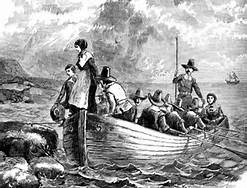
pilgrimsWould you be a Pilgrim for your children or grandchildren?  Would you risk your life for their future?  Many of us believe that the Pilgrims came to America seeking religious freedom.  This is only partly true.  “They also came,” writes Chuck Colson, “because their teenagers were giving them fits.”

Here’s some background.  The Church of England was the established church in 1608.  If a Christian objected to aspects of the “official church,” they were labeled a Separatist and sometimes thrown into prison for worshipping “in their own way.”  A group of those Separatists escaped to Holland in 1608 because they were determined to worship as they believed they should.  William Bradford, age seventeen, was among them.  In his journal, Bradford noted how desperate the Separatists were becoming, not because they couldn’t worship as they wanted, but because it was difficult to make a living.  Labor was grueling and some of the Separatists actually preferred prison in England to liberty in Holland.

It was not, however, the backbreaking work that motivated this group of Christians to leave Holland and set out for America.  It was their children.  Many of the young people who had moved with families from England to Holland were losing their faith.  They were influenced by a licentious culture.  They were lured by evil examples.  They were turning away from their parents and living wayward lives.  The Christians who had escaped from England to Holland now realized it was time to plan a dangerous journey — for the sake of their sons and daughters.

Parents have always had to take a stand against evil in the battle for the souls of their children.  In the case of the Pilgrims, staying in Holland meant watching their children be tempted away from God by saloons, prostitutes and sensual living.  These parents, with their children’s eternal future in view, needed to act.

Perhaps you have thought about becoming a Pilgrim.  Perhaps, because your children are giving you fits, you have entertained the notion of packing them up and moving to a “safe” place away from it all.  But where is such a place?  For a while, the Pilgrims found new land where they could instruct their children in the way of the Lord.  But soon enough, their children’s children were also tempted and giving their parents fits.  That’s how it is with sinful people in a sinful world.

So what is a parent to do?  We may not be able to escape the culture, but we can certainly equip our children for living in it without being of it.  This requires training… training that begins in the home.  Our own as well as theirs.

This Thanksgiving, we can do what the Pilgrims did.  We can look at our children in light of their eternal destiny.  We can be willing to do the hard things that godly parents have always had to do.  We can be faithful… not trusting in ourselves, but holding fast to the Word of Life.

(With appreciation to Chuck Colson
and his devotional How Now Shall We Live, 2004)

Read Full Post »

If you’ve never watched Rev. Jonathon Fisk on YouTube at Worldview Everlasting, you’re going to be in for a surprise.  This Lutheran pastor talks to the “now” generation but, the question is: Can the now generation keep up? In this episode, Rev. Fisk challenges a new culture of women but with unchanging Truth that endures the ages.  Young women… let me know what you think.  Better yet, become a subscriber of Worldview Everlasting 🙂

Read Full Post »

Eric Metaxas from Breakpoint (10/28) brings something to Ezerwoman’s attention.  Having been concerned about the separation of procreation from sex here in the American culture, I find the following worthy of our attention.  Eric Metaxas writes:

Long-time BreakPoint listeners know about Japan’s catastrophically-low birthrates: by 2060, Japan’s population is projected to fall by a third, the same percentage killed by the Black Death in 14th-century Europe.

Japan’s demographic decline has spawned some creepy adaptations, such as lifelike talking dolls for elderly Japanese without grandchildren, or the borrowing of other people’s grandchildren for a day.

Attempts to encourage child-bearing through economic incentives have failed, as they have in other countries with low birth-rates. Younger Japanese aren’t interested in reproducing themselves.

And now, according to a recent article in the UK’s Guardian, they’re increasingly uninterested in sex, as well.

A 2011 survey found that 61 percent of unmarried men and 49 percent of unmarried women between 18 and 34 were not involved in any kind of relationship. Another survey found that a third of those under thirty had never dated.

Daily_Commentary_10_28_13MMore ominously, a study by the Japan Family Planning Association revealed that 45 percent of all Japanese women between the ages of 16 and 24 “were not interested in or despised sexual contact.” More than a quarter of their male counterparts felt the same way.

As the Guardian puts it, “Japan’s under-40s won’t go forth and multiply out of duty, as postwar generations did.” Why? Part of the reason has to do with Japanese attitudes to women in the workforce. As one 32-year-old woman told the paper, “a woman’s chances of promotion in Japan stop dead as soon as she marries.” The assumption is that she’ll become pregnant and have to resign.

While that helps to explain why her generation isn’t having children or even getting married, it doesn’t explain the lack of interest in sex. And it certainly doesn’t explain why an increasing number of Japanese men aren’t interested in it either.

One 31-year-old man spoke for many of his peers when he said, “I find some of my female friends attractive but I’ve learned to live without sex. Emotional entanglements are too complicated . . . I can’t be bothered.”

“Can’t be bothered.” Or mendokusai in Japanese. (Didn’t think I could speak Japanese, did you? Well, I can’t.)

Most of the other possible factors the Guardian cites, including “the lack of a religious authority that ordains marriage and family,” are only partial explanations. Japan’s “precarious earthquake-prone ecology that engenders feelings of futility, and the high cost of living and raising children” don’t explain the increasing lack of interest in sex. But here’s something that does: it’s the lack of interest in having children. The assumption of the sexual revolution was that, having severed the link between sex and procreation, the result would be “better sex.”

Newsletter_Gen_180x180_BBut the Japanese experience suggests that the opposite may be closer to the truth. Having stripped sex of one of its God-ordained purpose, we turned it into just another pleasurable human activity, albeit one that often comes with complicated emotional entanglements.

Since the “urban pastimes” available to younger Japanese provide pleasure without the entanglements, sex can seem like a bad investment of time and energy. Mendokusai.

The Guardian calls Japan’s separation of love and sex “pragmatic.” But the evidence strongly suggests that there is nothing “pragmatic”—as in “dealing with things sensibly and realistically”—about that separation. We human beings simply aren’t wired that way.

In some important respects, the difference between Japan and us is one of degree, not kind. It remains to be seen if a generation of young Americans will one day replace “whatever” with “mendokusai.”

Read Full Post »

« Newer Posts - Older Posts »