Feeds:
Posts
Comments

Joseph and His Rib

Joseph and MaryJoseph, a young man from the house of David, was probably like every other soon-to-be husband: nervous, but excited all the same.  That is, until his fiancée came to him with shocking news.  Mary was pregnant, but Joseph was not the father.  The world, as Joseph knew it, had collapsed around him.  He felt betrayed, hurt, angry.  Break the engagement, whispered his pride, and walk away from this woman.

Everything had changed.  Plans were ruined.  Reputation was at stake.  Unchartered territory lay ahead.  At this precarious moment in his life, Joseph had nothing to hang on to… nothing, that is, except the Word of the Lord.

The Word gave Joseph courage.  “Don’t be afraid!”  It was the word that showed Joseph how to be faithful.  “Take Mary as your wife.  She will give birth to a son, and you will name him Jesus” (Matthew 1:20-21).

Perhaps, in holding on to the Word, Joseph remembered the experience of his ancestor, Adam.  Perhaps, in a moment of truth and with eyes focused, Joseph could picture Adam standing next to his wife, Eve.  Perhaps, with wisdom only from the Holy Spirit, Joseph recognized the significance of Eve’s creation by God from man’s rib.

God made (literally: “built”) woman using part of man.  With this, He established their relationship within the order of creation.  A rib is structural; it supports.  A rib guards and protects the heart and breath of life, yet it is vulnerable.  Under attack, it can easily be fractured or even broken.  Satan despises the order of creation that God uses to protect the man and woman He so loves.  So, that day in the Garden, Satan set his target and went straight to Adam’s rib.  The man was responsible for using God’s Word to cover his wife, yet he did nothing.  Joseph knew the consequences that followed.

Perhaps, with discernment only from God, Joseph understood that he must not repeat the sin of his ancestor and do to his rib what Adam had done to his.

Perhaps, in remembering what Adam had failed to do, Joseph was given the courage to cover his wife, Mary, and lead her to safety.  Let the village talk!  Adjust carefully-made plans!  Trust the Word of the Lord!  Although it meant leaving his zone of comfort, Joseph did what the angel of the Lord had commanded him to do.  He covered his rib by taking Mary as his wife.  And, when Mary’s child was born, Joseph named Him Jesus.

God wanted Joseph to make a difference – a difference that would impact the world.  But, such a difference could be made only by being faithful.  Such faithfulness required that Joseph leave all that was familiar and put his life and the life of Mary into the hands of God.

Today, when a young man pressures his girlfriend to have sex, he is leaving her physically, emotionally, and spiritually vulnerable.  He has placed his “needs” before hers and, in so doing, left her open to attack.  When a man does not promise to love, cherish, and cover a woman with his name, but simply share living quarters and a bed, he is leaving her open to attack.  When a man fathers a child but does not accept the privilege and responsibility of being a daddy, he is leaving both mother and child uncovered and vulnerable to the world.

But, when a man remembers God and His call to leadership, he is able to make a difference.  A young man who guards his girlfriend’s virtue makes a difference.  A husband who remains true to his wife makes a difference.  A dad who understands the privilege, responsibility, and generational influence of fatherhood makes a difference.  Men of faithfulness have a grand opportunity to defend against chaos and leave a legacy of hope.

Convenience told Joseph to walk away from Mary.  Self-defense told Joseph to think of “number one.”  Pride told Joseph that he could do better.  Fear told Joseph to hide.  But, God told Joseph not to be afraid to take Mary as his wife.

Joseph did what the angel of the Lord commanded.  He covered Mary, his rib, and the unborn Child whose heart beat under her own.  And, after the Baby was born in the most humble of circumstances, Joseph named the Child Jesus.  Through all the frightening days ahead, Joseph remembered the Word of the Lord.  And the Lord did not forget Joseph.  In the midst of danger, the angel of the Lord warned Joseph.  When uncertainty abounded, the angel of the Lord directed Joseph.

It’s true that life wasn’t ever the same for Joseph.  It certainly wasn’t what he had planned.  But, Joseph remembered the Word of the Lord.  And, in doing so, he received courage to do what was asked of him.  Joseph was faithful to cover Mary, his rib.  He raised her Son Jesus in a godly home and took Him to worship.  Some 2000 years later, the Boy who grew to be a Man in the house of a carpenter is still changing lives.

Joseph made a difference.

Copyright 2010
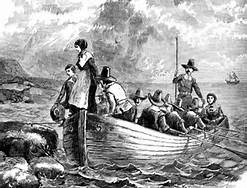
pilgrimsWould you be a Pilgrim for your children or grandchildren?  Would you risk your life for their future?  Many of us believe that the Pilgrims came to America seeking religious freedom.  This is only partly true.  “They also came,” writes Chuck Colson, “because their teenagers were giving them fits.”

Here’s some background.  The Church of England was the established church in 1608.  If a Christian objected to aspects of the “official church,” they were labeled a Separatist and sometimes thrown into prison for worshipping “in their own way.”  A group of those Separatists escaped to Holland in 1608 because they were determined to worship as they believed they should.  William Bradford, age seventeen, was among them.  In his journal, Bradford noted how desperate the Separatists were becoming, not because they couldn’t worship as they wanted, but because it was difficult to make a living.  Labor was grueling and some of the Separatists actually preferred prison in England to liberty in Holland.

It was not, however, the backbreaking work that motivated this group of Christians to leave Holland and set out for America.  It was their children.  Many of the young people who had moved with families from England to Holland were losing their faith.  They were influenced by a licentious culture.  They were lured by evil examples.  They were turning away from their parents and living wayward lives.  The Christians who had escaped from England to Holland now realized it was time to plan a dangerous journey — for the sake of their sons and daughters.

Parents have always had to take a stand against evil in the battle for the souls of their children.  In the case of the Pilgrims, staying in Holland meant watching their children be tempted away from God by saloons, prostitutes and sensual living.  These parents, with their children’s eternal future in view, needed to act.

Perhaps you have thought about becoming a Pilgrim.  Perhaps, because your children are giving you fits, you have entertained the notion of packing them up and moving to a “safe” place away from it all.  But where is such a place?  For a while, the Pilgrims found new land where they could instruct their children in the way of the Lord.  But soon enough, their children’s children were also tempted and giving their parents fits.  That’s how it is with sinful people in a sinful world.

So what is a parent to do?  We may not be able to escape the culture, but we can certainly equip our children for living in it without being of it.  This requires training… training that begins in the home.  Our own as well as theirs.

This Thanksgiving, we can do what the Pilgrims did.  We can look at our children in light of their eternal destiny.  We can be willing to do the hard things that godly parents have always had to do.  We can be faithful… not trusting in ourselves, but holding fast to the Word of Life.

(With appreciation to Chuck Colson
and his devotional How Now Shall We Live, 2004)

Women and Narcissism

If you’ve never watched Rev. Jonathon Fisk on YouTube at Worldview Everlasting, you’re going to be in for a surprise.  This Lutheran pastor talks to the “now” generation but, the question is: Can the now generation keep up? In this episode, Rev. Fisk challenges a new culture of women but with unchanging Truth that endures the ages.  Young women… let me know what you think.  Better yet, become a subscriber of Worldview Everlasting 🙂

Eric Metaxas from Breakpoint (10/28) brings something to Ezerwoman’s attention.  Having been concerned about the separation of procreation from sex here in the American culture, I find the following worthy of our attention.  Eric Metaxas writes:

Long-time BreakPoint listeners know about Japan’s catastrophically-low birthrates: by 2060, Japan’s population is projected to fall by a third, the same percentage killed by the Black Death in 14th-century Europe.

Japan’s demographic decline has spawned some creepy adaptations, such as lifelike talking dolls for elderly Japanese without grandchildren, or the borrowing of other people’s grandchildren for a day.

Attempts to encourage child-bearing through economic incentives have failed, as they have in other countries with low birth-rates. Younger Japanese aren’t interested in reproducing themselves.

And now, according to a recent article in the UK’s Guardian, they’re increasingly uninterested in sex, as well.

A 2011 survey found that 61 percent of unmarried men and 49 percent of unmarried women between 18 and 34 were not involved in any kind of relationship. Another survey found that a third of those under thirty had never dated.

Daily_Commentary_10_28_13MMore ominously, a study by the Japan Family Planning Association revealed that 45 percent of all Japanese women between the ages of 16 and 24 “were not interested in or despised sexual contact.” More than a quarter of their male counterparts felt the same way.

As the Guardian puts it, “Japan’s under-40s won’t go forth and multiply out of duty, as postwar generations did.” Why? Part of the reason has to do with Japanese attitudes to women in the workforce. As one 32-year-old woman told the paper, “a woman’s chances of promotion in Japan stop dead as soon as she marries.” The assumption is that she’ll become pregnant and have to resign.

While that helps to explain why her generation isn’t having children or even getting married, it doesn’t explain the lack of interest in sex. And it certainly doesn’t explain why an increasing number of Japanese men aren’t interested in it either.

One 31-year-old man spoke for many of his peers when he said, “I find some of my female friends attractive but I’ve learned to live without sex. Emotional entanglements are too complicated . . . I can’t be bothered.”

“Can’t be bothered.” Or mendokusai in Japanese. (Didn’t think I could speak Japanese, did you? Well, I can’t.)

Most of the other possible factors the Guardian cites, including “the lack of a religious authority that ordains marriage and family,” are only partial explanations. Japan’s “precarious earthquake-prone ecology that engenders feelings of futility, and the high cost of living and raising children” don’t explain the increasing lack of interest in sex. But here’s something that does: it’s the lack of interest in having children. The assumption of the sexual revolution was that, having severed the link between sex and procreation, the result would be “better sex.”

Newsletter_Gen_180x180_BBut the Japanese experience suggests that the opposite may be closer to the truth. Having stripped sex of one of its God-ordained purpose, we turned it into just another pleasurable human activity, albeit one that often comes with complicated emotional entanglements.


Since the “urban pastimes” available to younger Japanese provide pleasure without the entanglements, sex can seem like a bad investment of time and energy. Mendokusai.

The Guardian calls Japan’s separation of love and sex “pragmatic.” But the evidence strongly suggests that there is nothing “pragmatic”—as in “dealing with things sensibly and realistically”—about that separation. We human beings simply aren’t wired that way.

In some important respects, the difference between Japan and us is one of degree, not kind. It remains to be seen if a generation of young Americans will one day replace “whatever” with “mendokusai.”

prison cellThe 28th of October — three days from now — marks the tenth year of incarceration for my young friend Travis.  His life was forever changed when the jury pronounced him “guilty.”  He has no excuses.  Travis knows that he made terrible choices that led to life-threatening drug addiction.

He remembers that day in court when the verdict was read.  His mom reached for him, begging for one last hug but was denied by the U.S. Marshall who cuffed him and dragged him away.  Travis describes himself as a scared little boy in a man’s body unable to grasp the reality of what was happening, yet conscious of frightful images.  Where was he going?  With whom would he be imprisoned?  What would they do to him?  Would he be raped, stabbed or killed?

Travis writes, “I began to plot in my head how to end it all . . . life was not worth living anymore.  I thought of creative ways to use a bed sheet, or perhaps I could pick a fight and hopefully be killed in the process.”  But God was with Travis.  “The comfort I felt when I cried out to Him in one last ditch effort before I ended my life was so amazing.  God really did put His arms around me and lifted me up.”

It would be easy to languish in prison, to let the depression win and the hopelessness take root.  But there, in the most unlikely of places and under the Potter’s own hand, Travis has learned his true identity.  The world calls him a criminal.  A drug-abuser.  A law-breaker.  A bad boy.  A misfit.  But that is not how God identifies him.  God calls Travis His son in Jesus Christ.  A forgiven sinner.  A person of value.  A man with a future of hope.

Travis could remember October 28 as the end of his life.  Instead, he remembers it as the beginning of new life.   Before prison, Travis was captive to the lies.  In prison, he was set free in the Truth.  Before October 28, Travis had forgotten who he was.  On October 28, The Father reminded his child, “Fear not, for I have redeemed you; I have called you by name, you are mine” (Isaiah 43:1).

It is in darkness that light shines brightest.  Travis admits to struggling with fear, doubt, sadness, anger, and depression.  But knowing who he is in Christ, Travis also knows he is being transformed.  As a son of God in Christ, Travis has purpose.

You are . . . his own possession, that you may proclaim the excellencies of him who called you out of darkness into his marvelous light . . . once you had not received mercy, but now you have received mercy (1 Peter 2:9).

The Helper Needs Help

praying womanEzerwoman has sadly neglected her blog this year.  Two years ago, she began a project that had, in reality, been taking shape for twenty years or more.  Ezerwoman prays that the work will soon be completed.  If God so blesses the effort, then Ezerwoman will share the news with you.

An ezer is a helper.  This ezer strives to help and encourage men and women, but also the Church.  Would you please pray that this helper receives the help of the Holy Spirit?  Truly, the Holy Spirit is The Helper, Encourager, and Counselor.

As for all the rest of you ezerwomen — you helpers of husbands, children, parents, siblings, friends and neighbors — may God grant you wisdom, desire for holiness, and strength to shine light into the dark places of this world.  Sons and daughters of God in Jesus Christ anticipate His return for us but, while we wait, we affect the culture one life at a time.

See to it that no one takes you captive by philosophy and empty deceit, according to human tradition, according to the elemental spirits of the world, and not according to Christ (COLOSSIANS 2:8).

thumbnailScarlett O’Hara, in the movie Gone With the Wind, believed her figure would be perfect only if she had an 18 inch waist.  Every day, Scarlett instructed her “mammy” to push, prod and tightly lace her into a corset.  The experience was literally breath-taking.  (It was no wonder that women of Scarlett’s era fainted so easily.)  Scarlett may have been a story-book character, but the fashionable corset was a cruel reality.  Thousands of American women attained the so-called perfect figure, but at a high price.  The following true story explains.

When Hiram Powers, the great sculptor, was visiting in the U.S., he attended an elaborate party.  A friend observed Mr. Powers watching a beautifully dressed and fashionable woman.  The friend said, “What an elegant figure she has, don’t you agree?”

“Well,” said Mr. Powers, “I was wondering where she put her liver.”

You see, Mr. Powers had studied the human body, and he knew that in order to shape a female body in the outline of the woman he was watching, some internal organs would have to be forced out of their properly functioning place.

A physician during that same era, Dr. J.H. Kellogg, examined thousands of women in a year’s time.  He stated that it was almost impossible to find a woman whose stomach was where it belonged.  This was a serious matter because no organ can function efficiently when it’s out of its proper position.

Dr. Mary Wood-Allen, a physician and the author of a series of books for young women growing up in the early 1900s, wrote: “The reason we admire the tapering waist is because we have been wrongly educated.  We have acquired wrong ideas of beauty.  We have accepted the ideals of ‘fashion’ rather than those of the Creator.” (Purity and Truth: What a Young Woman Ought to Know, Vir Publishing, 1898)

In the late 1950s, a toy company defined the so-called perfect figure by creating the Barbie doll.  Almost every American girl not only wanted a Barbie, she wanted to look like Barbie.  But Barbie’s figure is abnormally out of proportion.  A real girl with Barbie’s measurements would fall over on her face.

Perhaps we, too, have fallen over on our faces and caused our brains to stop thinking.  In what ways do we put our health dangerously at risk in order to have a “perfect” figure?  Who determines the “perfect” skin color?  How many piercings and tattoos are enough to suit the trend-setters?

Why do we let fashion designers (who don’t know us) tell us how we should look?  Why do we let department stores (who profit from our purchases) tell us what to buy?

We’ve listened to the world long enough.  Don’t you think it’s time to hear what the Creator of our bodies has to say?

Take a breath.  Pick up your Bible.  What does God say to you in Isaiah 43:1, 7; 45:9-11; 1 Samuel 16:7; 1 Peter 3:3-5; and 1 Corinthians 6:18.

From Lesson Eight: “Beauty at Any Price?”
Dressing for Life: Secrets of the Great Cover-up
A Bible Study by Linda Bartlett
(Lutherans For Life or Concordia Publishing House)

At Titus 2 Retreats, one of the topics we discuss is modesty in clothing and behavior.  Perhaps, on behalf of our brothers, it would be best for me to share their thoughts on why modesty matters.  Please listen ~


writing a letterDear Friend,

It was my hope to write much sooner.  I hope this finds you growing in the confidence of our Father’s mercy and love.

Our paths crossed for a time on this earthly journey.  Choices you were making brought suffering to your family and those you care most about.  Those choices forever changed their lives… and yours.  Perhaps the sexual sin that held you captive for too long is part of the reason why I’ve been working on a project.  A very difficult project.  A book that I’d rather not write.  The actual writing began almost two years ago, but the experiences and lessons learned over a period of nearly thirty years laid the foundation.  For now, the working title is The Failure of Christian Sex Education: Mistaken Identity, Compromised Purity.  I have no idea when the last sentence will be written or, if published, who will want to read it.  But the book begged to be written.

Over fifty years ago, those who promoted the new concept of sex education in both public and parochial schools said it was necessary to decrease unwed pregnancies and sexually transmitted diseases.  To parents and congregations they said, “Stop teaching so many ‘nos.’  Let us teach your children to say ‘yes’ to the wonders of sex because, after all, children are sexual, too.”  They promised: “Getting everyone comfortable with their sexuality will benefit marriage.”

All that I see proves that too many of us believe the lie that “children are sexual from birth.”  Kinsey built that lie on skewed research and criminal behavior.  He called it science.  Those of the humanist faith were waiting for such “science” to reform the whole of society, one child at a time.  But children are not “sexual” (as Kinsey meant it) from birth.  And we are certainly more than sexual beings, we are spiritual beings.  We will live forever — either with or apart from God.  The Church has forgotten to be distinctively different from the world and, in doing so, failed to encourage children and adults to see themselves as God does.  As baptized persons, we are sons and daughters of God in Christ.  That makes us holy.  Holy means being set aside for noble purpose.  We are not common, but uncommon.  As such, we are useable not just by anyone but by God.  What a difference it makes to see ourselves this way.  Sadly, the world convinces too many of us to identify ourselves as sexual beings and that — from early on — has set the stage for promiscuity, abortion, living together, homosexuality, re-definition of marriage, pedophilia, and a great deal of sin, suffering, and separation from God.  The humanists may claim some victory now, but we know Who has the final Word, don’t we?  Souls are in danger… and for that reason we need to do battle with the sinful world and our own corrupted nature even as we fall at the foot of the Cross — every day — and thank God for his mercies in Christ.

My deepest sense tells me that you know what I mean.  We modern sinners are no different from our first parents.  Eve doubted and thought she could become god of her life.  Adam failed to remember God’s Word and use it to bring order out of the chaos.  Ever since, the enemy of our lives comes to us in our weakest moments, tempting us to doubt God’s strong Word.  We think ourselves wise, but we are foolish.  We think ourselves “good” and, most certainly, we are not.  So, at the end of every day, it is a great privilege and comfort to entrust ourselves to our Savior, poor miserable beings that we are.  In the morning, all things are new and, because of His forgiveness, we can begin all over again.  You know this.  You believed this.  But wrong choices taught you how much sin hurts.  It changes lives.  Covered sin saps our strength.  It shapes us more and more into a common vessel useable by our enemy.

However, there is hope.  There is always hope!  Hope came to us in the Son of God Himself.  Harold L. Senkbeil wrote a revealing book entitled Dying to Live (The Power of Forgiveness).  It explains what the Incarnation — the Word made flesh — means for us.  Simple water, bread, wine and words work in sinful lives to make people over into new creatures.  We can’t go back to Eden.  We live in a dying world.  But God is with us!  Like Moses and Elijah, we cannot look directly at God, but God comes to us in mystery.  Senkbeil calls Jesus (who is God) the “backside” of God.  He is the part of God we can see.  He came in flesh — to teach, to sacrifice, to die — but also to conquer Satan and eternal death.  For me, this is a new way of thinking about Christ.

Consider what this means.  God comes to us in the mystery of water (Baptism), bread and wine (Communion), and His Holy Word.  Wow!  God really has come to you and me… to all who are dying to live 🙂  I think you would like what Harold Senkbeil has to say about the power of forgiveness.  May you know that power in Christ.  May I know that power in Christ.  And may we persevere — with our families and loved ones — on this journey through a strange and unfriendly land to our eternal home.  Can you imagine?  There, at the banquet table, we will be able to rest our eyes on the magnificence of God.  He will no longer have to hide His fullness from us.  We will know His glory in every way.

Your life took a dramatic and traumatic turn.  Sin never improves us but, rather, beats us up.  You have known guilt, regret and great loss of relationships.  Your family, friends and loved ones have also suffered.  But each new day is new opportunity.  The past is what it is.  We are affected by every choice that we make.  Life becomes much more difficult and painful when we fail to use the Word to bring order out of the chaos of life.  But no matter those choices and circumstances — no matter our sins, or lack of health or popularity — our identity never changes when we cling to our baptism.  We are sons and daughters of God in Christ.  Think of what this means!  We really do have hope.  New hope every morning!

May you cling to your baptism even as I will strive to cling to mine.  I am amazed that God continues to carry me.  Forgive me.  Work through me.  It is for this reason that I have grown in a deeper appreciation of the Divine Service.  God doesn’t need my praise, but this empty vessel sure needs to be filled with His Word and Sacrament.  I need to be divinely served by Him in a service distinctively different from the world… and then, in response, I can praise Him in my work, relationships and service to others all week long.  I pray that you know his Divine Service in your life so that, no matter what the days ahead may bring, you will be able to say: I am not common.  I am uncommon in the hands of a mighty God.  I am poor.  I am miserable.  I am unworthy… but I am chosen as a son of God in Christ.

May you know the overwhelming mercy that only God Himself in the humility of Christ can bring to you.  The Cross changes everything for us.  We are no longer captive to sin, but set free to leave old ways behind.  Dear friend, let us both pray for a diminished pride so that we don’t get in the way of the Spirit’s work in us, through us…

… in spite of us.

The following excellent post is from THE CHRISTIAN PUNDIT.  It’s worth the time and thought of any young woman who is contemplating marriage.

It Matters Whom You Marry

My husband and I were once with a youth group. There were three kids sitting across from us at a meal: two guys and a girl. The one guy was a computer geek with glasses. The other one was a college student with slightly cooler hair and no glasses. The girl was obviously with him. But while the computer geek was busy serving everyone at the meal, clearing plates and garbage, the college student got angry with the girl for a small accident and poured red juice over her leather jacket and white shirt. She picked the wrong guy, and the juice didn’t seem to change her mind. She is in for some grief if that relationship continues and especially if it leads to marriage.

So to all the young, unmarried Christian girls out there, listen up: who you marry matters. You might think that the way he treats you isn’t so bad. It’s not going to get better after the wedding. You might think that he’ll change. It’s possible, but most don’t. You might think that you’ll be able to minister to him and help him. Possibly, but if you can’t now, you won’t then, and you will be at risk yourself. A husband should lead and cherish you, not need your counsel for basic personality or behavior issues.

Unless someone married is very frank with you, you can’t understand how much a husband will impact your entire life. Next to salvation there is no other long term event that will change so many areas of your life so deeply. Here are just some of the ways that marriage will impact every aspect of living.

1. It will impact you spiritually. If the guy is not a believer, you can stop right there. You have no business yoking a redeemed soul with an unregenerate one, even if he seems open to change. Christ has bought you with a price and it is not an option to give away that blood bought heart to someone who doesn’t know and love your Lord. It will cripple your spiritual development, open up a host of temptations, stifle your prayer life, make regular church going difficult, and cause massive parenting conflict if you have children.

If the guy is a believer, is he a strong one? Will he lead you in prayer, Bible reading, family devotions, and public worship? Or will you be on your own? Is he going to make spiritual growth a priority or do other things come first? Is he going to ask you how it’s going with your soul so he can help you grow in holiness and love for Christ, or will he leave that to your pastor? Is he going to lead the children in this, or will you have to spearhead that? In church, is he going to help the kids sit well, pray, find the hymn, or will you be the one pointing out what is happening next and helping the family keep up? Many women have married spiritually immature men, thinking that it wasn’t a big issue, or that the man would change, and they were wrong. They bear the scars.

The health of your eternity is at stake. Think carefully.

2. It will impact you emotionally. Is the guy you’re thinking of going to encourage you, love you, be kind to you, and seek to understand you, or will he want to go out with the guys when you’re having a hard night? Will he listen when you are struggling with something or will he be preoccupied with a video game? Is he going to be annoyed when you cry or will he get you Kleenex and give you a hug? Is he going to going to understand that you are probably more tender than he is, more sensitive to issues and comments, or is he regularly going to run rough shod over your feelings? One woman was struggling to breastfeed her new baby, believing that that was the best thing for her, but it was very difficult. Instead of giving support and encouragement, the husband would make mooing sounds whenever he saw his wife working at it. We have to get rid of princess complexes, but we do have emotional needs. Any guy who is uncaring about your feelings and self esteem is selfish and should be left alone.

Be careful – a husband can cripple or foster emotional health.

3. It will impact you physically. Is the guy you’re with going to provide for your basic needs? Will he be able to shelter, clothe and feed you? At one point in our marriage, I was worried that there was no employment opportunity. My husband assured me that he would work at McDonalds, dig ditches, clean up roadkill – whatever it took to provide for the family, regardless of his gifts and training. That’s the kind of attitude you want. A man who doesn’t provide for his household is worse than an infidel (I Tim. 5:8). You might have to help ease the financial burden, but unless your husband is disabled or there is another unusual circumstance, you shouldn’t have to carry it yourself.

Will the man you are with care for your body or abuse it? If he gives you little smacks, kicks, etc. when you’re dating, get away. It’s almost guaranteed that he will abuse you after marriage, and stats show that’s especially true when you are pregnant. Is he going to care for and protect your body or will he hurt it? There are women in churches across America who thought it was no big deal to have little (sort of friendly) punches or slaps from their boyfriends, but who are covering up the bruises from their husbands.

Will the man you are with care for you sexually? Is he going to honour the marriage bed in physical and mental faithfulness to you or will he flirt, feed his porn addiction, or even leave you for another woman? You can’t always predict these issues, but if the seeds or practices are already there, watch out. I recently saw a newly married couple and the husband was flirting openly with another woman. Unless something drastic happens, that marriage is headed for disaster.

Is he going to be tender and gentle to you in bed? An unbelieving co-worker once told my sister that after her first sexual encounter, she had trouble walking for a few days because her boyfriend was so rough. In other words, he wasn’t selfless enough to care for the body of the woman he said he loved.

Watch out. Your body needs care and protection.

4. It will impact you mentally. Is the man that you’re thinking of going to be a source of worry or will he help you deal with your worries? Is he going to encourage your intellectual development, or will he neglect it? Is he going to value your opinions and listen to what you are thinking, or will he disregard your thoughts? Is he going to help you manage stress so that your mind is not burdened that way, or is he going to let you struggle through issues alone? Is he going to care for you and be thoughtful of you if you are experiencing mental strain, or will he ignore it? I know of a woman who could handle pregnancy and child birth very well physically but postpartum depression took a huge toll on her mind. The husband overlooked it, continuing to have more children, until his wife ended up in a mental institution.

You might think that the intellectual or mental side of a marriage is small. It’s bigger than you think. Consider it seriously.

5. It will impact you relationally. How’s your relationship with your mother? Your dad? Do you love them? Does your boyfriend? Fast forward ten years: you tell your husband that your mother is coming for the weekend. Is he excited? Disappointed? Angry? Making snide jokes with his friends? Of course, a husband should come first in your priority of relationships, as you both leave father and mother and cleave to one another. But parents are still a big part of the picture. Whatever negative feelings he has about your parents now will probably be amplified after marriage. Your marriage will either strengthen or damage – even destroy – your relationship with your parents. The people who know you best and love you most right now could be cut out of the picture by a husband who hates them.

It’s the same with sisters and friends. Will they be welcomed, at reasonable times, in your home? Will the guy who you’re with encourage healthy relationships with other women, or will he be jealous of normal, biblical friendships? Will he help you mentor younger women and be thankful when older women mentor you, or will he belittle that?

Don’t sacrifice many good relationships for the sake of one guy who can’t value the people who love you.

So how will your boyfriend do after the vows? Because this is just a sampling of the ways that a husband can bless or curse his wife. The effects are far reaching, long lasting, and either wonderful or difficult. True, there are no perfect men out there. But there are great ones. And it’s better to be single for life than to marry someone who will make your life a burden. Singleness can be great. Marriage to the wrong person is a nightmare. I’ve been in a church parking lot where the pastor had to call the police to protect a wife from a husband who was trying to stop her from worshiping and being with her family. It’s ugly. Don’t be so desperate to get married that your marriage is a grief. If you are in an unhappy marriage, there are ways to get help. But if you’re not married, don’t put yourself in that situation. Don’t marry someone whose leadership you can’t follow. Don’t marry someone who is not seeking to love you as Christ loved the church. Marry someone who knows and demonstrates the love of Christ.