Feeds:
Posts
Comments

Posts Tagged ‘Jesus Christ’

Most of us have followed a car bearing the bumper sticker: Coexist.  Symbols of different religions make up each letter of the word.  Sounds good.  In order to “give peace a chance,” shouldn’t we all “coexist?”  But, what does this mean?

Not everyone in my circle of family, friends or neighbors believes exactly as I do.  Therefore, I “coexist” with people of many perspectives on life and of many faiths by treating them as the human beings God made them to be.  They are worthy, because of what Jesus Christ has done for us all, of my kindness.  Respect.  Civility.  Care.  Concern.  Help.

Does the bumper sticker “coexist” suggest something more?  If so, other questions follow.  Can the religion of humanism or atheism coexist with the Biblical worldview of Creation, The Fall, and Redemption?  Can the way of Mohammed, Buddha, or Gaia coexist with the God who calls Himself “I Am;” who spoke to Job, asking: “Were you there . . .  Have you commanded . . . Do you know how . . . ?”  Can Jesus Christ coexist with the religion of “save yourself?”

At every Titus 2 Retreat, I share the passage from Ezra 4:3.  It is a powerful message for Christians living in this “progressive” age.  The Israelites had been captive in Babylon for a long, long time.  When the Babylonian king told the Israelites they could return to their homeland, very few of God’s people chose to do so.  They had coexisted with the Babylonian religions and practices for so long that they didn’t want to return to their “old ways.”  A relatively small number of Israelites returned to re-build the decayed city of Jerusalem.

With such few workers, the re-building of Jerusalem was difficult.  Watching the process, some non-believing neighbors in the land offered their assistance.  (Did they have an agenda of their own?)  But, God cautioned His people not to accept the help of unbelievers.  Why?  1) The job of rebuilding Jerusalem was given exclusively to God’s people, 2) accepting help from non-believers would obligate God’s people to pagan ways, and 3) the potential for corruption in worship was too great if God’s people aligned themselves with non-believers.

Can people who call upon the name of the Lord Jesus Christ coexist with those who do not?  As kind and civil human beings who see each of their neighbors as creations of God: Yes.  But, as believers in the One True God who reveals Himself in three persons: Father, Son, and Holy Spirit: No.  We cannot “coexist” if the definition is “blend,” “bend,” or “bow to other gods.”  The Biblical worldview of male and female, children and family, education, human care, law, government, and even economics contrasts all others.

What partnership has righteousness with lawlessness?  Or what fellowship has light with darkness?  What accord has Christ with Belial . . . What agreement has the temple of God with idols (2 Corinthians 6:14-16)?”

In the end, it comes down to our answer to the question asked by Jesus:

Who do people say that the Son of Man is (Matthew 16:13)?”

Read Full Post »

Ezerwoman has not written for two weeks.  I’ve been spending time with family and friends in Colorado.  It was a joy to help my uncle with words of encouragement even as he shared words of experience and wisdom with me.  It was a joy to help my older, widowed friend settle into her new home even as we both recognized that “two are better than one.”  The days were long.  There was much pouring out.  But, the Creator re-energizes me with a “Rocky Mountain high.”

Leaving the grand mesa and palisade of vineyards and orchards, I climbed the majesties.  Somewhere between sparkling streams and golden aspens I remembered something a man had told me the day before.  He and his wife had built their house with wrap-around view.  “We just can’t get enough of this.”  I understood what he meant.  I haven’t been able to “get enough” of Colorado since I was a child.  I can’t “get enough,” but neither can I absorb what I see.   That’s how it is with humans.   Our eyes see and say, “I want more,” but our minds can not begin to process creation’s magnificence.

At such times, nothing is more profound than the simple.  Few words are better than many.  “Thank You, God!”

Here is the Source of my “Rocky Mountain high.”   Even while many worship the created, I have the greater privilege of worshipping the Creator.

It is to the Creator God — Father, Son and Holy Spirit — that I entrust my uncle.  My widowed friend.  All.

Read Full Post »

Liberal thinkers like to call themselves “progressive.”  They have “evolved” to a higher and more enlightened view and practice of life.  Is this true?

Between the years of 1904 and 1909, archaeological excavations at Gezer (once known as the Canaanite region) revealed the ruins of a temple.  This temple, or “high place” was built to worship Ashtoreth, the “wife” of the idol named Baal.  Great numbers of jars were discovered under the debris of the temple.  These jars contained the remains of children who had been sacrificed to Baal and Ashtoreth.  The whole area (an enclosure 150 feet by 120 feet) proved to be a cemetery for babies.

“Foundation sacrifices” were performed by Israelites who had adapted the ways of the people around them.  When a house was to be built, a child would be sacrificed and his or her body “built” into the wall with the belief that “good luck” would come to the rest of the family.  Many tiny bodies were dug up in Gezer, Megiddo, Jericho, and other sites.

How could a mother lay her child in the arms of Baal, a stone-cold idol who stood above a flaming fire?  How could the father permit it?  Infant sacrifice was practiced by parents seeking a change of circumstances.  A better life.  Prosperity.

Are we more civilized today?  Are we truly more “progressive?”  We have sacrificed 53,310,822 preborn babies in the United States since 1973.  Biology and ultrasound technology remind us that the abortionist is not removing “globs of tissue” but sons and daughters.  These children are sacrificed, not at the temple of Ashtoreth or Baal, but at the temple of Self.

Approximately 95 percent of abortions in the U.S. are not for rape, incest, or the life of the mother, but for convenience.  Mothers and fathers in Canaan sacrificed their children to idols for personal gain or out of fear.  Today’s practice of abortion is really no different.  Mothers and fathers lay their babies in the arms of stone gods named “my choice.”  “My convenience.”  “My best interest.”  One life is sacrificed for another.  “If I have an abortion, I will regain control of my life.”  “If I have this abortion, my future won’t be at risk.”  “Having this abortion is the sacrifice I must make for myself.”

But, God demands no such sacrifice.  He has already paid the ultimate and only necessary sacrifice for a future of hope.  God does not require mothers and fathers to sacrifice their children so that others might live well or fear less.  God made the sacrifice for us.  The Cross of Jesus Christ is the reminder of amazing grace on pitifully desperate people.  The Cross tells us that no one else — not even a “fetus” (Latin: young one) — needs to be sacrificed.

No peace for the soul was found in the temple of Ashtoreth.  No hope for the future was found in the temple of Baal.  Peace and hope elude the mother or  father who bend at the temple of Self.  “The sorrows of those will increase who run after other gods” (Psalm 16:4 NIV).  Ashtoreth. Baal.   Self.  All seek to deceive, then forsake.

But, those who trust in the God who calls each child by name will not be deceived.  God’s Word opens eyes and changes hearts and minds.  When fear presses down and momentary evil seems justifiable, God’s Word convicts… then comforts.  God does not forsake those who cry out to Him. He may not answer in the way we want or expect, but He promises His faithfulness in all circumstances.  Apart from God, there is no good thing.

With God, goodness and mercy rise up.  Push back against evil.  Overcome.  When wrong choices of the past made in fear and desperation are confessed and taken to the Cross, they are forgiven. Forgotten.  Covered by Jesus’ robe of righteousness.

I sought the Lord, and He answered me; He delivered me from all my fears.  Those who look to Him are radiant, and their faces shall never be ashamed . . . The angel of the Lord encamps around those who fear Him, and delivers them (Psalm 34:4-5, 7 ESV).

Read Full Post »

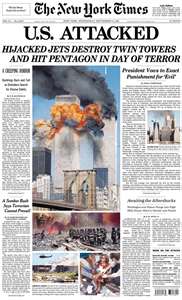
We all know where we were ten years ago on 9/11.  I was privileged to be in the presence of our younger son who was studying flight manuals for the airline that had just hired him.  Together, we saw plane number two crash through the second of the twin towers.   Josh didn’t know it, but his life would be significantly changed by 9/11.  The airline industry struggled in the aftermath of the terrorist attack.  In all reality, every American’s life was affected by the attack on our country.

I began praying.  I called my husband who was in Omaha at the time watching Air Force One circle overhead.  I called my dad.  Our eldest son.  My brother and sister-in-law.  Other family members and friends.  It was important for me to know where everyone was and that they were o.k.  The prayers continued.

Ten years ago, 2,753 people — most of them our fellow citizens — died in the name of Islam.  The plot against America was strategically planned and carried out by Muslims jihadists who, after a great many daily prayers calling on the name of Allah, intended to gain their way into paradise.

This Sunday, a memorial event will be celebrated at Ground Zero.  Many people have expressed strong opinion about praying together where the towers once stood.  Others have expressed strong opinion in opposition of any kind of joint prayer.  But, are all religions the same?  Do we all pray to the same god?  Are all gods equal to the one true God — the God of Abraham, Isaac, and Jacob?  The Triune God of Old and New Testament?  The God who calls Himself “The Word made flesh” (John 1)?

Twelve days after the 9/11 attacks, the mayor of New York City called for a “Prayer for America” memorial service.  Hindus, Buddhists, Muslims, Jews, and Christians were given opportunity to “pray.”  Tragically, reports Michael Youssef, “every representative of Christian denominations, but one, judiciously avoided mentioning the unmentionable — Jesus Christ — out of political correctness.  There was only one elderly Armenian Orthodox bishop who dared to utter the name of our Savior, the Son of the living God.”  (onenewsnow.com 9-3-11)

God warned Moses before entering the Promise Land that His people must not fall into syncretism by mixing their worship with that of the Canaanites.  The Canaanites worshiped every sort of god, yet no god at all.  God’s people disobeyed.  They attempted to mix Yahweh — “I Am” — with the gods — “I think I am” — of false religions.

As I ponder on 9/11 and its significance for me, I think of all the freedoms I enjoy because I was born in this country.  These freedoms are hallmark of this extraordinary republic.  I want to pray faithful to the First Commandment: “You shall have no other gods.”  I want to pray as a believer in the Triune God — one God who reveals Himself as Creator, Redeemer, and Encourager.  I want to pray as a Christian citizen motivated to push back evil even as I help build a culture on Truth.

I can.  I should.  I will.  But, my prayers will not be said at a prayer service where others are praying to Allah.  Buddha.  Mother god.  Where all voices are raised to what too many presume to be the “same god.”

My prayers and supplications to the Savior, Jesus Christ, will not be alone.  There will be countless — millions — of others.  No one can stop these prayers.  They will be lifted from churches.  Homes.  Small family circles.

God of grace and God of glory, on Your people pour Your power.  Grant us wisdom, grant us courage… for the facing of this hour (LSB 850) . . . in Jesus’ name.  Amen.

Read Full Post »

Sometimes, Christians are called people of the New Testament.  What does this say about the Old Testament?  What do we really know of Jesus without both Old and New Testaments?  In John 1, we are told that Jesus is The Word.  But, is that Word of Jesus only the red print of our New Testaments?

Think of all the New Testaments that have been published for a variety of reasons.  But, is the New Testament complete without the Old?  The New Testament is the Gospel of our Lord Jesus Christ.  But, for what reason do we need the Gospel?

Is the Old Testament just, well, old?  Didn’t Jesus come to do away with the old and bring in the new?

John 1 tells us: “In the beginning was the Word, and the Word was with God, and the Word was God.  He was in the beginning with God.  All things were made through Him, and without Him was not any thing made that was made.  In Him was life, and the life was the light of men.  The light shines in the darkness, and the darkness has not overcome it . . . And the Word became flesh and dwelt among us, and we have seen His glory, glory as of the only Son from the Father, full of grace and truth” (vv. 1-4, 14).

Hmmm.  This New Testament Word seems to identify Jesus as the Creator of all things.  But, where do we learn the details?  Upon what is “The Word was with God, and the Word was God” founded?  We are comforted by the salvation story of the New Testament, but upon what does it stand?  Is our hope in a feeling?

Every younger generation thinks itself more progressive and enlightened than the previous generation.  Technologically advanced, it’s easy to proclaim, “Out with the old!  In with the new!”  But, relegating the Old Testament of God’s Word to dusty shelves of folklore leaves Christianity without a foundation.  Ignoring historical relevance and archeological evidence leaves Sunday school children ill-equipped to defend their faith in the marketplace of ideas.

Genesis is the foundation of Christianity.  But, describe Genesis as a fairy tale for “neanderthals” and one can begin to undermine the authority of God’s Word: Jesus Christ.

The message of sin and the Cross was foolishness to the Greeks of St. Paul’s day.  That’s because the Greeks (Acts 17) had no knowledge or understanding of the first book of the Old Testament.  Without belief in Genesis, they were, shall we say, pre-Darwin people.  Evolutionists of a sort.  Captive to their own imaginings.  For this reason, the Apostle Paul had to define his terms and lay the foundation for the Gospel of Jesus Christ by starting at the beginning with the Genesis creation.  It was only then that some people could understand and believe on the Lord Jesus Christ.

In contrast, the Jews (Acts 2) were familiar with the Old Testament.  They understood and believed the history of Genesis.  They acknowledged the origin of sin.  Therefore, some of them could better understand the Gospel when the Apostle Paul presented it to them.

Before we can be new people — transformed people, we need to see the old for what it is.  God presents His-Story by starting at the beginning.  We should do the same.

Jesus becomes more than an “experiential moment” for people of the Old and New Testaments.  The One who calls Himself “The Way, the Truth, and the Life” is authority.   Jesus is The Word of creation.  He is the God who created male and female.  Defined marriage and family.  Ordered society.  Determined everything right.  Moral.  Good.  The first man and woman rebelled against The Word and fell from perfect creation.  We’ve been rebelling ever since.   But, for our sake, The Word did something unthinkable.  “The Word became flesh and dwelt among us.”   The Word — Jesus — became our Savior.

The glory of Christ — from Old Testament through New — is “full of grace and truth.”

Read Full Post »

When I was a little girl, my parents took my brother and me to Split Rock Lighthouse on the North Shore of Lake Superior.  We returned for numerous visits.  I was fascinated with the lighthouse.  What fun, I thought, to be the daughter of the lighthouse-keeper!

Re-visiting the Lighthouse as an adult, I recognized the lighthouse-keeper’s job was a lonely one.  Daily structured.  Difficult in the midst of storms.   The duty of the lighthouse-keeper, after all, was to keep the light shining no matter what.  Wicks needed to be trimmed.  Plenty of oil on hand.  All equipment needed to be in working order so that nothing prevented the light from shining when fog quickly rolled in or darkness overwhelmed the shoreline.

There was another duty.  From time to time, the lighthouse-keeper was called down from his lofty place high on the hill to the rocky shore below where hurting lives lay ship-wrecked and in trouble.

Such is our duty, too.  We are called to shine our lights high on the hill to help everyone see.  The light of God’s Word flowing through us warns others of danger and shows the way of hope and salvation.  But, when someone is hurting because he or she has come upon hard times, suffering and pain, God’s Word compels us to step down from the hill to offer comfort and care.   To help carry the burden.  God’s love flows through our servant hands.

My friend’s mom, Gladys, came down from her lighthouse countless times to serve the needs of others.  Now, it is is the turn of her children and grandchildren to serve.  To show their respect.  To practice caring.  To model what Gladys taught them.  I know.  I know.  Gladys would much rather go to the mansion God has prepared for her, but not yet.  Not until God’s work in and through her is done.  For now, she can trust that God is doing a work through her for others.  She can trust that He is speaking to her about important matters of eternal significance.  Then, as Jesus did in the Garden of Gethsemane, she can know that God’s will is being accomplished.

Things for Gladys seem upside down.   Storms have carried her wrecked and helpless body onto the rocky shore.  But, the light in Gladys is still shining.  The oil of God’s Word has so filled Gladys that, even as a very sick patient, her light inspires others to kindness.  Patience.  A servant’s love.

Read Full Post »

It’s possible that very soon my friend, Gladys, will be called home.  Poison in her system cannot be contained.  Her kidneys are shutting down.  Her lungs are weary.  She is in pain.  My friend is impatient to go home, yet — a faithful servant of God to the end — she does not ask anyone to send her before her time.

What Gladys does ask is that she be kept as pain-free as possible.  In an article I wrote years ago, I quoted Dr. Matthew Conolly.  He acknowledged that the greatest fear of most patients — and, thus, the reason that “mercy killing” or euthanasia grows ever popular — is pain.  Too many physicians believe their most important role is to heal or cure.  When they cannot, the patient may become a reminder of the doctor’s “failure.”  At such times, some physicians abandon the patient.  What they could do, as Dr. Conolly pointed out, is learn the art of caring for the patient even when the prognosis is not good.  What they could do is to learn the art of pain control.  Appropriate pain control does not hasten death, but brings dignity to both patient and family.

Today, my friend’s daughter — my dear friend, Rita — is talking to the hospital chaplain and hospice care workers.  Rita does not want to decide when her mother should die.  That is up to God.  But, she does want to do all she can to keep her mother comfortable.

I am reminded of a story I’ve shared when speaking about end-of-life issues.  A pastor’s wife, in her battle against cancer, was undergoing extensive treatment.  She was placed on a rubber cooling blanket to keep her temperature down.  It was very uncomfortable.  “I don’t know if I can stand this,” she told her husband.  “If you cannot,” he told her, “tell the nurses you want to discontinue this treatment.”  Then, anxious and exhausted, he left to get a few hours sleep.  When he returned, he was greeted by a nurse.  “Boy, does you wife have something to tell you.”  The pastor rushed in to his wife’s room where he found her smiling.  “What happened?” he asked.  “It was wonderful,” she said.  Sometime after you left, I could bear it no more.  I prayed that God lift me from this suffering.  And, you know what?  Angels appeared.  I felt warm; snug as a bug.  I slept.”

Does God know our pain?  Does He hear us when we ask for comfort?  For strength to endure?  For courage?  Think about Jesus as He was preparing to take on the sins of the world.  On the night He was betrayed, He took His disciples with Him to the garden.  He told them, “Do not fall into temptation, but pray.”  Then He went off by Himself.  He was in anguish.  His sweat was like drops of blood.  “Father,” He prayed, “if You are willing, take this cup from Me; yet not My will, but Yours be done.”  Do you know what happened?  An angel from heaven appeared to Him and strengthened Him.  (Luke 22:39-43)

When our physicians cannot heal, may we encourage them to comfort.  To seek better pain control.

And, when we feel that we are falling into temptation — ready to ask someone to end our life and send us on our way home — may we, instead, call upon the Great Physician.  The One who knows pain.  Who carried sorrow.  Who endured every whip and lash for our benefit.  If God heard the plea of His own dear Son, Jesus Christ, and sent an angel to strengthen Him, won’t He also hear us?  Won’t He give us exactly what we need, when we need it, until His work through us is done?

Read Full Post »

My friend, Rita, is sitting at the bedside of her mother.  It has been Rita’s great joy and blessing to have Gladys as her mom.  Now, as mother battles life-threatening infection, daughter wants to serve as she’s been served.  She is doing that by faithfully remaining at her mom’s side… reading to her, praying with her, and re-counting treasured memories.

It is at such times, however, that even the most faithful believers ask, “God, where are You?  Why do you allow our loved one to endure this?”  Gladys has lived a full and good life.  “She has been faithful, Lord.  Isn’t her work done?  Dear Jesus, why don’t You just take her home with you?”

Our family asked similar questions not long ago when my father-in-law battled bacterial brain infection.  We were given opportunity to hang on to and put into practice every pro-life conviction on which we stand.  For years, I had been speaking to others about the value of one life — the life in the womb and the life in a hospital bed.  So, I had to ask myself, what value was I going to put on the life of my husband’s father?  After all, he was 80 years old.  (Gladys is 91.)  His life was blessed.  Full.  Active.  He knew Jesus as His Savior and I knew my father-in-law, Max, would be taken to heaven when he died.  I knew I would forever appreciate the wisdom he had shared and the lessons he had taught.

I remember days and nights when Max, almost catatonic, could only thrash fitfully in bed.  I remember spoon-feeding him and begging him to swallow before a feeding tube was inserted.  Without really meaning to, Max pulled it out three times.  Three antibiotics were flowing into his bloodstream by IV.  No one knew for sure what the side-effects of those toxic chemicals might be.  So, when the brain surgeon said there was no more she could do, and the infectious disease team told us the odds of beating this infection were not good, and the social worker encouraged us to “take your dad home to hospice,” we could have said, “It has been a good fight.  We did all we could.”

But, God wasn’t through with Max — and He wasn’t through with me or my family either.  There were so many more lessons yet to be taught and learned.  From a bed not of his choosing, Max challenged his family to make words real in deed.  Not by accident he became my teacher, model, and witness.  My journal is filled with lessons taught by a man who was ready to meet Jesus; yet so desperately clung to the life he loved.  Here are a few of those lessons:

SERVICE: How can we make a difference when we are helpless?  Max had always been a hard worker.  His hands tilled the soil and planted the seed.  But God does not need our hands or anything else we have to offer.  His work is accomplished in spite of us.  God said to Max Bartlett, “My power is made perfect in your weakness.”  This power was witnessed by family, friends, and the medical community.

DETERMINATION: Although we were willing to let Max be with Jesus, we weren’t ready to give up.  Nor was a man named Ravi Vemuri, a physician who seemed to have developed a personal interest in Max and his ever-present family.  Dr. Vemuri, a practicing Hindu, loved life too, and he had one more antibiotic to try.  In addition, perhaps moved by our involvement, he granted our request to compliment his chemical approach with nutritional supplements.  The determination of doctor, family, and the patient Max was not lost on those who watched.

CONTROL: Desiring some kind of control, I wanted to work with a plan.  On the days when we nearly lost Max, I planned for death.  On the days when he rallied, I planned for life.  But, through Max Bartlett, God showed me that He has a plan not like my own.  He asked me only to trust.

INCONVENIENCE: If asked how I would handle sometimes 15-hour days in a hospital room and shared sleeping quarters with assorted family members, I’m not sure how I would have responded.  But God did not ask me how I felt about such things.  Through Max, He simply asked me to be faithful.

SELF: During my first long stay at the hospital, my thoughts turned to self.  Does anyone appreciate what I am doing or realize what I’m giving up?  In a private moment I will never forget, God used the patient, Max, to help the caregiver, Linda, adjust her attitude.

WORSHIP: One evening, alone with my father-in-law, I asked, “Sometimes, when you appear to be sleeping, you are really talking to God, aren’t you Max?”  Squeezing my hand even tighter, he simply said, “Yes, you know, don’t you?”  What soul work was being done.  A frightening brush with death brought a humble man of God named Max Bartlett into an even closer relationship with His Heavenly Father.

So, what is the price of one life?  Is it the price of helplessness or suffering?  Is it the price of sleepless nights and frightening days?  Is it the price of inconvenience?

The price of one life is what God puts on it.  He planned that life.  He knit that life together in the secret place of a mother’s womb.  He promised to be with that life whether dependent on bottle-feeding or tube feeding.  He loves that life.  The greatness of that love is evidenced by the Cross on which His own dear Son, Jesus Christ, was sacrificed for one life — yours, mine, a preborn child, Max, and Gladys.

God wants us to love one life, too.  He wants us to protect one life and speak up for one life.  Early in my pro-life ministry days, I predicted that the generation that ushered in abortion would be ushered out by euthanasia.  This culture has been shaped to value human life only if it is wanted.  Convenient.  Not a threat to our own.  But, the value God places on the life He creates and redeems is priceless.  God wants us to be an advocate for each life.  To leave ourselves open and willing to learn every lesson taught by the “least of these.”  To trust.

If God gives us one life to love, He will also give us what we need — for as long as we need it — to care for that life.

Read Full Post »

A group of judges took it upon themselves to re-define marriage in Iowa.  Within the year, a new definition was given to the Holy Family in my neighboring town of Cedar Falls, IA.,  when two women posed with Baby Jesus in their congregation’s “living” Nativity.

We used “the youngest baby in the congregation to play the role of Jesus,” said Rev. Linda Butler, pastor of St. Timothy’s United Methodist Church in Cedar Falls.  “The parents just happened to be two women.”

“What we emphasized was that this was two parents,” she said, “and this is our baby and this is our story.”  Butler continued, “It does fit so well biblically,” noting that Jesus had a human mother, but Joseph was not the Savior’s actual father.  “If He was born of a virgin, then Joseph is not the father.  He’s not part of the conception.”

In an interview with WND (WorldNetDaily), Butler explained that her church welcomes all sexual orientations and gender identities.  In his article for WND, Joe Kovacs quoted from Butler’s sermon of December 26:

“In the midst of this Christmas joy,” she said from the pulpit, “when God appears to us in human form, the gospel reading reminds us . . . we have to shout at church actions . . . that do not affirm God’s holy work among lesbian, gay, bisexual and transgender people.  We have to shout [that] the government shifts money away from the prevention of AIDS and HIV to abstinence-only policies . . . We have to increase our efforts to strengthen LGBT youth who come out, and are thrown out of their families so depression and suicide do not become their modus operandi.  We have to advocate against local schools . . . that have attempted to eliminate books on multi-dimensional families from curricula and libraries.”

Kittredge Cherry, who calls herself a lesbian Christian author and minister from Los Angeles, promotes her own style of “gay” Nativities on YouTube.  “What if the child of God was born to a lesbian couple or a gay couple?  Because, after all, love makes a family.”  Cherry admitted, “Obviously this is not about historical accuracy, but I believe that [it is] true to the spirit of the Christmas story in the Bible: God’s child conceived in an extraordinary way and born into disreputable circumstances.  Love makes a family . . . including the Holy Family.”

God’s Word, the Bible, never once describes or mentions same-sex “marriage.”  The opposite is true.  The Old Testament, rich with the history of civilization, records warnings against homosexuality, calling it an “abomination” and a “sin.”  God’s Word in the New Testament is consistent.  Romans 1:26-27 explains that the “unnatural relations” and “shameless acts” of sodomy bring dire consequences.

Ms. Butler doesn’t want depression and suicide to become the modus operandi of young people.  Nor do I.  But, for that not to happen, two things must take place.

First, we have to expose the modus operandi of those who deceive young people.  GLSEN and other LGBT advocates work feverishly to mentor girls and boys because, as Dan Savage (founder of the “It Gets Better” anti-bullying campaign) writes, “. . . Gay activists want educators to teach future generations of children to accept queer sexuality” because “our future depends on it.” (Salon magazine)  Daniel Villarreal is just as candid as Savage in his article that appeared in the homosexual blog Queerty in May.  He wrote,  “I and a lot of other people want to indoctrinate, recruit, teach and expose children to queer sexuality.”  So who, Ms. Butler, is putting young people at risk for depression and suicide?  And, for what reasons?

Second, God loves all of His creation.  Each one is precious in His sight.  In a fallen and sinful world, however, we struggle against our own passions.  We desire to do the things we shouldn’t and fail to do the things we should.  But, once again, God’s love appears for our benefit.  In Jesus Christ, we have an advocate before the Father.  In Jesus, we find strength to leave dangerous ways behind and, with the help of caring parents and community, move patiently forward on a safer and more hopeful journey.  God is not cruel.  He does not create people to be homosexual or lesbian and then laugh because they don’t “fit.”  Can’t procreate.  Are at higher risk for anal cancer and HIV/AIDS.  No!  God wants all of us — those tempted by homosexual or heterosexual sins — to practice self-control.  Turn away from the cliff of despair and toward new beginnings.  Leave old ways behind and shed burdens at the foot of the Cross.

Ms. Butler, we prevent HIV/AIDS by helping people abstain from sex apart from real marriage.  We show compassion not by tolerating harmful behavior and calling it “good,” but by involving ourselves in the lives of young people and leading them away from deception, predators and profiteers.  Young people rarely ask to be restrained.  But, responsible adults do it anyway – for the sake of the boy or girl.  As a Methodist in your position, Ms. Butler, you serve your people best with God’s Word rather than improvised words of your own.

And, Ms. Cherry, contrary to what you may think, love doesn’t make a family.  God makes a family.  He uses the love of a man for his wife in the procreational act of sex to bring new life into the world.  That is a family.  In His Book, it always has been.  Always will be.

My appreciation to Joe Kovacs and WND, 8-5-11

Read Full Post »

Rep. James Lankford (OK) and Rep. Tim Scott (SC) are Christians who unashamedly discuss their faith — in the home, on the job and against political odds.  Both are in their 40s.  Both were raised in less than perfect homes but with God’s Word.  The book of Nehemiah convinced Rep. Lankford to take the path to Capitol Hill.  Biblical mentors encouraged Rep. Scott to work his way toward Congress.

Both Reps. Lankford and Scott are fully aware of the ideological and spiritual battles in Washington, D.C.  Rep. Scott is pro-life, a faithful pray-er, and a defender of Biblical values.  He has sponsored legislation that prevents unions from demanding mandatory dues; thus halting the devastating effects that unions have imposed on the federal budget and socially conservative values.  Unions spend hundreds of millions to undermine marriage, the sanctity of human life, parent’s rights, and other values that are cherished by the very members who pay the dues, but have no say on how the money is spent.

Rep. Lankford says he is grounded by the wisdom of Proverbs.  “How do we handle debt as a nation?” he asks.  “A wise man leaves an inheritance to his children’s children.  We [are spending] the inheritance of our children’s children.  So, how do we correct that?  How are we able to honor the poor . . . promote justice . . . [practice] what is right and just?”

He continues, “I don’t know of another generation of leaders that has said, ‘Times are tough.  I’m going to make it tougher on my kids to make it easier for me.’  As weird as it may sound . . . debt is the moral issue of the day.”

“At the heart of many of the problems facing our country stands an institution under siege,” Lankford proclaims.  “That institution is the American family.  The best way to ensure a strong nation is to have strong families.”  The U.S. Department of Justice announced on February 24 that it would no longer defend the 1996 Defense of Marriage Act.  Lankford took to the House floor to call out the hypocrisy.  “Many in this chamber are aware of my . . . Biblical worldview.  I am unashamed of my personal faith in Jesus Christ . . . I believe words have meaning . . . the meaning of marriage is the union between a man and a woman.  The Defense of Marriage Act codified that definition into law . . . this issue is well beyond faith . . . or social or political issue.  Marriage is now not only the center of a national social debate, but also a constitutional debate.”

Scriptural warnings, said Lankford, are clear for politicians and for the church.  “We have a first responsibility to take care of those in poverty.  To take care of our own families.  To take care of the needs around us.  The more that the church backs up from that, the more the government engages in it . . . [T]he more the nation and the family break down, the more social services are needed.  But, the more strong families you have, the less government you have . . . so we have this endless cycle that we have got to pull out of.  The only way to pull out is [to have] churches engaging in [preserving the] family.”

Are we raising sons and daughters with a Biblical worldview so that they can be morally upright citizens?  Marry and start a family?  Use their skills through honest labor?  Become involved parents?  Not be burdened by our failure to invest in the future?

Lankford says it’s not about what you do, but whom you follow, that should define you: “My calling is first and foremost not to an occupation.  It is to follow a person.  My calling is to follow Christ.”

Rep. Scott agrees.  He tries to surround himself with believers that “keep me accountable.”  There is “peace and direction for me in my leadership role,” he says, quoting Psalm 23 and Luke 6:38.

The Lord is my Shepherd; I shall not be in want . . . He restores my soul . . . I will fear no evil . . .

Give, and it will be given to you.  A good measure, pressed down, shaken together and running over, will be poured into your lap.  For with the measure you use, it will be measured to you.”

Excerpts from CITIZEN, August/September 2011

Read Full Post »

« Newer Posts - Older Posts »