Feeds:
Posts
Comments

Posts Tagged ‘God’s Word’

women combat waitingAmericans have developed a bad habit of turning social experiments into policy and code.  Do you know what I’m talking about?

A social experiment arrogantly opposes God’s created order.  It has the look and feel of liberty but, in reality, puts human life at risk.   Abortion and the “marriage” of two men or two women are social experiments.  So is the political correctness of putting women into combat.  Social experiments are reckless and foolish.

Let’s Think About It

During His life on earth, Jesus honored and elevated women in remarkable new ways.  Certainly, He could have chosen both men and women to serve as His apostles.  He did not.  Jesus was not only aware of the created differences of male and female (after all, He was present at creation Genesis 1:26), but of their differing yet complementary roles and vocations.  Equality does not mean that everyone does the same thing, but that male and female each have the opportunity to serve God and others according to their design.

Q: How might the Christian woman consider serving in combat in this light?

A: We might begin with some personal introspection.  I know that God created me.  I am His design for His purpose.  But, like Eve before me, I am tempted to doubt the Creator and, in fact, position myself as lord of my own life.  My choices are too easily influenced by personal feelings, circumstance, convenience, pride, envy, short-sightedness, and search for identity.

Dr. Leroy Vogel, retired U.S. Navy chaplain and professor emeritus at Concordia Seminary, St. Louis, writes, “While it may be argued that there is no specific Scriptural passage that forbids a woman to serve as warrior, the apparent accommodation of some within the Church to the spirit of the age that turns warrior into a unisex role would appear, at a minimum, to be a departure from the divine wisdom of the Creator regarding the differentiation of the sexes.”

Q: What is the issue – sexual equality or ordered equality?

A: Dr. Vogel notes that when we ignore the Biblical account of creation, sexual differentiation and roles are viewed as “social constructs and, if society has created the distinctions, society can abolish them.”  To overturn the created order of differentiation and roles is to abandon Biblical faith.  “Scripture is clear,” writes Dr. Vogel.  “God made two sexes [genders], equal but with assigned roles.  Sexual equality is not the issue; ordered equality is.  Scripture and the tradition of the Church assign to man the role of defender, protector, warrior.  To woman is given the role of life-giver, nurturer, sustainer.”  Dr. Vogel offers a curious Hebrew interpretation of a Deuteronomy 22:5 (NIV translation): “A woman must not wear men’s clothing . . . for the Lord your God detests anyone who does this.”  Dr. Vogel submits that this verse is about more than cross-dressing.  He explains that “men’s clothing” in Hebrew is translated keli-gerber.  Keli denotes “equipment,” specifically a soldier’s equipment.  The Hebrew noun geber denotes “mighty man” or “hunter” or “warrior.”  So, writes, Dr. Vogel, “a legitimate translation of the phrase uses language of a decidedly military flavor: ‘No woman shall put on the gear of a warrior.’”  It seems that the church fathers John Calvin and Martin Luther agreed.  “Luther knew Hebrew,” writes Dr. Vogel, “and comments on the verse as follows: ‘A woman shall not bear the weapons of a man . . . it is improper . . . Through this law [God] reproaches any  nation in which this custom is observed.’”  Why, you ask?  Dr. Vogel answers, “Because God created male and female with specific and complementary characteristics.  It is in their relationship with one another that the two constitute the full expression of humanity.” (“Women in Combat: Two Views,” The Lutheran Witness, May 2003, p. 16-20.)

Q: What is the significance of Genesis 3:20 for this issue?

A: Woman’s glory is found in her God-given role as life-giver and nurturer.  Dr. Vogel paraphrases Luther, saying that “women were created not to kill and destroy, but to be a vessel for life.”  A culture that encourages women to destroy life is a culture that rebels against God’s design for His creation.  A culture that doubts the created differences between the “defender” of life (male) and “bearer” of life (female) is a culture that has been deceived by Satan’s question: “Did God really say . . .?” (Genesis 3:1).

Q: George Gilder writes, “The ancient tradition against the use of women in combat embodies the deepest wisdom of the human race.  It expresses the most basic imperatives of group survival: a nation or tribe that allows the loss of large numbers of its young women runs the risk of becoming permanently depopulated.  The youthful years of women, far more than of men, are precious and irreplaceable.”  (Men and Marriage, p. 135).  What brings a society to the place where it forgets or ignores this truth?  What does the future hold for such a society?

A: There are two worldviews: God’s and all others.  The Christian who trusts God’s Word can be confident that the Creator of life has a way that things of life work best.  Consider the words of God to Job (Job 38-41).  God speaks His worldview to us through His Word – from Genesis to Revelation.  He speaks His Word to us through Jesus Christ who, literally, is the Word become flesh (John 1).  But, perhaps, when we are blessed with resources and exist without threat of enemy at our door, we can become complacent and self-absorbed.  At such times, might our hearts and minds be influenced more by the foolishness of the world than the wisdom of God?  What does 1 Corinthians 1:16-30 say about wisdom?  What does the future hold for people who seek after personal desires or the world’s view?  “. . . [T]he world is passing away along with its desires, but whoever does the will of God abides forever” (1 John 2:15-17).

Before moving on to Part 3, here’s something to ponder.  Edwin Feulner, president of the Heritage Foundation, writes, “The reason we all know the idea of women playing pro football is absurd is because we’re serious about football.  It’s tough game, and if you allow yourself to be distracted by irrelevant issues like ‘sexual equity’ when you should be making your team the toughest it can possibly be, you’re going to get creamed.  So why are we letting feminists impose ‘sexual equity’ on an area that makes football look like a tea party; something that is  not a game, but a matter of life and death for our nation as well as for the ‘players,’ namely, our military?”

“Bearers and Defenders of Life” is Lesson 11 of
Men, Women, and Relationships first published in 1999 and revised in 2004.
If you’re curious about this collection of 12 studies on
Biblical manhood and womanhood, please contact
Lutherans For Life or Concordia Publishing House.
Read Full Post »

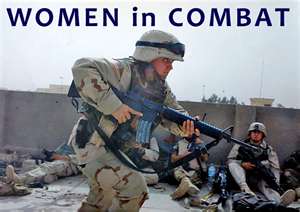
women in combat“Women in combat” is a life issue.  It is an issue to which God speaks.  In this post and several to follow, I would like to offer questions, answers, and commentary for Christians to ponder. 

The question, I think, that we need to be asking is not: “Can women be in combat?”  The question is: “Should women be in combat?”  I don’t know about you, but I’m looking for, shall we say, better ammunition for my argument than “if men can do it, so can women.”

Bearers and Defenders of Life

Discussions of men and women in combat bring mixed reactions.  Some people believe that women do not belong in combat because they do not have the physical capacity to endure the rigorous standards of training or the hardships of war.  Some believe that it is a woman’s “right” to defend her country and that she can do so as well as any man.  Besides, they insist, modern warfare seldom involves the physical force of front-line battle

Let’s put reason and logic to work: Consider the physical differences between men and women, such as their bone and muscle structures.  Gender-integrated basic training undermines rigorous standards.  But, this argument can be countered with examples of women who have developed body strength and can keep up with a man.

Consider the sexual attraction between men and women.  Gender-integrated training and combat duty creates an environment in which men and women are vulnerable to sexual misconduct and abuse.  But, this argument can be countered with practiced self-control.

This debate deserves more than opinion.   It deserves more than a simple “it’s my right.”

So, what are real soldiers saying?   A classmate of my son’s served on board ship in the Persian Gulf.  In a conversation, this 21-year-old woman confessed a breakdown in respect for both women and men.  Everything, she said, took on a “sexual connotation,” modesty was nearly “impossible,” and the rate of pregnancies on board ship was “higher than on shore assignment.”

Specialist Hollie Vallance was quoted in the Dallas Morning News (2-20-91) before being shipped to the Gulf War.  She said, “I never really thought about going into combat.  I never dreamed anything like this would happen in my lifetime, let alone right after I had my first child.”  She continued.  “I’ve built an ice wall around my heart to try to cool the pain, and sometimes I worry that [my husband and baby daughter] won’t be able to melt it away.”

In a commissioned survey of women in the Army, 79% of enlisted women and 71% of female noncommissioned officers said they wouldn’t volunteer for combat.  Only 10% of the female privates and corporals agreed with this statement: “I think that women should be treated exactly like men and serve in combat just like men.”  Less than one-quarter of mid-grade sergeants answered yes.  (The Washington Times, 10-5-98).

A young husband and relative of mine serving in the Persian Gulf was forced to share his tent with a woman soldier.  He told me “it was not a good situation any way you chose to look at it.”

Pfc. Jessica Lynch and Army Specialist Shoshana Johnson returned home from the War in Iraq in the spring of 2003 as heroines.  Although neither of them was technically in a combat position, they were, nonetheless, placed so close to the front line of battle that they were each captured by the enemy.  After being rescued, neither of them, it seems, wanted to be “poster girls” for women in combat.

Is there a problem with women serving in the military?  I don’t think so.  A strong, effective military respects and utilizes the abilities of women in medicine, teaching, and tactical maneuvers.  But, to pretend that women are no different from men, place them together in close quarters, lower standards of physical endurance, and compromise training is to place men, women, families, and country in harm’s way.

The question we need to be asking is not: “Can women be in combat?”  The question is: “Should women be in combat?”

In the end, it really doesn’t matter what our opinion might be or how we feel about it.  What does matter is what God says.

In gaining perspective on women in combat, do you find significance in the name of the first woman?  Genesis 3:20 tells us that Adam named his wife Eve.  Eve, in Hebrew, means “life.”  How this must have angered Satan who despises the humans that God so loves.  But, it was God’s plan that Eve became the mother of every living person.

During a Titus 2 Retreat, some women will tell me that having women in combat must be o.k. because, after all, Deborah went into battle against the enemy of the Israelites.  But, have they read the whole account found in Judges 4:4-22?  Did Deborah lead the troops into battle or fulfill the role of encourager?  Why didn’t the man Barak receive glory for the way his enemy died?  Was the enemy killed by a woman with a weapon on the battlefield… or not?  (Be patient.  We’ll come back to this in Part 3.)

The prophet Nehemiah told the men to do battle for their families.  He said, “Do not be afraid of them [enemies].  Remember the Lord, who is great and awesome, and fight for your brothers, your sons, your daughters, your wives, and your homes (Nehemiah 4:1-14).

Want to continue this discussion with some Q & A?  Then please continue to Part 2 of this series.

“Bearers and Defenders of Life” is Lesson 11 of
Men, Women, and Relationships first published in 1999 and revised in 2004.
If you’re curious about this collection of 12 studies on
Biblical manhood and womanhood,
please contact
Lutherans For Life or Concordia Publishing House.

Read Full Post »

sandy hook school shootingThe Sandy Hook Elementary School massacre caught the attention of most Americans.  It should.  The brutal killing of students and teachers is a national wound.  It should be.  Parents and families mourned the loss of 26 human beings whose lives were cut short.  We all should.  What happened at Sandy Hook was evil.  Evil should always be resisted.

On this 40th anniversary of Roe v. Wade, 54 million other deaths should also capture our attention.  Be felt as a national wound.  Bring us to our knees in mourning.  But, 3,500 preborn babies are aborted every day in this country and people act as if nothing is happening.  An evil of monumental proportions is taking place before our very eyes, yet people who call themselves by Christ’s name appear unmoved and indifferent.

How can this be?

Rolley Haggard, writing for Breakpoint, observes that apathy and silence on abortion are evidence of a theological problem.  He notes that some will argue that Scripture is silent on abortion; after all they say, the term does not appear once in the Old or New Testament.  Nor are there any commands to “vote pro-life” or “peacefully demonstrate in front of Planned Parenthood.”  So, some Christians actually believe they have discerned the “letter of the law” and are obeying it by keeping silent.

But, asks Haggard, what about the “spirit of the law”?   The purpose and intent of the law?  St. Paul was  inspired to write, “He who loves his neighbor has fulfilled the law.  If there is any other commandment, it is summed up in this saying, ‘You shall love your neighbor as yourself.’  Love does no wrong to a neighbor; therefore love is the fulfillment of the law.  The whole Law is fulfilled in one word, in the statement, ‘You shall love your neighbor as yourself.’  Bear one another’s burdens, and thereby fulfill the law of Christ” (Romans 13:8-10; Galatians 5:14; 6:2).

Haggard begs the question of us all: Can we hear and believe God’s commandment to love our neighbor and still maintain passivity on abortion?  “The sober reality,” Haggard writes, “is that ‘he who does not love his brother whom he has seen cannot love God whom he has not seen” (1 John 4:20).  Modern technology allows us to see inside the womb.  Having seen, can we un-see?  Are we not compelled to speak of what we have seen?

It’s possible, Haggard writes, that our error in not speaking has been an honest one.  “Perhaps our embrace of the letter rather than the spirit of the law has been unwitting.  Perhaps.  This much is certain: ‘When a man who is honestly mistaken hears the truth, he will either quit being mistaken, or cease to be honest.’” (Note: This quote is often attributed to Abraham Lincoln).

Have those of us who call ourselves “Christ followers” heard the truth?  Knowing the truth, how do we respond?  When we see babies (woven together in the womb by God’s own hands – Psalm 139:3-16) being denied their God-given right to life, how do we respond?  When we know that the majority of abortions are done for convenience (not the life and health of the mother), how do we respond?  When we know that abortion says “no” to a new generation of creativity and hope, how do we respond?

(My appreciation to Rolley Haggard, “Brilliant Darkness,” www.breakpoint.org 1/23/2013)

Read Full Post »

Please check out Ezerwoman’s new page entitled “Titus 2 Talk.”  I’ve been encouraged to record portions of the Titus 2 Retreat and certain Ezerwoman blogs.  Sometimes, I was reminded, it can be helpful to hear a personal voice, a “plea,” or a word of instruction and hope.

This is a new experience.  Please pray that it honors the Lord of Life.

Read Full Post »

Thanks, Alicia, for reminding me of The Word that stands… no matter what.

“Lord Jesus Christ, with us abide, for round us falls the eventide. O let Your Word, that saving light, shine forth undimmed into the night.

In these last days of great distress grant us, dear Lord, true steadfastness that we keep pure till life is spent, Your holy Word and Sacrament.

To hope grown dim, to hearts turned cold, speak tongues of fire and make us bold to shine Your Word of saving grace into each dark and loveless place.

May glorious truths that we have heard, the bright sword of Your mighty Word, spurn Satan that Your Church be strong, bold, unified in act and song.

Restrain, O Lord, the human pride that seeks to thrust Your truth aside or with some man-made thoughts or things would dim the words Your Spirit sings.

Stay with us, Lord, and keep us true; preserve our faith our whole life through – Your Word alone our heart’s defense, The Church’s glorious confidence.”

Lutheran Service Book, 585

Read Full Post »

Labeling sex education “child abuse” is a strong statement.  No one wants to be accused of abusing a child.   I would not easily call someone a “child abuser.”  All of us, however, are deceived by theories and techniques of the world.  Education built on false teaching is sure to do harm.

If we blend false teaching or worldly ideas with God’s Word, we will most certainly compromise our best intentions.  We will weaken the protective boundaries of God’s commands.  It is never a good thing to tamper with things of God, especially the instructions He gives us about children.

God’s Word never tells us to educate children in sex.  It tells us to instruct children in purity.  To guard their innocence.  To do nothing that might lead a child astray.

Here are some reasons why sex education – in or out of the church – is “child abuse.”

  1. “. . . [S]ex education is child abuse because it is ill-planned and poorly thought out, thus adding to the very problem it is trying to address and eroding the structure of a healthy family.”  (Douglas Gresham, step-son of C.S. Lewis and founder of Rathvinden Ministries, a ministry to post-abortive and abused women in Dublin, Ireland, in an e-mail to ezerwoman.)
  2. Early, explicit, and boy/girl sex education classes can steal the innocence of children and create mind absorbing images, conflicts, and preoccupations.  Boy/girl classes in sex education or “human sexuality” can be a form of desensitization that eventually strips away defenses and induces acceptance of alternative values.
  3. Sex education is taught in the “cool condition” of a classroom where children can say, “Yes, I’ll be smart,” but things change in “hot conditions.”  Children may be informed in the classroom but, because their pre-frontal cortex is not fully developed, they possess neither the reasoning skills nor good judgment necessary to take command over feelings or peer pressure in the heat of the moment.  (Dr. Miriam Grossman defines “cool” and “hot” conditions in her book, You’re Teaching My Child What?)
  4. Sex education removes the natural and protective covering of modesty.  After their sin, God covered Adam and Eve’s embarrassment with far more than a bikini.  He covered their shame with the promise of Christ’s Robe of Righteousness.  Putting boys and girls together in a classroom for an intimate discussion of “human sexuality” makes children vulnerable by stripping away modesty and stirring up self-awareness and curiosity.
  5. A goal of sex education is to get young people “comfortable with their bodies” or their “sexuality,” therefore, it should come as no surprise when scantily-clad girls approach the Lord’s Table much to the discomfort of pastors offering the Sacrament (or other gentlemen present).  Too many girls are no longer embarrassed but, indeed, “comfortable” with drawing attention to themselves at the mall, on the beach, socializing, or even in church.  In what way does this help a boy or man maintain chaste thoughts?  (A helpful resource is the Bible study Dressing for Life: Secrets of the Great Cover-up available from CPH Publishing.)
  6. Sex education is a utopian lie.  Secular sex education is built on the foundation of evolution and a worldview that opposes the Biblical worldview.  Instruction in purity is built on the Word of the Creator and Redeemer.  Christian educators may want children to grow comfortable with the beauty of God’s creation; to recover the Garden experience, but we’re not in the Garden anymore.  Sin changed our hearts and the way we look at one another.  Jesus says, “Out of the heart come evil thoughts, murder, adultery, sexual immorality, theft, false witness, slander” (Matthew 15:19).  Do we better equip children to fight the battle with sexual immorality by telling them they are “sexual beings” – or immortal souls?  Captive to their sensual nature – or able to “control [their] own body in holiness and honor” (1 Thessalonians 4:4)?
  7. Christian sex education, most specifically, tantalizes the child; in other words, it presents something desirable to the view, but continually keeps it out of reach It gives children much information about sex and “sexuality,” but then tells them to wait for marriage until after college and an established career.  Does this seem cruel?
  8. Sex education may tempt into idolatry or self-worship.  It’s “my identity.”  It’s “my need.”  It’s “my right.”
  9. Sex education may, unintentionally, get adolescents “hooked,” but then leave them “unprotected.”  (Hooked by Joe McIlhaney, M.D. & Freda McKissic Bush, M.D.; Unprotected by Miriam Grossman, M.D.)
  10. Sex education might change a child’s attitude toward God.  No matter what our sin, God is always our Father; we are always His children in Christ.  But, if a child is given all manner of sexual information before he or she can make wise use of it in its proper time, then might the child ask, “What kind of loving God would create me with all these sexual desires and then tell me not to fulfill them?”  Have we set the child up for frustration and anger toward God?  Might the child ask, “What does it matter what I do if I am assured of Jesus’ love and forgiveness?”  Might a child re-define God according to his or her perspective of what is “right” or “wrong” depending upon the situation?

What words of hope are there for the Christian who has been deceived?  Who may have trusted sex education as something helpful for children?  If we have built on wrong foundation or passed on a half-truth or lie, there is hope!  King David sinned against God and hurt other people.  But, with broken and contrite heart, David acknowledged his sins to the Lord (Psalm 32:3-5).  He received God’s free grace and forgiveness.  Leaving sinful ways behind, we become a “vessel for honorable use” (2 Timothy 2:23).

In Christ, we are “vessels for honorable use.”  Wow!  This identity does indeed raise us above that of just a “sexual being.”  Imagine the change in thought.  Word.  Behavior.

(Excerpted from Faithfulness: One Child at a Time,
a work nearing completion by Linda Bartlett.
A PDF file is available at Issues. Etc., or Titus 2 for Life.)

Read Full Post »

The question was asked, “What is the difference between ‘modern sex education’ and ‘comprehensive sex education?'”  The answer: Both are education in sex.  Education in sex is quite different from God’s Word to instruct in purity and guard modesty.  So, perhaps, when we know a particular class is called “sex education” or “sexuality for boys and girls,” or a set of books is labeled “a sex education series,” or even “Christian Sex Education,” we ought to ask: What are the desired outcomes?

One of the desired outcomes of modern sex education is to help boys and girls become more comfortable with their bodies.  With their “sexuality.”  A well-known Christian author/teacher in the field of sex education once confronted me.  He said: I understand that you’re displeased with our church’s sex education.  In that particular time and place, I could only respond quickly with my concern about modesty.  “Yes, I am concerned.  Couldn’t we, at the very least, teach boys and girls separately so as not to break down their natural inhibitions and destroy protective boundaries?  Doesn’t God desire that we protect the innocence of children?”  His response?  He said he was pleased that his son, at age ten, knew more about sex than he did at that age.  I wondered aloud: “Is that a good thing?”

Modern sex education has, indeed, achieved a desired outcome.  Everywhere I look, I see young women who are comfortable with their bodies.  Their “sexuality.”  They are comfortably exposed at the Lord’s Table much to the discomfort of pastors offering the sacrament.  They are comfortably exposed at the mall, on the beach or at the pool, on dates, playing sports, at church youth events, or in Bible study.

Girls are, indeed, comfortable with their “sexuality.”  Christian girls shop at Victoria’s Secret or Abercrombie & Fitch just like non-Christian girls.  They purchase sensual dresses for prom or other social events, often to the delight of moms who gush pride in their “sexy” daughters.  Girls are not embarrassed by sexually-suggestive remarks.  They speak, text, and post sensual messages.  They are so “comfortable” with their bodies — their “sexuality” — that very little is left to the male imagination.

It’s difficult to mentor, guard, or practice modesty when sex education’s goal is to make classrooms of boys and girls together more comfortable with themselves.  When God speaks of modesty, isn’t He calling us to be “holy” as opposed to “sexy”?  Isn’t He calling us to dress and act in ways that call attention not to our glory, but His?  And, as with all things godly, isn’t there a reason for this?

Those who promote Christianized-sex education insist that their emphasis is on chastity.  They claim this is a far cry from secular instruction on how to use a condom or where to go for an abortion.  But, the innocence of children is stolen away by even the most passionate Christian who wants to come out of the Victorian closet of prudish inhibition.  There are many well-meaning Christians who, with the sincere hope of preventing sexually-transmitted diseases and unwed pregnancy, support some form of sex education.  But, Douglas Gresham, the step-son of C.S. Lewis explained to me that he views “modern sex education as child abuse because it is ill-planned and poorly thought out, thus adding to the very problem it is trying to address and eroding the structure of a healthy family.”

What does he mean?  Perhaps this.  So-called “sex education” before Alfred Kinsey was generally a discussion of human biology and procreation, hygiene, and marriage.  It was a discussion to be had in the home with the parent in the role of teacher.  Who would better guard the virtue of children?  Who would better explain “sex” (defined by a pre-sexual revolution dictionary as ones “maleness” or “femaleness”)?  Who would better assist a son or daughter in being patient until marriage and, thus, help build a structure for a healthy family?  But, after Alfred Kinsey, this life-shaping responsibility was transferred to school teachers and so-called “experts.”  Prior to the release of Kinsey’s research, Sexual Behavior in the Human Male in 1948, no child development experts suggested that children were sexual from birth or that they benefited from childhood sexual activity (or, I’d like to add, from childhood sexual discussions between boys and girls in classrooms).  (Note: For documentation on this and more, I recommend you read Kinsey: Crimes and Consequences by Dr. Judith A. Reisman, 2000)

In 1986 Planned Parenthood (PP) commissioned a poll to determine how “comprehensive” sex education affected behavior.  “Comprehensive” means placing emphasis on the practice of “safe sex.”  Much to the PP’s dismay, the study showed that children exposed to such a program had a 47% higher rate of sexual activity than those who’d had no sex education at all.  (Planned Parenthood Poll, “American Teens Speak: Sex, Myths, TV and Birth Control.”  Lou Harris and Associates, December 1986, p. 59, table 6-1.)

So, I wonder:

  • Do Christian children exposed to modern sex education (post-1960, teacher/expert, boy/girl classroom-style) have a higher rate of sexual awareness, sensual dress, and sexual inhibition than those who’ve had no sex education at all?
  • Has sexual activity increased more among Christian young people who’ve been sexually-educated in the last three decades than those who’ve had no sex education at all?
  • Do Christian young people who’ve been made more comfortable with their “sexuality” suffer from more sexually-transmitted diseases, depression following multiple bonding, unwed pregnancy, and post-abortion grief than those who’ve had no sex education at all?

I’m thinking that it just might not be a good thing — no, not a good thing at all — if my nine-year-old grandson knows more about sex than I did at his age.

Read Full Post »

Liberal thinkers like to call themselves “progressive.”  They have “evolved” to a higher and more enlightened view and practice of life.  Is this true?

Between the years of 1904 and 1909, archaeological excavations at Gezer (once known as the Canaanite region) revealed the ruins of a temple.  This temple, or “high place” was built to worship Ashtoreth, the “wife” of the idol named Baal.  Great numbers of jars were discovered under the debris of the temple.  These jars contained the remains of children who had been sacrificed to Baal and Ashtoreth.  The whole area (an enclosure 150 feet by 120 feet) proved to be a cemetery for babies.

“Foundation sacrifices” were performed by Israelites who had adapted the ways of the people around them.  When a house was to be built, a child would be sacrificed and his or her body “built” into the wall with the belief that “good luck” would come to the rest of the family.  Many tiny bodies were dug up in Gezer, Megiddo, Jericho, and other sites.

How could a mother lay her child in the arms of Baal, a stone-cold idol who stood above a flaming fire?  How could the father permit it?  Infant sacrifice was practiced by parents seeking a change of circumstances.  A better life.  Prosperity.

Are we more civilized today?  Are we truly more “progressive?”  We have sacrificed 53,310,822 preborn babies in the United States since 1973.  Biology and ultrasound technology remind us that the abortionist is not removing “globs of tissue” but sons and daughters.  These children are sacrificed, not at the temple of Ashtoreth or Baal, but at the temple of Self.

Approximately 95 percent of abortions in the U.S. are not for rape, incest, or the life of the mother, but for convenience.  Mothers and fathers in Canaan sacrificed their children to idols for personal gain or out of fear.  Today’s practice of abortion is really no different.  Mothers and fathers lay their babies in the arms of stone gods named “my choice.”  “My convenience.”  “My best interest.”  One life is sacrificed for another.  “If I have an abortion, I will regain control of my life.”  “If I have this abortion, my future won’t be at risk.”  “Having this abortion is the sacrifice I must make for myself.”

But, God demands no such sacrifice.  He has already paid the ultimate and only necessary sacrifice for a future of hope.  God does not require mothers and fathers to sacrifice their children so that others might live well or fear less.  God made the sacrifice for us.  The Cross of Jesus Christ is the reminder of amazing grace on pitifully desperate people.  The Cross tells us that no one else — not even a “fetus” (Latin: young one) — needs to be sacrificed.

No peace for the soul was found in the temple of Ashtoreth.  No hope for the future was found in the temple of Baal.  Peace and hope elude the mother or  father who bend at the temple of Self.  “The sorrows of those will increase who run after other gods” (Psalm 16:4 NIV).  Ashtoreth. Baal.   Self.  All seek to deceive, then forsake.

But, those who trust in the God who calls each child by name will not be deceived.  God’s Word opens eyes and changes hearts and minds.  When fear presses down and momentary evil seems justifiable, God’s Word convicts… then comforts.  God does not forsake those who cry out to Him. He may not answer in the way we want or expect, but He promises His faithfulness in all circumstances.  Apart from God, there is no good thing.

With God, goodness and mercy rise up.  Push back against evil.  Overcome.  When wrong choices of the past made in fear and desperation are confessed and taken to the Cross, they are forgiven. Forgotten.  Covered by Jesus’ robe of righteousness.

I sought the Lord, and He answered me; He delivered me from all my fears.  Those who look to Him are radiant, and their faces shall never be ashamed . . . The angel of the Lord encamps around those who fear Him, and delivers them (Psalm 34:4-5, 7 ESV).

Read Full Post »

Christians have taken up with a man named Alfred Kinsey.  Knowingly or not, we embraced his worldview and adapted it as our own.  We rejected whatever seemed perverted, but quickly wrapped Jesus around whatever appealed to our (sinful) human nature.

Has the church paired with the “Canaanite woman?”   Have little icons of Kinsey’s religion been placed in the house?  Are not we all under the influence?   Have not the heads of two or three generations been turned by a worldview contrary to Christianity?

Kinsey’s worldview promoted the idea of total sexual autonomy even for girls and boys.  His beliefs were shared by Margaret Sanger, the founder of Planned Parenthood.  Together, they determined to free every man, woman, boy, and girl from the restraints of Biblical bondage.  They have accomplished what they set out to do.  It was not difficult.  One phrase — one simple distortion of truth — was repeated over and over: “Children are sexual from birth.”  If indeed “sexual,” then “sexual needs” cry out to be met.  “Sexual rights” must not be denied.  “Sexual expression” must take its “personal course.”

Once deceived, it was not long before fear took root.  “If children are intrinsically sexual beings, they will probably ‘do it;’ therefore, we have to help them ‘do it’ safely.”  No parent wants to see their son or daughter suffer HIV/AIDS or the new “illness” called pregnancy.  PP stood ready to help with a plethora of services including the s0-called “planning of parenthood” or practice of “reproductive choice,” a.k.a. abortion.

Parents — those to whom children are entrusted — doubted Biblical instruction in purity and stepped into the quicksand of sex education.   One worldview was exchanged for another and association with PP was rationalized.  But, Jesus — The Word — does not wrap Himself around opposing worldviews.

Jesus — The Word (John 1) — does not say that children are “sexual from birth.”  He says that children are knit together by God in the wombs of their mothers as human beings of the male or female sex.   He says that dads and moms are to guard the innocence of boys and girls, equal but different, as they also mentor Biblical manhood and womanhood.  Good parents do not rev up their son’s engine nor encourage their daughter’s provocative dress.  Good parents, according to the Christian worldview, instructs sons and daughters in patience.  Purity.  Wisdom.

Stealing away — child by child — from the Biblical worldview is the institutional monolith created by the Kinseyites and Sangerites.  Can we be so foolish as to not learn from history?  Just as the Canaanites had their way with the Israelites, do these modern “ites” have their way with us?  Does the modern church think itself beyond temptation? Can Christian parents — in any way — defend the work of PP?

Some Americans are calling for a full-scale Congressional investigation of PP.  In recent years,  PP clinics have been caught placing girls and young women at further risk.  PP employees have assisted pimps and sex traffickers, misled girls and women about the dangers of abortion, refused to comply with parental-notification laws, and misused millions of taxpayer dollars.  Evidence reveals PP’s failure to report child sex abuse.  Instead, PP clinics have been caught advising under-age girls and those who exploit them on how to circumvent mandatory reporting laws on rape and abuse.

PP needs to be investigated.  But, at the same time, Christians should be calling for full-scale investigations of their church’s educational sources, teaching, and practices.

We should clear our houses of Canaanite icons.

As people of God’s Word — both Old and New Testament — we should repent of our failures to guard the innocence of the little ones He calls by name.

We should contrast the Biblical worldview with all others.

Then, remembering that we have forgiveness in Jesus Christ, we can leave wrong ways behind.  Resist temptation and doubt.  Push back against ungodly-ites.  Restore and rebuild.

Early Christians knew they should stand in protection of their children.  That is why they instructed sons and daughters in patience.  Purity.  Wisdom.  That is why they encouraged modesty of dress and behavior.  That is why they taught that God’s Word can be trusted.

Modern Christians are compelled to do the same.

Read Full Post »

Elizabeth Skoglund and I have met only once.  But, our friendship grew by way of phone conversations over a period of years.  Elizabeth is the author of over twenty books.  One of them caught my eye in a bookstore when I was researching end-of-life issues.  That book, Life on the Line, proved to be powerfully helpful to me.  Elizabeth and I share the same worldview on life issues, but her experience as a counselor in private practice and as a gifted researcher and writer equipped me to be a better defender of the sanctity of human life.

Life on the Line was so helpful to me that I wanted others to be encouraged by her, too.  I invited Elizabeth to be a workshop presenter at one of our Lutherans For Life conferences.  Illness prevented her from coming, but some time later, I asked Elizabeth if she would author a short handbook on decision-making at the end of life to be published by Lutherans For Life.  She did.  The book is titled Before I Die.  I highly recommend both Life on the Line and Before I Die in this time of technological advances, shifting standards, and babel of confusing and often contradictory voices.

Elizabeth notes that volumes could be written on all the “what-ifs” of medical technology.  “But,” she writes, “we are on much safer ground if we follow certain general Biblical principles . . . whether or not we like them.  If we do not, we are in desperate danger of trying to become gods and making our own rules based on what we feel and what we want at any given time.”

Those Biblical principles, writes Elizabeth, “can be summarized in three phrases: the sanctity of human life; the sovereignty of God, including His timing in matters of life and death; and the goodness of God, who will not fail to do right.”

Elizabeth explains that questions like “What would Aunt Sally want?” are not designed to find out the will of God in bioethics.  They merely express what we want or feel.  The Christian believer does better to ask, “What is the will of God?”

There are gray areas in times of decision-making.  Use of the respirator, for example, is troubling for many of us.  The respirator is uncomfortable.  It’s use is controversial among doctors.  Elizabeth admits that being on a respirator is one of her own great personal fears.  She expresses sympathy for those who let it be known that under no conditions do they wish to be put on a respirator.

But, writes Elizabeth, if a respirator can be a bridge back to life, she believes we have an obligation to try to live.  On the other hand, if the respirator is used when death is inevitable, simply to slow down the dying process, then it is wrongfully keeping a person from being released to be with God.

I haven’t spoken with Elizabeth for some time.  A good visit is long overdue.  In these times, we need to challenge one another to think.  To encourage one another to trust our Creator God and Savior Jesus Christ.  To work where we’ve been placed in helping others respect the dignity of human life — that of the preborn and that of a loved one nearing their death.

Our last moments on earth are important ones.  For some, it is a time of decision.  For others, it is a time of transition from this life to the next.  It is a valuable time for the family who gathers at the bedside of one who is so close to going home.  Elizabeth quotes John White (Decision, May 1989):

“In life we are on a stage.  Angels and demons watch as we enact the drama of our earthly existence, and it is important that the scene close properly.  Christ has shown us how the lines should be uttered, as a cry of joyful triumph: “Father, into Thy hands I commit my spirit!”  (Luke 23:46 RSV).  We will only die once and will therefore have only one chance to die properly.  We must learn our lines well beforehand so that the curtains fall on a note of triumph.”

Read Full Post »

« Newer Posts - Older Posts »