Feeds:
Posts
Comments

Posts Tagged ‘men’

All students at Redwood Heights Elementary School in Oakland, CA., were recently instructed in a sexual indoctrination course.  The training host and consultant was a Bay Area-based organization called Gender Spectrum.

In the lesson called “Gender Spectrum Diversity Training,” documents released by the school say that students were taught that “gender is not inherently nor solely connected to one’s physical anatomy.”  Another document from the school advises parents that “when you discuss gender with your child, you may hear them . . . exploring where they . . . fit on the gender spectrum and why.”  Gender Spectrum tells parents that children need to learn that sexual “variation is normal.”

Students in all grades were told there are different ways to be boys and different ways to be girls.  Some of the reading list includes Boy, girl or both? and My Princess Boy (grades K-1), What is gender? and 10,000 Dresses (grades 2-3), and Three Dimensions of Gender (grades 4-5).

Gender Spectrum hosts training events and consultations aimed at questioning the role of gender in society.  They encourage gender neutral restrooms in schools.  The course program at Redwood Heights Elementary School was funded through a grant from the California Teachers Association.

The Pacific Justice Institute (PJI) asks: Should a child in kindergarten be introduced to the question of whether or not they really are a boy or a girl?  Does this have a place in public schools?  Are they engaging in an area that will, without question, result in children having problems that they likely would not have had otherwise?

According to PJI, there is no legal “right under California law for parents to opt out from this kind of pro-transgender indoctrination.”  PJI is offering advice to parents who want  help protecting their children from gender-diversity lessons.

In the Book of Beginnings, God’s Word explains that He created humans “male and female” (Genesis 1:27).  No where after that — in Old or New Testament — does God say that He changed His mind or decided to experiment with and alter His creation.

Is what happened at Redwood Heights Elementary School acceptable by parents?   What parents have requested that their child experience a “gender indoctrination” program?  What is the origin and purpose of this kind of teaching?

In May 2009, President Obama appointed Kevin Jennings to the position of Safe Schools Czar with the U.S. Department of Education.  Jennings is the founder of the Gay, Lesbian, and Straight Education Network (GLSEN) and wrote the introduction to the book Queering Elementary Education.  Early in June, Jennings met with the White House to address LGBT (lesbian, gay, bisexual, transgender) topics.

Jennings is leaving his post in July, but in what ways has he influenced the security of our education system?

(For details, visit OneNewsNow.com, Focus on the Family, or The Family Research Council)

Read Full Post »

Where are the mentors?  They are us!

They are older women — in age, experience, or spiritual maturity.  Unfortunately, too many of us seem to fear the concept of mentoring.

Yes, we may mentor a child at school.  Yes, we may mentor through a “Big Sister” program.  But, mentoring Biblical womanhood is counter-cultural.  There is strong resistance.  Obstacles stand in the way.  There are two: the younger women and the older woman.

The younger woman is, quite honestly, the least problematic.  Why?  Because younger women naturally resist mentoring.  The younger generation always considers itself more enlightened.  It’s typical for a young woman to consider herself more progressive than her mother or grandmother and, therefore, want to leave “old ways” behind.  Even when a younger woman is willing to learn some things from an older woman, she may still believe (as I’ve been told): “The culture is different than it was when you were my age.”  Well, the culture is always different with every new generation.  But, Truth never changes.

The greater obstacle to mentoring Biblical womanhood is the older woman.  It is the older woman who resists the opportunity to mentor.  Why?  Maybe because we are afraid.  Perhaps we’re afraid to mentor because it means we have to act our age.  Perhaps we’re afraid to mentor because it means re-visiting our past mistakes and becoming vulnerable all over again.  Perhaps we’re afraid to mentor because we fear rejection by younger women.

Some of us might be afraid because we are untrained.  Perhaps no one mentored us with God’s Word.  Perhaps we were led off the good path of life on painful and dangerous detours by older men and women we trusted more than God.  Perhaps a parent, professor, friend or even a pastor that we trusted had been deceived by “silly myths” and passed them on to us.  Out of respect for them, we may feel defensive about what they taught us.  The ideas to which we cling.  But, letting the light of God’s Word illuminate the dark corners of our minds, may we move out of a defensive posture.  Lift up in prayer the person who passed wrong ideas on to us.  Let go of “silly myths” and deception.

I’m a baby-boomer.  Talk about a generation influenced by “silly myths!”  My generation was raised with no boundaries; told to obsess on our bodies; dared to compete with men; and sent to the university where marriage, family, and the church were mocked and boldly dismantled.

The fact is, we can’t mentor if we’re afraid to act our age.  If we don’t want to accept where we’re at in life.  If we’re afraid to re-visit our past and acknowledge our failures.  If we’re afraid of rejection.  In other words, we can’t mentor if it’s all about me.

I can’t mentor if it’s all about me.  My fears.  My inabilities.  My past.  I can’t make a positive difference in my world if it’s all about me.  I can, however, make a life-changing difference if I’m all about God.  God’s Word.  God’s Word in Jesus Christ.  It is God’s Word that tells me who I am and why I exist.  Trusting the Word, I don’t need to fear myself or the world.

As an older woman, I think God wants me to accept my age.  My experiences.  My failures.  My disappointments.  Then, making use of all of these, He wants me to warn.  Train.  Equip the younger women He places in my life.  There is only one thing necessary for me to mentor: His Word.  Trusting God’s Word and using it makes me wise.  Willing.  Confident.  Less focused on self and more focused on others.

The world is not my friend.  Recognizing this, I (and all older women) mentor with the Word of God.  Away from “silly myths.”  Toward hope.

Read Full Post »

Titus was a young pastor who served his people on the island of Crete.  Young Titus and his congregation found themselves in the midst of a pagan culture.  “One of the Cretans, a prophet of their own, said, ‘Cretans are always liars, evil beasts, lazy gluttons” (Titus 1:12).

How could Titus and the men and women of his congregation not only remain faithful to God in the midst of evil, but affect the culture?  Shine light?  Share hope?  Titus was in need of a model, something that his people could use in the midst of selfishness, unhealthy lifestyles, and false teachers.

St. Paul warned Titus away from the worldly influence, but also was inspired to give him a model for mentoring generations of hope.  That model is found in Titus 2:1-8.  That model — indeed, the wholeness of the Gospel — brings salvation and leads to self-controlled living.

Titus 2, however, is one of the least popular chapters of Scripture.  It is not particularly favored by Christian women.  There are at least three reasons.  Most obvious is the fact that Titus 2 speaks to men and women separately… because we were created equal, but not the same.   Painfully obvious is the part about women “submitting” to their husbands.  (Ouch.)  But, a third reason that Titus 2 may be dismissed or ignored is that older women are instructed by God to mentor younger women.  Oh my!  How is an older woman — who has not made right choices; who has had an abortion or lived with a man not her husband; who has been abused, or become addicted, or suffers depression — going to mentor a younger woman?

This weekend, at a Titus 2 Retreat, we’ll be talking about why an older woman (in age, experience, or spiritual maturity) might feel too intimidated to mentor.

I’ve heard older women say, “I can’t mentor!”  But, every one of us mentors… at any given moment… whether we realize it or not.  We are mentoring some kind of faith, lifestyle, or way of thinking.  We are being an example… of something.

There is a reason God calls an older woman to mentor the younger.

Let’s push aside all of her past circumstances, sins, fears, and failures.  If she is a new person in Christ, she is forgiven and set free to live in a way that glorifies God.  In 1 Timothy 5:9-14, we read that the Church was to distinguish older widows from younger widows.  The older woman is distinguished by her “faithfulness” and “reputation for good works.”  She is distinguished if she has “been the wife of one husband, brought up her children, shown hospitality, washed the feet (served) the saints, cared for the afflicted, and devoted herself to every good work.”

The younger widow, however, is different.  She is more easily drawn away from Christ by her romantic passions (v. 11).  She may be more easily tempted away from the “faith” (Greek: “oath” or “solemn promise”) if she had promised not to remarry, or to abide by the Christian faith and teaching.  The young widow (v. 13) without a father, husband, children, or a job might be prone to social problems such as being idle, falling to gossip and the behavior of a busybody, or losing control of her tongue.  The Church was to encourage young widows to “marry, bear children, manage their households, and give the adversary (Satan) no occasion for slander” (v. 14).

In what way would the young widow, perhaps more easily influenced by the world, be helped?  By the mentoring of an older, experienced, spiritually mature woman.  A woman who had also been wrongly influenced, but was brought out of darkness into light.   Who was rescued from the mess of life and covered by Jesus’ robe of righteousness.  The older woman is not distinguished because she is sinless, but because she has learned to trust God.  Not be deceived by silly myths.  Have faith in God’s created order.  And keep her eyes on the Cross of Jesus Christ.

An older woman does not need to fear being a mentor.  Her very experience — from floundering and failing to recognition of her identity as a treasure of Christ — makes her an instrument in God’s hand.  Using God’s Word, she becomes an example of humility.  Service.  Patience.  Self-control.  Hope.

Read Full Post »

A woman who faces the reality of her abortion is in need of someone else whom God has named.  That person is you.  It is me.  We are her friends.  Comforters.  Encouragers.  We are imitators of the Good Shepherd who walks beside the heavy-hearted through a dark valley toward “goodness and mercy.”  A mother who mourns the loss of her child needs a Good Shepherd (John 10:1-18).

You and I must take care not to soften the seriousness of sin.  This devalues the magnitude of God’s forgiveness, bought and paid for by the sacrificial life and death of Jesus Christ.  At the center of our forgiveness stands the Cross of Christ.  Forgiveness is costly.  Our forgiveness cost the innocent Son of God His life.  There is no forgiveness without blood being shed, without paying a price, without the sacrifice of Jesus Christ.  But, because of Jesus’ sacrifice, sin cannot defeat us.

Peter, a follower of Jesus, sinned greatly, but he confessed his sin and received God’s forgiveness.  Through Jesus’ forgiveness the Holy Spirit enabled Peter to live a changed life.  That same power of the Holy Spirit works through the Gospel to change our lives — to enable us to live lives that reflect God’s love for us and withstand the temptation of Satan, the world, and our sinful flesh.

You and I can love and accept people burdened by their sin, but only God, in Christ, can heal them.  A woman who’s suffered an abortion may believe that God has forgiven her, but has difficulty forgiving herself.  Jesus is the key that opens the door and sets all sinners free.  What was the process for David in Psalm 51?  David was sorry for his sin, confessed that sin, turned from that sin, received God’s forgiveness, and was restored from sin.  Then he rejoiced over God’s healing touch of forgiveness and was eager to witness to others of God’s great forgiveness.  You and I can assure those who grieve that the memory of their aborted child will remain with them, but,

The steadfast love of the Lord never ceases; His mercies never come to an end; they are new every morning; great is Your faithfulness” (Lamentations 3:22-23).

Word of Hope is a ministry of hope and healing after abortion.  I have volunteered with this ministry for many years.  We know that God has called each child by name.  We grieve their loss, but entrust them to God.  We also know that He has called every mother, father, grandparent, and care-giving friend by name.  May we encourage all in a manner that honors the One who named us.

If you would like to talk with Grace Kern at Word of Hope,
please call (888) 217-8679 begin_of_the_skype_highlighting            (888) 217-8679      end_of_the_skype_highlighting

Read Full Post »

Today, a stint in the military comes with educational benefits.  Young women as well as men see opportunity.  There is also patriotism, especially after 9/11.  Both men and women find value and meaning in serving their country.

There are many ways for women to serve their country.  But, when foolishness rules, “rights” quickly become “wrongs.”  What we think we can do might not be what we should do.

Here’s a question.  When a man hears the sound of someone breaking into his house, does he send his wife, daughter or mother to face the enemy?

Late one evening, my brother and sister-in-law heard the sound of breaking glass.  Looking out their bedroom window, they could see a strange man attempting to break in their back door.  Did my brother send my sister-in-law to the door?  (After all, she is smart and athletic.)   Did he send his wife to confront the enemy?  No.  My brother went to the door where he found the intruder reaching through the glass to turn the inside lock.  He grabbed the intruder’s hand.  There was a brief skirmish before the enemy fled.   Soon, the police arrived.

Did my brother believe that his wife had no role to play in protecting their home?  Did he see her incapable of helping?  No.  He instinctively knew that he was to protect his wife and family, but he also knew that his wife was part of the “team.” So, from a secure area, he asked her to call 911.   The police arrived because she made that call.

An enemy at the door is not Xbox.  Nor is it equal opportunity for women.  When the enemy stood at my brother’s door, he knew better than to be distracted by the irrelevant issue of “sexual equity.”

I am certain it would be in the best interests of our nation — and surely the men engaged on the front lines of battle — not to be distracted by irrelevant issues.  Foolishness puts us all in harm’s way.

Read Full Post »

Twisted feminism is foolish.  It puts civilization in harm’s way.

It is foolish to believe that a woman can have freedom only if her child is aborted.  It is foolish to believe that men and women are the same.  It is foolish to fantasize women warriors.

“The ancient tradition against the use of women in combat embodies the deepest wisdom of the human race.  It expresses the most basic imperatives of group survival: a nation or tribe that allows the loss of large numbers of its young women runs the risk of becoming permanently depopulated,” writes George Gilder in Men and Marriage.

“Beyond this general imperative is the related need of every society to insure that male physical strength and aggressiveness are not directed against women . . . All civilized societies train their men to protect and defend women.  When these restraints break down . . . the group tends to disintegrate completely and even to become extinct.”

What about the so-called successful use of women in today’s military?  It, writes Gilder, “depends on men overcoming their natural impulse to treat women differently and more considerately.  The consequence of this latest demand for equality would be nothing more or less than a move toward barbarism.”

I like George Gilder.  Again and again I return to “Men and Marriage” because, from a purely sociological and economic perspective, Gilder explains how the foolishness of women competing with men ravages family and destroys harmony.  If my sources are correct, Gilder became a Christian later in life.  (What God has created is naturally revealed unless our eyes are shut and minds are closed.)

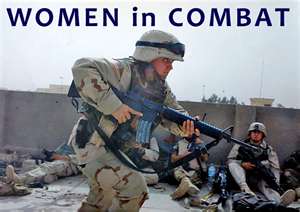
“Women in combat” is one of the “hot button issues” discussed during a Titus 2 Retreat.   The topic stirs mixed feelings.  Some believe women don’t belong in combat because they don’t have the physical capacity to endure the rigorous standards of training or the hardships of war.  Some believe it’s a woman’s “right” to defend her country and that she can do so as well as a man.  Others note that “modern” warfare is more technological than “front-line.”

Generally speaking, there is significant difference between male and female bone and muscle structure.  This reality has undermined the rigors of basic training and is why Stephanie Gutmann titled her book A Kinder, Gentler Military.  Of course, the physical strength argument can be countered with examples of women who have developed body strength and can keep up with men.

There is also sexual attraction between men and women.  Putting men and women together for training and in combat creates an environment in which each are vulnerable to sexual misconduct and abuse.  But, this argument can be countered with the practice of self-control.

So, for me, the question isn’t, “Can women be in combat?”  The question is, “Should women be in combat?”  I enter this discussion from my vocation or role of “helper” (Hebrew: ezer).  That’s what God created woman to be.  I am a helper for man and, therefore, for all that man is called by God to do.  Will I help for good, or for harm?  Away from temptation, or into?  With focus on others, or self?  Nurture life, or put it at risk?

I pause to let you ponder.  But, there’s much more to consider… in another post.

Read Full Post »

Maura and Nichole don’t know about oxytocin.  But, Matt doesn’t know about vasopressin.  Women are not the only ones who bond during sexual intimacy.

Vasopressin is the neurochemical responsible for the male brain response and synaptic change.  It plays a role in regulating blood pressure and, through its influence on kidney function, regulates fluid in the body.  In relationships, vasopressin works to bond a man to a woman and create attachment to his offspring.

Vasopressin is often referred to as the “monogamy molecule.”  Why?  Because it appears to be the primary cause of a man’s attachment to a woman with whom he shares close and intimate physical contact.  The God who creates and loves life has provided a way for the human race to survive.  This “monogamy molecule” is important not just to create a bond with a woman, but with the children that come from that bond.  In the healthy and selfless bond of husband and wife, children have a greater chance of being raised by two biological parents — both of whom are attached to those children.  Such attachment provides sons and daughters with an increased chance of better health and a more hopeful future.

If Matt is physically intimate with a woman — wisely or unwisely — he can bond with her.  If Matt is unwise in his choice, the bond may lead to a long-term, but unhealthy and destructive relationship.  Bonding may tie Matt to a woman who disrespects or abuses him.  It wouldn’t be unusual for Matt to keep going back to a woman who treats him poorly and, if asked, he wouldn’t know why he does it.  Simply put, vasopressin floods a man’s brain (just like oxytocin floods a woman’s brain) and produces a partial bond with every sexual partner.

Men, like women, can become addicted to the “rush” of sexual intimacy.  But, being sexually intimate with many women places at risk the vital ability to develop a healthy, long-term attachment to one woman.  Studies show that the brain can “mold and gel” so that, in time, it begins accepting that particular sexual pattern as normal.  Such a pattern, however, “seems to interfere with the development of the neurological circuits  necessary for the long-term relationships that for most people result in stable marriages and family development.  The pattern of changing sex partners therefore seems to damage their ability to bond in a committed relationship.”  (p. 43 of Hooked by Joe S. McIlhaney, Jr., M.D., and Freda McKissic Bush, M.D.)

“The inability to bond after multiple sexual encounters,” writes Drs. McIlhaney and McKissic Bush, “is almost like tape that loses its stickiness after being applied and removed multiple times.”

Matt’s brain is the most powerful sexual organ in his body.  But, in keeping with God’s design, the brain needs to be used, molded and adapted in the right ways — for life — or, with wrong behavior, parts of it will wither and die.  Perhaps, for this reason, God’s Word says in Deuteronomy 30:19-20:

I set before you life and death, blessing and curse.  Therefore choose life, that you and your offspring may live, loving the Lord your God, obeying His voice and holding fast to Him . . .”

Shame on adults who tempt Matt.  Who open the gates to adventures in sex, but fail to explain his “monogamy molecule.”  Who keep from Matt God’s Word for life.  Who ignore the lesson of the sticky tape.

Read Full Post »

Some say, “How could a woman end the life of her child?”  This statement is not intended to be cruel, but it is heard as a  judgment.

Others, hoping to be less judgmental, say, “I would never have have an abortion myself, but I believe every woman should have the right to choose.”  This statement sounds compassionate, but to the woman who has had the abortion, it sounds like a comparison: “Abortion is wrong and because I am a good person I wouldn’t do such a terrible thing, but women not capable of doing the right thing should have a choice.”

Both statements are condeming.  Neither offer hope before or after an abortion.

There is a third response.  Trying to imitate Jesus.  Jesus understands why people like you and me sin.  He came to live among us —  to feel our frustration, fears, and sorrow.  He placed Himself in the midst of a messy world.  Jesus loved us so much that He willingly took on our disgrace, our burden, our sin.  Only by living under His Cross am I able to see those hurt by sin (including my own) in a new way.

Days on which we celebrate life are meant to be happy days, but for many they are not.  In the heart of nearly every post-abortive woman is an empty place that is forever expectant and waitiing.  Although she may have believed the lie that there was no room, a cry of sorrow echoes in the room that was always there… waiting.

We cannot go back to erase years of legalized abortion nor the effect on women, men, children, and society.  Mothers who once believed there was no room in their life for a baby now mourn the child whose heart beat so close under their own.  Fathers who once believed there was no room in their life for a baby are now angry at themselves for failing to protect their son or daugher.  Grandparents who once believed there was no room in their lives for a baby now dream of grandchildren that would have filled the rooms of their homes with laughter.

Sometimes, when I am holding my grandsons, my thoughts turn to Mary.  She approached me after I was finished speaking to a group of women.  She asked for my address and phone number.  In the letters and conversations that followed, she confessed two abortions.  “There has been so much pain in my heart,” Mary wrote.  “I could understand how God could forgive a murderer, but not someone who has killed their own child.”

This pain and the belief that she had committed the sin “too big to be forgiven” held Mary captive.  But, “the reason I want to tell you my story,” Mary continued, “is to thank you.  If, years earlier, I had heard the words of compassion and forgiveness that I heard from you, I would not have had a second abortion.  I would have been reconciled to God and turned my life around a lot earlier instead of wallowing in the muck of sin and accusation.”

“Marys” are everywhere… and they are waiting.  They are silently waiting for a word of hope.  Their broken hearts long to be healed.  God has given to me — to you — His Word to speak in love.  To be sure, the Word of Truth presses hard on the source of pain.  The psalmist (Psalm 32:3-5) writes:

When I kept silent, my bones wasted away through my groaning all day long.  For day and night Your hand was heavy upon me; my strength was dried up as by the heat of summer.  Then I acknowledged my sin to You, and I did not cover my iniquity; I said, ‘I will confess my transgressions to the Lord,’ and You forgave the iniquity of my sin.”

There is hope for women and men who have been pierced by abortion’s blade.  It is Jesus.  In Jesus, all who confess their sin are cleansed and forgiven (1 Timothy 1:15).  In Jesus, the captive is set free (Galatians 5:1).

(The thoughts of this post are available in a
brochure form upon request from Word of Hope or LFL.)

Read Full Post »

Yesterday was not a day of celebration for those wounded by abortion.  Mother’s Day is a difficult day for the women who have an abortion in their past, for men unable to save a child from abortion, and for grandparents.  Mother’s Day, for many people, is a reminder of lost lives and denied relationships.

Abortion continues to be a heated debate in this country, but for millions of American women and for the men, grandparents, siblings, and friends in the lives of those women, abortion is  not a debate — it is a loss.  It is the loss of a son, a daughter, a grandchild.  That’s because motherhood and fatherhood — yes, grandparenthood, too — begin at conception.

Many of us know someone who has lost a child through miscarriage.  We grieve with them, offer the peace of Christ, and entrust their precious little one to God.  But abortion is a secret pain.  It is a dagger of guilt.  It is a loss that is carried deep inside and alone.

The great loss of life should pierce the heart of every one of us.  The numbers are staggering.  More than 3,000 women have an abortion every day.  These women are in our families, congregations, and circles of friends.  They are Christians who worship with us and go to Bible study with us.  I know some of these women.  At least 25 of my friends, relatives, or acquaintances have had abortions.  Seventeen of them are Lutheran.  Three are the wives of Lutheran pastors.  At least three have had more than one abortion.

Abortion has created a new mission field for the church.  There is a need to enter this mission field — but first, we must understand that we will almost certainly encounter denial, anger, self-hatred, distrust, grief, remorse, and the nature, but perhaps deeply buried, desire for reconciliation with the Giver of Life.

For those in denial, I pray my message can gently convict.  For those already convicted, I pray my message will offer hope and my behavior be welcoming.  I pray my arms remain open with the merciful love of Jesus who reconciles us all with God.

When I became a grandmother for the first time, I realized that holding my grandson was surprisingly different from holding my own two sons.  Each gaze upon the child of my child is a generational moment.  The room of my heart excitedly received my first grandchild.  The room of my life rearranged itself.

Often, when holding my first… then second, third, and fourth grandsons, I think of the thousands of other women of my generation whose arms will never hold a grandchild.  Their arms will never hold the child of their child.  That’s because when finding themselves “with child,” these women believed the lie: “make this one sacrifice and choose a better time to be a mother.”  Although the room of their hearts may have whispered a word of welcome, the room of their lives did not.

Because these women either did not hear or did not trust God’s promise, the world captured their every thought and desire.  Tossed in a tumultuous sea, these women reached toward “salvation” in the guise of a “quick and painless” abortion.

But the degrading act goes against all that is maternal and natural.  Sent away from the abortion clinic, women are abandoned to burdens of guilt, grief, and anger that threaten to pull them into cold and lonely darkness, away from the Giver of Life.

So, how do you and I respond?  Please read on to my next post . . .

Read Full Post »

Much dialogue followed the front page story and photo in my hometown newspaper.  What would one expect after reading the headline: “Mr. & Mr.”?  Discussions have been sane and civil.  No voices raised.  No anger.  Some disagreement, yes.  Concern, yes.  Disappointment, yes.  But,  no hateful words.

Then arrived in my mail a simple but hand-written note from Exodus International.  Exodus is a ministry for those leaving the homosexual lifestyle.  When others ask, “Is there hope?  Is change possible?,” Exodus follows the example of Christ by walking the journey with struggling people.  Exodus doesn’t just speak God’s Word.  It makes use of it.   Over a period of years, I have kept my eye on this organization, watching to see how they treat people.  How they respond to attacks from their opposition.  Who funds them.  Why they continue to exist.  I donate to this ministry, recommend them to others, and offer their resources.  Exodus takes prayer requests from those on their mailing list.  Following the “marriage” of the two young men in my community, I asked the Exodus staff to include these two men in their prayers.

A few days later, I received a hand-written note.  “Dear Linda,” it read, “Thank you so much for your support.  Today in our prayer time, we prayed for the two young men you mentioned in your community.  We will continue to lift you and your family up as well.  God bless!”  It was signed,  “In Christ’s name, Janine.”

Exodus took my prayer request seriously.  They “heard” and responded with a promise to rely not on themselves, but on God.  This personal note was evidence that Exodus takes the struggle of homosexuality seriously.  When this ministry speaks of “hope” and “change,” it speaks not in human terms, but Godly.  Exodus is bold in Jesus’ name because they have evidenced the hope that comes with changed behavior.  Exodus does not shame those they serve, but treats them with a compassion not unlike Jesus who reached out to include those who didn’t seem to fit this or that mold.

Too many people don’t want to believe that change in behavior is possible.  The ministry of Exodus is opposed by gay and lesbian advocacy groups.  But, the stories of men and women who have found hope in changed behavior witness to me of what happens when we stop resisting the Word of Christ and trust Him with our lives.

The media doesn’t sing the praises of Exodus and other ex-gay ministries.  But, if one is really interested in the souls of their neighbors, they might want to visit Exodus.

Read Full Post »

« Newer Posts - Older Posts »