Feeds:
Posts
Comments

Archive for the ‘Culture Shifts’ Category

In his article, “Are We Dumb and Getting Dumber?,” Regis Nicoll writes, “Distinguishing between science and faith is problematic, given that there is more than a little measure of faith in science; especially, materialistic science:

  • Faith that nature is a mechanism that can be explained by physical laws,
  • Faith that those laws are universal and unchanging,
  • Faith that our senses reliably perceive the world as it really is,
  • Faith that our minds accurately interpret those perceptions, and
  • Faith that the origin, diversity, and complexity of nature is the unguided product of chance and necessity.”  (Breakpoint – Published May 6, 2011)

Nicoll continues, “Similarly, discriminating conventional wisdom from actual wisdom is difficult-to-impossible, given their considerable overlap.  The conventional wisdom that ‘what goes up, must come down,’ is congruent with the actual wisdom of Newton’s laws.  In the same way, conventional beliefs about things like murder, cruelty and rape accord with the universal conviction of their actual immorality.”

Nicoll notes that, “Our real challenge is not discerning between such false dichotomies but discerning science from science fiction and truth from falsehood.  When a frog-turned-prince tale is dismissed as myth until the time frame is changed from a bibbidi-bobbidi-boo instant to 150 million years, it signals a discernment deficit.  When the time frame is extended to a few billion years to spin a neutrino-turned-prince tale, it signals a discernment crisis.”

Who are the “gatekeepers” of truth?  Nicoll recalls a NOVA special featuring an astrophysicist who stated, “We’re descended from neutrinos!”  Then, after a reverential pause, he added, “They’re our parents.”  (This… from an astrophysicist?  He’s joking, right?)  Nicoll writes, “The gatekeepers have spun many an imaginative yarn about how the universe came to be and how matter ‘went live.’  But despite the intellectual charm of creative neutrinos, cosmic inflation, multiverses, emergence, abiogenesis, and the like, their ever-inventive tales remain, and will always remain, just that: tales with no more claim to truth than those of a court astrologer.”

I came across Nicoll’s article in Breakpoint (5-6-11) while trying to respond to my agnostic friend.  He’s the one who threw into the “hopper of our discussion” the quote from William Inge (see Part I, previous post).   I explained to my friend that I am a builder of relationships.  I am a woman who, because of both facts and faith, accepts and finds joy in my defined role of “helper.”  My Biblical worldview defines my role in Genesis 2:18.  “The the Lord God said, ‘It is not good that the man should be alone; I will make him a helper fit for him.’ ”  (The Hebrew word for “helper” is ezer, which elsewhere in Scripture also means “assistant” or “ally.”  Thus, my blog name ezerwoman.  In no way do I find “helper” to be inferior; rather, I find order, sanity, and hope in a chaotic, insane, and hopeless world.)  As a builder of relationships and a “helper,” I could have been blessed with a brain that easily processes scientific data and enjoys doing so.  But, no.  Such a brain belongs to my husband and sons.  Nevertheless, I do possess reason and logic.  My reason and logic agrees with Nicoll when it comes to these “gatekeepers of truth.”

Nicoll writes, “The idea that ‘in the beginning were neutrinos’ that went bump in the cosmos to form intelligent beings is as fantastic (more so, really) as the Mayan account that ‘in the beginning were only Tepeu and Gucumatz . . .[who] sat together and thought, and whatever they thought came into being.’ ”

Are we witnessing an intentional change in education?  Isn’t the proper goal of education to teach students how to think, not what to think?

“Intelligent design and Darwinism,” writes Nicoll, “are controversial theories that enjoy wide currency in the marketplace of ideas.  Teaching one theory to the exclusion of others, and without presenting its weaknesses along with its strengths, is indoctrination, not education.”

Read Full Post »

“Science . . . contemplates a world of facts without values,” wrote William Inge, but “religion contemplates values apart from facts.”

What is “religion?”  Doesn’t everyone have a “religion,” a worldview upon which they stand?  True to their “religion” or worldview, don’t they practice it “religiously?”  My worldview determines how I see and respond to everything.  Faith in my worldview compels me to study and weigh facts.  It also compels me to set higher standards (values).  Together, these facts and values determine how I think, live, and treat myself and others.

My worldview tells me that science/facts and “religion” (faith)/values are not exclusive of one another.  The atheist and I both put our faith in something; then we, true to our faith, practice it.  The atheist doesn’t want to believe in an authority higher than himself.  I, however, have discovered that when I place myself on the throne of “authority,” I put myself and others at risk.

Facts are necessary.  Facts include more than science but also history and consequences of behavior.  My faith in God’s Word of Scripture, for example, is not without fact.  The Bible is fact.  It is recorded history.  It is eye-witness accounts.  Father telling son or Jew telling Gentile.  The Bible is backed up by facts.  Archeological evidence and scientific documentation abound.  My worldview impresses upon me the need for such facts over and above feelings and opinion.  I cannot trust my feelings.  They change with mood and circumstance.  My opinion is biased.  The law of gravity, on the other hand, is fact.  So are history and experience.  So, while I may feel like jumping off the roof of my house, it serves me well to remember that when my dad jumped off the roof of a barn, he broke his arches.  The law of gravity, together with history and experience, are beneficial to me.  Faith enters in for both the atheist and myself as a Christian, most especially when something happens that we didn’t see or can’t explain.  Both the atheist and I will act as people of faith: faith in something.  I didn’t see my dad jump off the barn.  I didn’t hear his cry.  Even though I can’t explain exactly what happened, I have faith in what my dad told me.  Faith in his words prevents me from a foolish (and painful)  jump.

Let’s assume, as Richard Dawkins insists, that there is no creator.  No creator of all that ever has or ever will exist; no creator of persons (bodies, minds, and souls); no creator of boundaries for the function, care and protection of those persons; no creator of conscience; no creator of all things right, honorable, merciful, and true.  In such a world, I become the “authority” of my life and Dawkins becomes the “authority” of his.  But, what values do we harmoniously work with for the benefit of community?  My values will be shaped by my “god” (me) and his will be shaped by his “god” (him).

Let’s be honest… and willing to expose our core faith.

Someone like Dawkins doesn’t want to acknowledge the Creator God who brings order out of chaos.  He resists the valid conclusion of both faith and science that Someone higher than himself exists.  Yet, in reality, he’s putting his faith in something.  Himself!  His core faith is himself!  He may claim to wrap himself in science and demean those of faith.  Nevertheless, he is practicing his faith.  And his values, like all values, flow out of his faith: whatever he believes in.

Science and facts divorced from faith and values?  No.  All are interrelated.  The more I study God’s Word and the more I am informed by facts — of biology, anatomy, archeology, and history, the more I recognize God at work.  Intelligent and orderly design.  “For what can be known about God is plain to them, because God has shown it to them.  For His invisible attributes, namely, His eternal power and divine nature, have been clearly perceived, ever since the creation of the world, in the things that have been made.  So they are without excuse” (Romans 1:19-20).

At the end of his life, Charles Darwin reflected on his work and confessed, “I was a  young man with unformed ideas.  I threw out queries, suggestions, wondering all the time over everything; and to my astonishment the ideas took like wildfire.  People made a religion of them.”

Louis Pasteur declared in one of his lectures, “Science brings man nearer to God.”

Read Full Post »

I don’t apologize for a Biblical worldview.  It answers the important questions: Who am I?   From where did I come?  What is my purpose?  Why do bad things happen?  Is there hope?

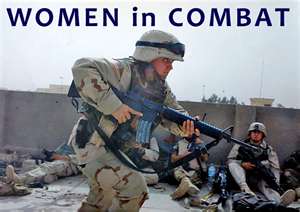
So, as I continue to ponder the topic of women in combat, I do best to use God’s Word on the topic.

According to Genesis, man was created to be the defender of life.  He is the steward over all.  God gave to man the instructions for life and the warnings against death.  Sin messed up the perfect world, but God still used His created order for the benefit of women, children, and society.  Man would continue in his roles of stewardship and defense as husband, father, and warrior.

Woman was created to be man’s helper.  She would help him be a good steward over all of life.  Together with God, the two would procreate new life, but the woman alone would bear that life from conception until birth.  Sin may change how some women feel about motherhood but, nonetheless, women are still the bearers of life.  Generational hope comes through the womb.

So… what sane and civilized people would send the bearers of life to be targets for the enemy’s bullets?

I began really paying attention to what was happening in our military during the Gulf War.  A photo in the Dallas Morning News (2/20/91) of Spec. Hollie Vallance tugged at my mother’s heart.  Dressed in fatigues and helmet, Hollie was holding her 7 month-old baby in a final good-bye before being sent away.  She was quoted, “I never really thought about going into combat.  I never dreamed anything like this would happen in my lifetime, let alone right after I had my first child.”  She continued, “I’ve built an ice wall around my heart to try to cool the pain, and sometimes I worry that my husband and baby daughter won’t be able to melt it away.”  Hollie’s husband was quoted, “It isn’t that she’s a woman that makes it harder.  It’s that she has a baby.  I’m afraid Hollie might not be the same person when she comes back.”

Bearers of life on the front lines of battle.  Mothers separating from children.  What about womanliness itself?  The female anatomy?  A woman marine who served in Iraq as a Humvi driver explained that she would go all day without water.  It was one thing for men to stay hydrated because relieving themselves is a simple procedure and requires no bush.  But, it’s both difficult and risky for a female soldier.   First, it’s awkward to manipulate the clothing of war.  Second, if there is a bush for privacy, does walking to it require leaving a safe zone?  What about that time of month?  What about shared living space with men?   I know a guardsman who, while serving time in the Persian Gulf, had to share his tent with a woman soldier.  It mattered to him… because he was married.

Most men I know believe in chivalry.  Chivalry was first practiced by Jesus Christ.  He literally sacrificed His life for His Bride, the Church.  He laid down His own life so that she might be spared.  Although not every man on board the sinking Titanic was a Christian, most all practiced chivalry.  It was, after all, the rule of the sea: Women and children into the lifeboats first.  Men, whether they knew it or not, were influenced by God’s Word for life.  So, what does a chivalrous male soldier do if a woman soldier is being attacked?  If she is taken prisoner?  Sexually abused?  In battle, is she “just one of the guys?”  But, not in battle, is she different?  What is the price of honorable — or dishonorable — sexual distraction?

Memorial Day approaches.  I wonder what our veterans would have to say about “equal rights” on the beaches of Normandy or Iwo Jima?   About “equal opportunity” for the bearers of life to unload from amphibious transport onto the open spaces of water and sand under enemy fire?

I think I know.

Read Full Post »

Today, a stint in the military comes with educational benefits.  Young women as well as men see opportunity.  There is also patriotism, especially after 9/11.  Both men and women find value and meaning in serving their country.

There are many ways for women to serve their country.  But, when foolishness rules, “rights” quickly become “wrongs.”  What we think we can do might not be what we should do.

Here’s a question.  When a man hears the sound of someone breaking into his house, does he send his wife, daughter or mother to face the enemy?

Late one evening, my brother and sister-in-law heard the sound of breaking glass.  Looking out their bedroom window, they could see a strange man attempting to break in their back door.  Did my brother send my sister-in-law to the door?  (After all, she is smart and athletic.)   Did he send his wife to confront the enemy?  No.  My brother went to the door where he found the intruder reaching through the glass to turn the inside lock.  He grabbed the intruder’s hand.  There was a brief skirmish before the enemy fled.   Soon, the police arrived.

Did my brother believe that his wife had no role to play in protecting their home?  Did he see her incapable of helping?  No.  He instinctively knew that he was to protect his wife and family, but he also knew that his wife was part of the “team.” So, from a secure area, he asked her to call 911.   The police arrived because she made that call.

An enemy at the door is not Xbox.  Nor is it equal opportunity for women.  When the enemy stood at my brother’s door, he knew better than to be distracted by the irrelevant issue of “sexual equity.”

I am certain it would be in the best interests of our nation — and surely the men engaged on the front lines of battle — not to be distracted by irrelevant issues.  Foolishness puts us all in harm’s way.

Read Full Post »

Twisted feminism is foolish.  It puts civilization in harm’s way.

It is foolish to believe that a woman can have freedom only if her child is aborted.  It is foolish to believe that men and women are the same.  It is foolish to fantasize women warriors.

“The ancient tradition against the use of women in combat embodies the deepest wisdom of the human race.  It expresses the most basic imperatives of group survival: a nation or tribe that allows the loss of large numbers of its young women runs the risk of becoming permanently depopulated,” writes George Gilder in Men and Marriage.

“Beyond this general imperative is the related need of every society to insure that male physical strength and aggressiveness are not directed against women . . . All civilized societies train their men to protect and defend women.  When these restraints break down . . . the group tends to disintegrate completely and even to become extinct.”

What about the so-called successful use of women in today’s military?  It, writes Gilder, “depends on men overcoming their natural impulse to treat women differently and more considerately.  The consequence of this latest demand for equality would be nothing more or less than a move toward barbarism.”

I like George Gilder.  Again and again I return to “Men and Marriage” because, from a purely sociological and economic perspective, Gilder explains how the foolishness of women competing with men ravages family and destroys harmony.  If my sources are correct, Gilder became a Christian later in life.  (What God has created is naturally revealed unless our eyes are shut and minds are closed.)

“Women in combat” is one of the “hot button issues” discussed during a Titus 2 Retreat.   The topic stirs mixed feelings.  Some believe women don’t belong in combat because they don’t have the physical capacity to endure the rigorous standards of training or the hardships of war.  Some believe it’s a woman’s “right” to defend her country and that she can do so as well as a man.  Others note that “modern” warfare is more technological than “front-line.”

Generally speaking, there is significant difference between male and female bone and muscle structure.  This reality has undermined the rigors of basic training and is why Stephanie Gutmann titled her book A Kinder, Gentler Military.  Of course, the physical strength argument can be countered with examples of women who have developed body strength and can keep up with men.

There is also sexual attraction between men and women.  Putting men and women together for training and in combat creates an environment in which each are vulnerable to sexual misconduct and abuse.  But, this argument can be countered with the practice of self-control.

So, for me, the question isn’t, “Can women be in combat?”  The question is, “Should women be in combat?”  I enter this discussion from my vocation or role of “helper” (Hebrew: ezer).  That’s what God created woman to be.  I am a helper for man and, therefore, for all that man is called by God to do.  Will I help for good, or for harm?  Away from temptation, or into?  With focus on others, or self?  Nurture life, or put it at risk?

I pause to let you ponder.  But, there’s much more to consider… in another post.

Read Full Post »

I could always count on the questions.  After each presentation on purity, girls — often shy, sometimes bold — would ask questions.  About boys.  Themselves.  Relationships.  Love.  Mothers brought their daughters to these events, but often stayed in the background.

Mothers were also in the audiences of the “lifestyle show” Judy Hayen and I took on the road.  The event, titled “Dressing for Life: Secrets of the Great Cover-up,” gave opportunity to address the consequences of “sexy” dress, casual attitudes about intimacy, and risky behaviors.  Clothing is fun.  But, whose idea is it?  Why does the Designer of clothing say we need more than fig leaves?  Why shouldn’t a boys hand go under a girls clothes?  The “lifestyle” show concluded with the perfect dress: the white wedding dress and why we wait to wear it.  It wasn’t the girls but the mothers who had tears in their eyes.  I know, I know.  Wedding dresses bring tears of joy to many moms.  But, I believe I also saw tears of disappointment and regret.  I know the statistics.  Too many don’t wait to wear the white wedding dress because oxytocin, not necessarily love, makes us warm and tingly.

Dozens of women have shared their abortion choices with me.  These choices were made after a touch.  A kiss.  Then the procreative act.   Oxytocin flipped the love circuit in their female brain.  There is trust.   A bond.  But physical contact and the oxytocin response it generates can blind women to a bad relationships.  These women, years after their abortions, explain to me tears of  failure.  Psychological trauma.  Heartache.  Loss.  Spiritual grief.

What were women who became mothers — of living or dead children — told about oxytocin?  What choices did they make because they weren’t told?  What were the consequences?  Is there a reason to keep from our daughters and granddaughters knowledge about their bodies?  How they are designed to function?  And why?

We are not captive to mistakes of the past.  They are forgiven because of Jesus Christ.  His death and resurrection are victory over every sin.  All we need to do is be sorry for our sins and confess them to God.  Then, in Christ, we are set free.  We are new every morning.  In Christ, we have the hope of better choices.  This hope is for daughters, granddaughters, nieces, and a neighborhood of girls.

God made oxytocin because He loves life.  He created one man to bond with one woman in marriage for life.  He joins with husband and wife in the procreational act of sex to bring new life.  He entrusts each new boy or girl to the nurture and instruction of their mom and dad.  With all of this, there is a future. There is hope.

Seems to me all ezerwomen should be talking about this.

Read Full Post »

Is this life after The Pill?

Shirley Wang is the author of “The Tricky Chemistry of Attraction — Taking Birth-Control Pills May Mask the Signals That Draw the Sexes Together, Research Shows.”  (Wall Street Journal)

Rush Limbaugh’s program of May 10, 2011, featured “The Tricky Chemistry of Attraction.”  My husband happened to be listening.  I thank him for catching this… and sharing it with me.  Whatever  you may think of Rush Limbaugh, research is research.  The thing is, some of it gets shared… some of it stays hidden.  This research helps make sense of many choices, behaviors, and lifestyles that I’ve been watching or aware of as a post-pill woman.

“Much of the attraction between the sexes is chemistry.”  Not hard to swallow, eh?  Let’s continue.  “New studies suggest that when women use hormonal contraceptives, such as birth-control pills, it disrupts some of these chemical signals, affecting their attractiveness to men and women’s own preferences for romantic partners . . . Evolutionary psychologists and biologists have long been interested in factors that lead to people’s choice of mates.”

The article goes on.  “One influential study in the 1990s, dubbed the T-shirt study, asked women about their attraction to members of the opposite sex by smelling the men’s T-shirts.  The findings showed that humans, like many other animals, transmit and recognize information pertinent to sexual attraction through chemical odors knows as pheromones.”

Continuing, “The study also showed that women seemed to prefer the scents of men whose immune systems were most different from the women’s own immune system genes known as MHC . . . the family of genes permit a person’s body to recognize which bacteria are foreign invaders and to provide protection from those bugs.  Evolutionarily, scientists believe, children should be healthier if their parents’ MHC genes vary, because the offspring will be protected from more pathogens.  More than 92 million prescriptions for hormonal contraceptives, including pills, patches and injections, were filled last year in the U.S., according to data-tracker IMS Health.  Researchers say their aim isn’t to scare or stop women from taking hormonal contraceptives.  ‘We just want to know what we’re doing’ by taking the pill, says Alexandra Alvergne, a researcher in biological anthropology at University College London in the U.K.  ‘If there is a risk it affects our romantic life and the health status of our children, we want to know.’ ”

Wang, in her article, explains that, “Both men’s and women’s preferences in mates shift when a woman is ovulating” (most often day 14 of her cycle) . . . “Some studies have tracked women’s responses to photos of different men, while other studies have interviewed women about their feelings for men over several weeks.  Among the conclusions: When women are ovulating, then tend to be drawn to men with greater facial symmetry and more signals of masculinity, such as muscle tone, a more masculine voice and dominant behaviors . . . The women also seemed to be particularly attuned to MHC-gene diversity.  From an evolutionary perspective, these signals are supposed to indicate that men are more fertile and have better genes to confer to offspring.”  (Limbaugh comments here: “All of this happens in a split second.  It’s not something that’s calculated . . . but it does dictate behavior and choices . . . .”)

Wang’s article continues, “Women tend to exhibit subtle cues when they are ovulating, and men tend to find them more attractive at this time.  ‘Women try to look more attractive, perhaps by wearing tighter or more revealing clothing,’ says Martie Haselton, a communications and psychology professor at the University of California, Los Angeles.  Research on this includes studies in which photos that showed women’s clothing choices at different times of the month were shown to groups of judges.  Women also emit chemical signals that they are fertile; researchers have measured various body odors, says Dr. Haselton.  Such natural preferences get wiped out when the woman is on hormonal birth control, research has shown.”

But, “Women on the pill no longer experience a greater desire for traditionally masculine men during ovulation.  Their preference for partners who carry different immunities than they do also disappears.  And men no longer exhibit shifting interest for women based on their menstrual cycle, perhaps because those cues signaling ovulation are no longer present, scientists say.”

Also, “There is accumulating evidence indicating men react differently to women when they are on birth control.  A 2004 study in the journal on Behavioral Ecology used the T-shirt study.  But instead put the shirts on 81 women.  A panel of 31 men, smelling the T-shirts, experienced the greatest attraction for the non-pill-using women when they were ovulating.  Twelve women on the panel didn’t detect any difference.”  (Limbaugh comments: “Basically, if this is true, the natural selection process of a woman wanting a traditionally masculine guy when she’s ovulating goes out the window.  Nothing to do with sexual orientation here.  But this, for example, could give rise to this whole notion of the metrosexual [a man who likes to shop, is in tune with fashion and appearance], if this is true.  That’s why if all of this is true, then it changes everything we know about our lives since when the pill became profligate in 1970.)

Take it… or leave it.  Limbaugh concludes, “It’s fascinating.  Now, you couple all this with the obvious role changes that militant feminism brought on, and it could explain a lot about general unhappiness, confusion, who’s supposed to be what that both sexes seem to exhibit.”

And, finally, another thought on the impact of hormonal birth control and how it affects women and men: “When the pill was approved for use in the U.S. in 1960,” said Limbaugh, “the divorce rate was less than 10%.  Over the two decades that followed, divorce rates climbed to over 20%.  So maybe it’s harder to stick it out in a marriage if the power of attraction wanes, and if the attraction wanes because the chemicals aren’t there that make it possible, well, that would explain a lot, too.”

Fascinating, don’t you think?

Men… women… not the same.  Dare we say created to be different, yet attracted to one another as part of the design… for a purpose.  Life.  Generations to come.  Hmmm.

But, what happens when we tamper with the design?

Read Full Post »

Some say, “How could a woman end the life of her child?”  This statement is not intended to be cruel, but it is heard as a  judgment.

Others, hoping to be less judgmental, say, “I would never have have an abortion myself, but I believe every woman should have the right to choose.”  This statement sounds compassionate, but to the woman who has had the abortion, it sounds like a comparison: “Abortion is wrong and because I am a good person I wouldn’t do such a terrible thing, but women not capable of doing the right thing should have a choice.”

Both statements are condeming.  Neither offer hope before or after an abortion.

There is a third response.  Trying to imitate Jesus.  Jesus understands why people like you and me sin.  He came to live among us —  to feel our frustration, fears, and sorrow.  He placed Himself in the midst of a messy world.  Jesus loved us so much that He willingly took on our disgrace, our burden, our sin.  Only by living under His Cross am I able to see those hurt by sin (including my own) in a new way.

Days on which we celebrate life are meant to be happy days, but for many they are not.  In the heart of nearly every post-abortive woman is an empty place that is forever expectant and waitiing.  Although she may have believed the lie that there was no room, a cry of sorrow echoes in the room that was always there… waiting.

We cannot go back to erase years of legalized abortion nor the effect on women, men, children, and society.  Mothers who once believed there was no room in their life for a baby now mourn the child whose heart beat so close under their own.  Fathers who once believed there was no room in their life for a baby are now angry at themselves for failing to protect their son or daugher.  Grandparents who once believed there was no room in their lives for a baby now dream of grandchildren that would have filled the rooms of their homes with laughter.

Sometimes, when I am holding my grandsons, my thoughts turn to Mary.  She approached me after I was finished speaking to a group of women.  She asked for my address and phone number.  In the letters and conversations that followed, she confessed two abortions.  “There has been so much pain in my heart,” Mary wrote.  “I could understand how God could forgive a murderer, but not someone who has killed their own child.”

This pain and the belief that she had committed the sin “too big to be forgiven” held Mary captive.  But, “the reason I want to tell you my story,” Mary continued, “is to thank you.  If, years earlier, I had heard the words of compassion and forgiveness that I heard from you, I would not have had a second abortion.  I would have been reconciled to God and turned my life around a lot earlier instead of wallowing in the muck of sin and accusation.”

“Marys” are everywhere… and they are waiting.  They are silently waiting for a word of hope.  Their broken hearts long to be healed.  God has given to me — to you — His Word to speak in love.  To be sure, the Word of Truth presses hard on the source of pain.  The psalmist (Psalm 32:3-5) writes:

When I kept silent, my bones wasted away through my groaning all day long.  For day and night Your hand was heavy upon me; my strength was dried up as by the heat of summer.  Then I acknowledged my sin to You, and I did not cover my iniquity; I said, ‘I will confess my transgressions to the Lord,’ and You forgave the iniquity of my sin.”

There is hope for women and men who have been pierced by abortion’s blade.  It is Jesus.  In Jesus, all who confess their sin are cleansed and forgiven (1 Timothy 1:15).  In Jesus, the captive is set free (Galatians 5:1).

(The thoughts of this post are available in a
brochure form upon request from Word of Hope or LFL.)

Read Full Post »

Think you know your parental rights?  THINK AGAIN!

God entrusted children to the care and nurture of their parents.  The United Nations Convention on the Rights of the Child (CRC) thinks differently.

I encourage you to visit Parental Rights.  Take the quiz and see why we need the Parental Rights Amendment to oppose the U.N.’s involvement in the raising of our children.

Here are a few things we need to know about the structure of the CRC:

  1. It is a treaty which creates binding rules of law.  It is no mere statement of altruism.
  2. Its effect would be binding on American families, courts, and policy-makers.
  3. The CRC would automatically override almost all American laws on children and families because of the U.S. Constitution’s Supremacy Clause in Article VI.
  4. A committee of 18 experts from other countries, sitting in Geneva, has the authority to issue official interpretations of the treaty which are entitled to binding weight in American courts and legislatures.  This effectively transfer ultimate authority for all policies in this area to this foreign committee.
  5. Under international law, this treaty overrides even our Constitution.

Here are a few things we need to know about the substance of the CRC:

  1. Children would have the ability to choose their own religion while parents would only have the authority to give their children advice about religion.
  2. The best interest of the child principle would give the government the ability to override every decision made by every parent if a government worker disagreed with the parent’s decision.
  3. A child’s “right to be heard” would allow him or her to seek governmental review of every parental decision with which the child disagreed.
  4. Christian schools that refuse to teach “alternative worldviews” and teach that Christianity is the only true religion “fly in the face of article 29” of the treaty.
  5. Allowing parents to opt their children out of sex education has been held to be out of compliance with the CRC.
  6. Children would have the right to reproductive health information and services, including abortions, without parental knowledge or consent.

More about the structure and substance along with notes and sources of information may be found by visiting Parental Rights.   The Parental Rights organization has proposed the following amendment to the U.S. Constitution.  Won’t you consider supporting it?

SECTION 1: The liberty of parents to direct the upbringing and education of their children is a fundamental right.

SECTION 2: Neither the United States nor any state shall infringe upon this right without demonstrating that its governmental interest as applied to the person is of the highest order and not otherwise served.

SECTION 3: No treaty may be adopted nor shall any source of international law be employed to supersede, modify, interpret, or apply to the rights guaranteed by this article.

Read Full Post »

The U.S. House of Representatives will debate the “No Taxpayer Funding for Abortions Act” (H.R. 3) on Wednesday, May 4.  This bill provides desperately needed conscience protections for life-affirming healthcare professionals and the patients they serve.

I encourage everyone to visit the Freedom2Care legislative action center.  Use the easy form to urge your Representative to vote YES on this bill and to oppose any weakening amendments.

Then, please familiarize yourself with the 16,000 member Christian Medical Association.

My personal e-mail to President Obama, my two senators, and representative reads:

With all due respect,

I am a citizen of this country who conscience cannot allow me to condone taxpayer-funded abortions or the force of medical personnel to perform them.  Legalized abortion has already removed 50+ million people who would have boosted the economy of this country in magnificent ways and brought new creativity and hope.  Instead, we have 76 million of my generation (babyboomers) with only 17 million of my sons’ generation.  What were we thinking?

Please listen to your conscience and vote “YES” on HR 3.  Please oppose weakening the amendment in any way.

Future generations of Americans thank you.  Health care providers who do not believe in taking a life — but rather saving lives — thank you.

Read Full Post »

« Newer Posts - Older Posts »