Feeds:
Posts
Comments

Archive for the ‘Vocation’ Category

The question is: “Who steps first into the circle of love and respect: The husband or wife?”

It helps to remember who created that “circle.”

God did.  And, true to His design, there is order.  God created human beings in His image, but He did not make them to be the same.  They are equal, but different.  God did not create woman at the same time as man, in the same way, or for the same purpose.  In fact, God revealed to man that he was incomplete.  “It is not good that the man should be alone; I will make him a helper fit for him” (Genesis 2:18).  “Fit for him” literally means: “Like his opposite.”  (Think of this!  Anatomically.  Hormonally.  Psychologically.)

Is it significant that woman was made for man?  To complete him?  Be his helper?  Yes.  The created order shows that man was to be the steward over all and she would help, assist, encourage, comfort, and be his advocate.  (The word “helper,” by the way, is not dissimilar to the word used by Jesus to describe the Holy Spirit [John 14:16,26).  In her privileged role, she is free to help without any initiative on his part.  She doesn’t wait for him to ask before she offers encouragement, comfort, or good counsel.

God’s created order is a reflection of Himself.  He is one God, yet three persons.  Father, Son, and Holy Spirit are equal, but with different functions.  There is headship in this orderly structure… and there is submission.  The same is true with male and female.  Even after sin spoiled God’s perfect design, the order of creation remained in place for our benefit.  Sin broke man and woman’s relationship with each other and with God.  But, in mercy, God used the submission of the Son, Jesus Christ, to save His Bride, the Church, and serve with humility.  A woman might resent the created order.  A man might abuse it.  But, whenever it is honored, it continues to serve family and society well.

Doesn’t the created order beg the question from a leadership perspective?  Shouldn’t the man be the first to step into the Ephesians circle?  No, not necessarily.  Even if he is stepping out front to fight wolves at the door, she is fully engaged as his ally and encourager.  In God’s design, the man is responsible for bringing order out of chaos, but she helps that happen.  Regardless of their different functions, both husband and wife can practice loving and respecting at all times.

There is no measuring stick.  No fairness meter.  In a godly home, neither husband nor wife keep track of what the other does or doesn’t do.  Both have the same goal: To do all they do to God’s glory.  And, when they fail, they apologize and forgive.  Both take their sin baggage to the cross — and leave it there.

Visits to the Cross happen all the time even in the best of marriages.   Let me approach this from a woman’s perspective.  Helping is what I naturally do.  But, flawed by sin, this becomes difficult.  My husband might not think he needs help.  Might not invite help.  Might resent help.  Might interpret my help to mean he needs “fixing.”  So, how do I enter the “circle of love and respect” at such a time?  Hopefully, I haven’t disengaged from the “circle.”  Hopefully, I am faithful in offering encouragement.  If I need to help, but he’s too prideful to accept it, I need to take care.  Be sensitive.  I may need to move slowly.  Mary told Joseph that she had been visited by an angel with news of her pregnancy, but Joseph was of the mind to quietly divorce her.  In their “circle of love and respect,” Mary understood that it wasn’t up to her to convince Joseph.  She needed to wait on God.  In His time, God helped Joseph get his arms around the situation.  A woman is helping — in one way or the other — all the time.  She may be helping to good… or bad.  To build up… or tear down.  To encourage… or discourage.  To trust God’s plan… or shape her own.

Ultimately, two are better than one.  One may fall, the other lifts up.  One may be overwhelmed, a team of two stands firm.  One alone is cold, two together stay warm.  One might fall out of the “circle” momentarily, the other welcomes him/her back in.  Woven with God, both are able to engage in the “circle” freely and unconditionally.

The pure circle of love and respect is tainted on this earth.  We too easily think of ourselves first.  How we’re not being served… or how we’re doing all the serving.  But, challenged to “shine like lights” and “hold fast to the word of life,” we do what we do for Christ — even if it means being “poured out as a drink offering upon the sacrificial offering of our faith” (Philippians 2:14-17).  Faith produces a sacrificial attitude for husbands and wives that frees us up to think less about self and more about other.

With this attitude, one might even forget who started, paused, stopped, or re-started the circle to go ’round.

Read Full Post »

I’m the mom of two sons.  Aunt of twelve nephews.  Grandmother of four grandsons. Men matter to me.

I’ve lived in the presence of faithful men.  These men — my grandfathers, dad, husband, brother, brother-in-laws, friends — are all aware of their inadequacies.  They know they frustrate.  Disappoint.  Fail.  But, they also seek wisdom in God’s Word.  They find strength in the humility and servanthood of Christ.  Because of this, I trust these men with my life.

There are other men.  Abusive, undisciplined, selfish men.  Men who have never been taught God’s Word for their life or rejected it.  These men have no concept of chivalry.  Instead, they dominate.  Worship self.  Fall to evil rather than good.  I could not trust them.  The women in their lives don’t.

A Biblical man stands in contrast.   The man who knows God as the Creator of male and female persons appreciates woman as his helper, not his possession.   The man who knows that God came to walk among us recognizes Jesus’ high regard for women.   A man familiar with the Word knows he was not made in the image of animals, but in the image of God.  Though fallen from that perfect image, he has attributes and characteristics of his Maker.  He is capable of thinking out his actions, weighing the consequences, and controlling his behavior for the benefit of family and society.

A godly man recognizes the leadership style of Christ.  Jesus laid down His life for His bride, the Church (Eph. 5:25).  He accepted responsibility.  On earth, Jesus was tempted.  The devil came to Him.  Tried to play with His mind.  Tease the flesh.  Even quoted Scripture.  The devil went away, then returned to tempt again.  But, Jesus stood firm.  The Christian man knows he, too, will be tempted.  Over and over again.  There is struggle in this world.  Knowing the battle is for the souls of his children, a father holds tight the Sword of Truth.  He wields its Law and Gospel with proper discernment.  This is a man of hope.

The man who wants to make a positive difference helps reconnect earthly fatherhood with the heavenly model.  The Heavenly Father is neither passive nor preoccupied.  He does not abandon His creation, but is involved with and committed to His children.  The Heavenly Father brings order out of chaos.  Sees male and female as equals, but delights in their differences.  Does not mentor girls in the same way as boys.   Sets boundaries for the protection of those He loves.  Explains the consequences of every choice — good or bad.  Pursues the lost.  Knows the desperate.  Welcomes all to lay the burden of every sin at the foot of His Son’s Cross.  Forgives.  His mercy in Jesus Christ is new every morning.

So, on Father’s Day — and with appreciation for faithful men — I promise my help.  My encouragement.  My supporting role as a rib.  Faithful men are needed by women.  Wives.  Sons.  Daughters.  Civilization itself.

Read Full Post »

June is the traditional month for weddings.  Marriage expectations are high.  Most brides and grooms expect to have all their hopes and needs met by the other.  Is this possible?

In God’s perfect world, yes.  In a fallen and sin-filled world, no.

Marriage was instituted by God.  It is a union of two completely different people — male and female — for the benefit of children and society.  It is a relationship that models the agape love of patience, kindness, selflessness, and faithfulness.  It builds family and community.  It mentors the vibrant and compatible roles of manhood and womanhood for generations to come.

History explains.  After God created man, He said, “It is not good that the man should be alone.  I will make him a helper fit for him” (Genesis 2:18).  God wanted man to know that he was not yet complete.  He had no mate appropriate for him and he had no means of procreation.

Fit for him” literally means “like his opposite.”  Imagine that.  She fit perfectly with him, yet they were not the same — anatomically, hormonally, or psychologically.  With God, they would procreate new life.  She would be the vessel for the young one he would protect.

Equal, but different, the man and woman would unite in a partnership.  Their unique character traits and personalities would harmonize.  In God’s order of creation, a “helper” (Hebrew: ezer) would be an “assistant” and “ally.”  The ezerwoman would not be dissimilar from the “Helper” sent by Jesus to the disciples.  That Helper, the Holy Spirit, was called a “comforter,” “advocate,” and “encourager.”

The woman would know joy and contentment in her role of “helper.”  She would find limitless possibilities in her multi-faceted vocation.  She would help man to be a better steward over all creation.  She would help nurture all the living.  The  man would rejoice in his completeness.   He would love the woman built from his rib and guard her life as if it were his own.  He would serve not his own glory, but the glory of God (to her benefit).

In the first marriage, there was no fear.  Resentment.  Envy.  Frustration.  Anger.  Heartache.  Disappointment.

Everything changed when the first husband and wife sinned against God.  They were equally guilty, yet the consequences of their sins were as different as their natures.

Today’s bride and groom may expect to have all their needs met.  But, in a fallen and imperfect world, no person can do that for another.  Only God can and will fulfill our deepest needs.  At the wedding of Prince William and Kate Middleton, the Bishop of London noted, “As the reality of God has faded from so many lives in the West, there has been a corresponding inflation of expectations that personal relations alone will supply meaning and happiness in life.  This is to load our partner with too great of burden.”

Let us ease the burden with encouragement.  Sin distorts God’s perfect plan, but the original design is still in place.  It serves well when trusted.

  • A woman “fit for him” remains a husband’s opposite.  She is made to think, act, and love differently.  Sin complicates those differences.  Not only are they male and female, they have contrasting personality traits, quirks, familial histories, and experiences that may threaten to tear the marriage apart.  But, there is another choice.  With forgiveness and practice, husband and wife can merge their best qualities for the benefit of a stronger marriage.  They can stop playing “me against you” and become “we.”  They can unite as a team for the sake of their children.
  • A woman’s role still complements the man’s.  She is his “helper.”  Regardless of sin and circumstances, she has a choice: to help him be a good or poor steward; to encourage or discourage; to build up or tear down; to connect him to children or disconnect.  He has the choice to use God’s Word for life, warn against death, and cover his wife and children with his faithfulness — or not.

Equal, yet different, husband and wife have an example to follow.

Jesus is equal to God.  He is God yet, in His role as the Son, He submitted to His Father’s will in order to be the Savior of the world.  A wife who respects her husband and submits to his appropriate leadership is really submitting to God.  A man who loves his wife as Christ loved the Church is submitting himself to God.

Marriage expectations?  On this earth, husband and wife won’t make each other completely happy.  Won’t meet each others every need.  Warm fuzzies will fade.  But, Jesus in a marriage makes two “better than one.”  Opposites who glorify God rather than self change the environment.  Root deeper.  Build stronger.  Persist against every foe.

A threefold cord (God, man and woman) is not quickly broken” (Eccl. 4:12).

Read Full Post »

Where are the mentors?  They are us!

They are older women — in age, experience, or spiritual maturity.  Unfortunately, too many of us seem to fear the concept of mentoring.

Yes, we may mentor a child at school.  Yes, we may mentor through a “Big Sister” program.  But, mentoring Biblical womanhood is counter-cultural.  There is strong resistance.  Obstacles stand in the way.  There are two: the younger women and the older woman.

The younger woman is, quite honestly, the least problematic.  Why?  Because younger women naturally resist mentoring.  The younger generation always considers itself more enlightened.  It’s typical for a young woman to consider herself more progressive than her mother or grandmother and, therefore, want to leave “old ways” behind.  Even when a younger woman is willing to learn some things from an older woman, she may still believe (as I’ve been told): “The culture is different than it was when you were my age.”  Well, the culture is always different with every new generation.  But, Truth never changes.

The greater obstacle to mentoring Biblical womanhood is the older woman.  It is the older woman who resists the opportunity to mentor.  Why?  Maybe because we are afraid.  Perhaps we’re afraid to mentor because it means we have to act our age.  Perhaps we’re afraid to mentor because it means re-visiting our past mistakes and becoming vulnerable all over again.  Perhaps we’re afraid to mentor because we fear rejection by younger women.

Some of us might be afraid because we are untrained.  Perhaps no one mentored us with God’s Word.  Perhaps we were led off the good path of life on painful and dangerous detours by older men and women we trusted more than God.  Perhaps a parent, professor, friend or even a pastor that we trusted had been deceived by “silly myths” and passed them on to us.  Out of respect for them, we may feel defensive about what they taught us.  The ideas to which we cling.  But, letting the light of God’s Word illuminate the dark corners of our minds, may we move out of a defensive posture.  Lift up in prayer the person who passed wrong ideas on to us.  Let go of “silly myths” and deception.

I’m a baby-boomer.  Talk about a generation influenced by “silly myths!”  My generation was raised with no boundaries; told to obsess on our bodies; dared to compete with men; and sent to the university where marriage, family, and the church were mocked and boldly dismantled.

The fact is, we can’t mentor if we’re afraid to act our age.  If we don’t want to accept where we’re at in life.  If we’re afraid to re-visit our past and acknowledge our failures.  If we’re afraid of rejection.  In other words, we can’t mentor if it’s all about me.

I can’t mentor if it’s all about me.  My fears.  My inabilities.  My past.  I can’t make a positive difference in my world if it’s all about me.  I can, however, make a life-changing difference if I’m all about God.  God’s Word.  God’s Word in Jesus Christ.  It is God’s Word that tells me who I am and why I exist.  Trusting the Word, I don’t need to fear myself or the world.

As an older woman, I think God wants me to accept my age.  My experiences.  My failures.  My disappointments.  Then, making use of all of these, He wants me to warn.  Train.  Equip the younger women He places in my life.  There is only one thing necessary for me to mentor: His Word.  Trusting God’s Word and using it makes me wise.  Willing.  Confident.  Less focused on self and more focused on others.

The world is not my friend.  Recognizing this, I (and all older women) mentor with the Word of God.  Away from “silly myths.”  Toward hope.

Read Full Post »

Titus was a young pastor who served his people on the island of Crete.  Young Titus and his congregation found themselves in the midst of a pagan culture.  “One of the Cretans, a prophet of their own, said, ‘Cretans are always liars, evil beasts, lazy gluttons” (Titus 1:12).

How could Titus and the men and women of his congregation not only remain faithful to God in the midst of evil, but affect the culture?  Shine light?  Share hope?  Titus was in need of a model, something that his people could use in the midst of selfishness, unhealthy lifestyles, and false teachers.

St. Paul warned Titus away from the worldly influence, but also was inspired to give him a model for mentoring generations of hope.  That model is found in Titus 2:1-8.  That model — indeed, the wholeness of the Gospel — brings salvation and leads to self-controlled living.

Titus 2, however, is one of the least popular chapters of Scripture.  It is not particularly favored by Christian women.  There are at least three reasons.  Most obvious is the fact that Titus 2 speaks to men and women separately… because we were created equal, but not the same.   Painfully obvious is the part about women “submitting” to their husbands.  (Ouch.)  But, a third reason that Titus 2 may be dismissed or ignored is that older women are instructed by God to mentor younger women.  Oh my!  How is an older woman — who has not made right choices; who has had an abortion or lived with a man not her husband; who has been abused, or become addicted, or suffers depression — going to mentor a younger woman?

This weekend, at a Titus 2 Retreat, we’ll be talking about why an older woman (in age, experience, or spiritual maturity) might feel too intimidated to mentor.

I’ve heard older women say, “I can’t mentor!”  But, every one of us mentors… at any given moment… whether we realize it or not.  We are mentoring some kind of faith, lifestyle, or way of thinking.  We are being an example… of something.

There is a reason God calls an older woman to mentor the younger.

Let’s push aside all of her past circumstances, sins, fears, and failures.  If she is a new person in Christ, she is forgiven and set free to live in a way that glorifies God.  In 1 Timothy 5:9-14, we read that the Church was to distinguish older widows from younger widows.  The older woman is distinguished by her “faithfulness” and “reputation for good works.”  She is distinguished if she has “been the wife of one husband, brought up her children, shown hospitality, washed the feet (served) the saints, cared for the afflicted, and devoted herself to every good work.”

The younger widow, however, is different.  She is more easily drawn away from Christ by her romantic passions (v. 11).  She may be more easily tempted away from the “faith” (Greek: “oath” or “solemn promise”) if she had promised not to remarry, or to abide by the Christian faith and teaching.  The young widow (v. 13) without a father, husband, children, or a job might be prone to social problems such as being idle, falling to gossip and the behavior of a busybody, or losing control of her tongue.  The Church was to encourage young widows to “marry, bear children, manage their households, and give the adversary (Satan) no occasion for slander” (v. 14).

In what way would the young widow, perhaps more easily influenced by the world, be helped?  By the mentoring of an older, experienced, spiritually mature woman.  A woman who had also been wrongly influenced, but was brought out of darkness into light.   Who was rescued from the mess of life and covered by Jesus’ robe of righteousness.  The older woman is not distinguished because she is sinless, but because she has learned to trust God.  Not be deceived by silly myths.  Have faith in God’s created order.  And keep her eyes on the Cross of Jesus Christ.

An older woman does not need to fear being a mentor.  Her very experience — from floundering and failing to recognition of her identity as a treasure of Christ — makes her an instrument in God’s hand.  Using God’s Word, she becomes an example of humility.  Service.  Patience.  Self-control.  Hope.

Read Full Post »

Experts in New Zealand praise the healthy habit of self-control.  Those with common sense respond, “Well, duh!”

New scientific research shows that if adults cultivate the practice of self-control — starting early — in children, a great many could be saved from addictions, poverty, and crime.  Isn’t that just like scientific evidence?  Always lagging behind but, when pure, testifying to God’s order of creation.

This ezerwoman is a better helper — of men, children, and society — when I practice self-control.  Lest I forget (or resist), God consistently reminds me to be “self-controlled.”  The books of 1 and 2 Timothy refer to the virtue of “self-control” at least four times.  At least five times, the book of Titus instructs older men and women to practice and mentor “self-control.”  There’s good reason.  Self-control glorifies God.  It can result in more hopeful consequences.  It can even reduce depression

Self-control is the opposite of living our lives however we please.  Doing whatever makes us “happy.”  Insisting that our “needs” be met.  Serving self over others.   Perhaps this is what happens when times are good.  We give ourselves license… for whatever, whenever.   We have (in my American lifetime) “lived on the earth in luxury and in self-indulgence” (James 5:5).  For sure, it is what happens when women are encouraged to let their emotions rule.

But, encouraging girls and young women to let their emotions rule has not made them happy.  It is widely reported, writes Dennis Prager, that women suffer depression at twice the rate of men.  If the clinical assumptions are true, Prager suggests that we consider the following:

“Wise cultures have learned that happiness is attained only when we conquer our nature.  This is true for male and female.  With modern feminism, however, came a belief in the superiority of the female nature.  The result?  Society was urged to suppress both the negative and positive aspects of the male nature with little or no suppression of the female nature.  Historically, societies and parents have always known it’s a good thing to teach boys to control two aspects of their male nature — their sexual desires and their predilection for violence.  Decent men were taught from youth to touch a woman sexually only with her permission and to channel physical aggression into sports or into helping fight evil by joining the police force or military.  Men who didn’t learn to control these aspects of male nature not only became bad men, but unhappy men.”

He continues, “Societies and parents also knew it was important to help girls control their natures — in particular, their predilection to be ruled by their emotions.  Women who allowed their emotions to rule them not only became destructive (to members of their families first and foremost), they became unhappy women.  But, while modern society continued to teach boys to control themselves, it stopped teaching girls to do so.  Girls’ emotions and feelings were treated as inherently valuable.  In fact, to repress a girl’s emotions or feelings was labeled ‘sexist’ and showed a ‘hatred of women.’ ”  (Excerpted from “Wanted by women: A few good old-fashioned men” by Dennis Prager, The Washington Times, 6-30-08)

Hmmm.  I’m reminded of the woman who showed up at an abortion clinic.  Why?  “He kissed me and I melted.  I was filled with passion and couldn’t help myself.  Now, I’m pregnant and must take control of my body.”

Lack of self control + unhappy woman = desperation and hopelessness.  Ugh.

There is another choice.   Mature men and women can be examples of self-control and mentor younger ones to do the same.  There is promise in such practice: Hope for living out our lives in anticipation of Jesus’ return (Titus 2).

Read Full Post »

I don’t apologize for a Biblical worldview.  It answers the important questions: Who am I?   From where did I come?  What is my purpose?  Why do bad things happen?  Is there hope?

So, as I continue to ponder the topic of women in combat, I do best to use God’s Word on the topic.

According to Genesis, man was created to be the defender of life.  He is the steward over all.  God gave to man the instructions for life and the warnings against death.  Sin messed up the perfect world, but God still used His created order for the benefit of women, children, and society.  Man would continue in his roles of stewardship and defense as husband, father, and warrior.

Woman was created to be man’s helper.  She would help him be a good steward over all of life.  Together with God, the two would procreate new life, but the woman alone would bear that life from conception until birth.  Sin may change how some women feel about motherhood but, nonetheless, women are still the bearers of life.  Generational hope comes through the womb.

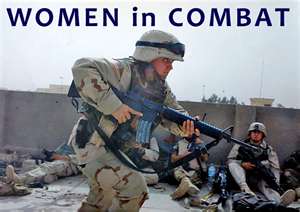
So… what sane and civilized people would send the bearers of life to be targets for the enemy’s bullets?

I began really paying attention to what was happening in our military during the Gulf War.  A photo in the Dallas Morning News (2/20/91) of Spec. Hollie Vallance tugged at my mother’s heart.  Dressed in fatigues and helmet, Hollie was holding her 7 month-old baby in a final good-bye before being sent away.  She was quoted, “I never really thought about going into combat.  I never dreamed anything like this would happen in my lifetime, let alone right after I had my first child.”  She continued, “I’ve built an ice wall around my heart to try to cool the pain, and sometimes I worry that my husband and baby daughter won’t be able to melt it away.”  Hollie’s husband was quoted, “It isn’t that she’s a woman that makes it harder.  It’s that she has a baby.  I’m afraid Hollie might not be the same person when she comes back.”

Bearers of life on the front lines of battle.  Mothers separating from children.  What about womanliness itself?  The female anatomy?  A woman marine who served in Iraq as a Humvi driver explained that she would go all day without water.  It was one thing for men to stay hydrated because relieving themselves is a simple procedure and requires no bush.  But, it’s both difficult and risky for a female soldier.   First, it’s awkward to manipulate the clothing of war.  Second, if there is a bush for privacy, does walking to it require leaving a safe zone?  What about that time of month?  What about shared living space with men?   I know a guardsman who, while serving time in the Persian Gulf, had to share his tent with a woman soldier.  It mattered to him… because he was married.

Most men I know believe in chivalry.  Chivalry was first practiced by Jesus Christ.  He literally sacrificed His life for His Bride, the Church.  He laid down His own life so that she might be spared.  Although not every man on board the sinking Titanic was a Christian, most all practiced chivalry.  It was, after all, the rule of the sea: Women and children into the lifeboats first.  Men, whether they knew it or not, were influenced by God’s Word for life.  So, what does a chivalrous male soldier do if a woman soldier is being attacked?  If she is taken prisoner?  Sexually abused?  In battle, is she “just one of the guys?”  But, not in battle, is she different?  What is the price of honorable — or dishonorable — sexual distraction?

Memorial Day approaches.  I wonder what our veterans would have to say about “equal rights” on the beaches of Normandy or Iwo Jima?   About “equal opportunity” for the bearers of life to unload from amphibious transport onto the open spaces of water and sand under enemy fire?

I think I know.

Read Full Post »

Today, a stint in the military comes with educational benefits.  Young women as well as men see opportunity.  There is also patriotism, especially after 9/11.  Both men and women find value and meaning in serving their country.

There are many ways for women to serve their country.  But, when foolishness rules, “rights” quickly become “wrongs.”  What we think we can do might not be what we should do.

Here’s a question.  When a man hears the sound of someone breaking into his house, does he send his wife, daughter or mother to face the enemy?

Late one evening, my brother and sister-in-law heard the sound of breaking glass.  Looking out their bedroom window, they could see a strange man attempting to break in their back door.  Did my brother send my sister-in-law to the door?  (After all, she is smart and athletic.)   Did he send his wife to confront the enemy?  No.  My brother went to the door where he found the intruder reaching through the glass to turn the inside lock.  He grabbed the intruder’s hand.  There was a brief skirmish before the enemy fled.   Soon, the police arrived.

Did my brother believe that his wife had no role to play in protecting their home?  Did he see her incapable of helping?  No.  He instinctively knew that he was to protect his wife and family, but he also knew that his wife was part of the “team.” So, from a secure area, he asked her to call 911.   The police arrived because she made that call.

An enemy at the door is not Xbox.  Nor is it equal opportunity for women.  When the enemy stood at my brother’s door, he knew better than to be distracted by the irrelevant issue of “sexual equity.”

I am certain it would be in the best interests of our nation — and surely the men engaged on the front lines of battle — not to be distracted by irrelevant issues.  Foolishness puts us all in harm’s way.

Read Full Post »

Twisted feminism is foolish.  It puts civilization in harm’s way.

It is foolish to believe that a woman can have freedom only if her child is aborted.  It is foolish to believe that men and women are the same.  It is foolish to fantasize women warriors.

“The ancient tradition against the use of women in combat embodies the deepest wisdom of the human race.  It expresses the most basic imperatives of group survival: a nation or tribe that allows the loss of large numbers of its young women runs the risk of becoming permanently depopulated,” writes George Gilder in Men and Marriage.

“Beyond this general imperative is the related need of every society to insure that male physical strength and aggressiveness are not directed against women . . . All civilized societies train their men to protect and defend women.  When these restraints break down . . . the group tends to disintegrate completely and even to become extinct.”

What about the so-called successful use of women in today’s military?  It, writes Gilder, “depends on men overcoming their natural impulse to treat women differently and more considerately.  The consequence of this latest demand for equality would be nothing more or less than a move toward barbarism.”

I like George Gilder.  Again and again I return to “Men and Marriage” because, from a purely sociological and economic perspective, Gilder explains how the foolishness of women competing with men ravages family and destroys harmony.  If my sources are correct, Gilder became a Christian later in life.  (What God has created is naturally revealed unless our eyes are shut and minds are closed.)

“Women in combat” is one of the “hot button issues” discussed during a Titus 2 Retreat.   The topic stirs mixed feelings.  Some believe women don’t belong in combat because they don’t have the physical capacity to endure the rigorous standards of training or the hardships of war.  Some believe it’s a woman’s “right” to defend her country and that she can do so as well as a man.  Others note that “modern” warfare is more technological than “front-line.”

Generally speaking, there is significant difference between male and female bone and muscle structure.  This reality has undermined the rigors of basic training and is why Stephanie Gutmann titled her book A Kinder, Gentler Military.  Of course, the physical strength argument can be countered with examples of women who have developed body strength and can keep up with men.

There is also sexual attraction between men and women.  Putting men and women together for training and in combat creates an environment in which each are vulnerable to sexual misconduct and abuse.  But, this argument can be countered with the practice of self-control.

So, for me, the question isn’t, “Can women be in combat?”  The question is, “Should women be in combat?”  I enter this discussion from my vocation or role of “helper” (Hebrew: ezer).  That’s what God created woman to be.  I am a helper for man and, therefore, for all that man is called by God to do.  Will I help for good, or for harm?  Away from temptation, or into?  With focus on others, or self?  Nurture life, or put it at risk?

I pause to let you ponder.  But, there’s much more to consider… in another post.

Read Full Post »

I could always count on the questions.  After each presentation on purity, girls — often shy, sometimes bold — would ask questions.  About boys.  Themselves.  Relationships.  Love.  Mothers brought their daughters to these events, but often stayed in the background.

Mothers were also in the audiences of the “lifestyle show” Judy Hayen and I took on the road.  The event, titled “Dressing for Life: Secrets of the Great Cover-up,” gave opportunity to address the consequences of “sexy” dress, casual attitudes about intimacy, and risky behaviors.  Clothing is fun.  But, whose idea is it?  Why does the Designer of clothing say we need more than fig leaves?  Why shouldn’t a boys hand go under a girls clothes?  The “lifestyle” show concluded with the perfect dress: the white wedding dress and why we wait to wear it.  It wasn’t the girls but the mothers who had tears in their eyes.  I know, I know.  Wedding dresses bring tears of joy to many moms.  But, I believe I also saw tears of disappointment and regret.  I know the statistics.  Too many don’t wait to wear the white wedding dress because oxytocin, not necessarily love, makes us warm and tingly.

Dozens of women have shared their abortion choices with me.  These choices were made after a touch.  A kiss.  Then the procreative act.   Oxytocin flipped the love circuit in their female brain.  There is trust.   A bond.  But physical contact and the oxytocin response it generates can blind women to a bad relationships.  These women, years after their abortions, explain to me tears of  failure.  Psychological trauma.  Heartache.  Loss.  Spiritual grief.

What were women who became mothers — of living or dead children — told about oxytocin?  What choices did they make because they weren’t told?  What were the consequences?  Is there a reason to keep from our daughters and granddaughters knowledge about their bodies?  How they are designed to function?  And why?

We are not captive to mistakes of the past.  They are forgiven because of Jesus Christ.  His death and resurrection are victory over every sin.  All we need to do is be sorry for our sins and confess them to God.  Then, in Christ, we are set free.  We are new every morning.  In Christ, we have the hope of better choices.  This hope is for daughters, granddaughters, nieces, and a neighborhood of girls.

God made oxytocin because He loves life.  He created one man to bond with one woman in marriage for life.  He joins with husband and wife in the procreational act of sex to bring new life.  He entrusts each new boy or girl to the nurture and instruction of their mom and dad.  With all of this, there is a future. There is hope.

Seems to me all ezerwomen should be talking about this.

Read Full Post »

« Newer Posts - Older Posts »